
SWPL: Bridging the Gap Between Content and Privacy in Social Networks
Content-Based Privacy Management on the Social Web
The paper introduces an intelligent privacy manager for social networks that automates sharing permissions using the novel Social Web Privacy Language (SWPL). By combining Named Entity Recognition (NER) for content analysis with Answer Set Programming (ASP) for policy reasoning, the system achieves an F-measure of 0.831 in recommending safe recipients on Facebook.
TL;DR
Researchers have developed a privacy management assistant that understands what you are posting before deciding who should see it. By combining Named Entity Recognition (NER) with a custom logic language (SWPL), the system automates the tedious task of setting permissions, achieving a 0.831 F-measure in predicting correct sharing audiences on Facebook.
Background: The "Privacy Burden"
In the current social web landscape, privacy settings are a paradox: they are simultaneously too granular and too blunt. Users are overwhelmed by dozens of toggles, yet they can rarely set a rule like "Don't show my location to coworkers when I'm at a bar." Existing systems primarily care about who you are related to, not the sensitive nature of the text you just typed.
The Insight: Content-Aware Policy
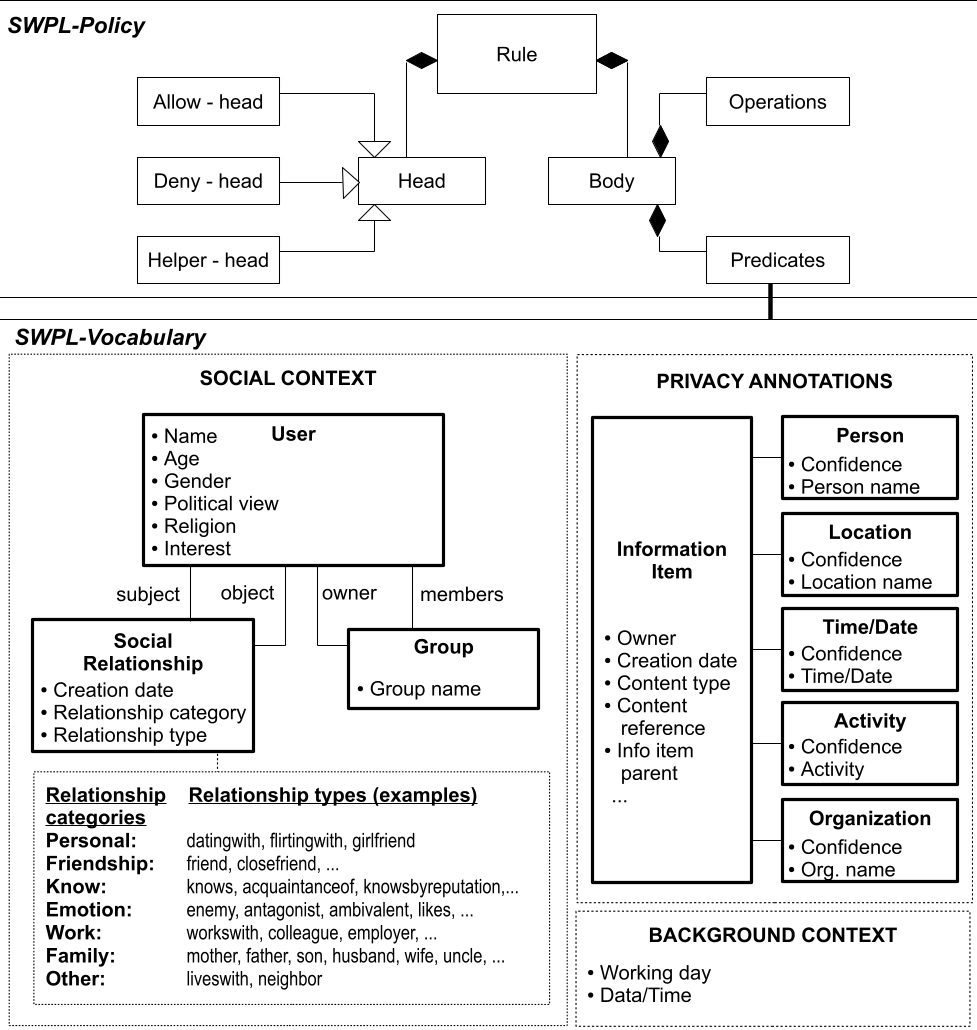
The authors argue that human privacy decisions are deeply rooted in context—specifically the Content (what is said) and the Social Context (who needs to know). Their solution is the Social Web Privacy Language (SWPL), which treats every status update as an "Information Item" to be dissected into five dimensions: Location, Person, Time, Activity, and Organization.
Methodology: The Intelligence Pipeline
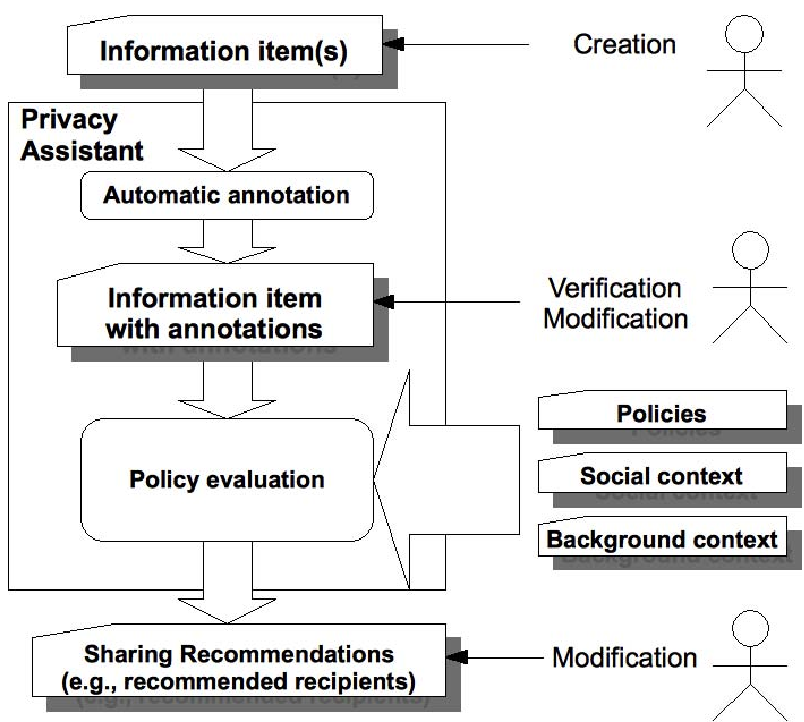
The mechanism operates in a two-stage pipeline:
- Automated Privacy Annotation: Using the GATE framework, the system runs an ensemble of NER algorithms. Whether you mention a colleague's name or a specific pub, the system extracts these entities and assigns confidence scores.
- Policy Evaluation: These annotations are fed into a logic reasoner (DLV). Users define high-level rules—for example, "Deny access to anyone in the 'Colleagues' group if the activity is 'Partying'."
The beauty of this approach lies in the SWPL-Vocabulary, which builds a formal bridge between raw text and social graph attributes like "Social Distance" or "Group Membership."
Experiments and Results
To validate the approach, the team built a Facebook prototype. They tested it against a synthetic dataset of 110 status updates.
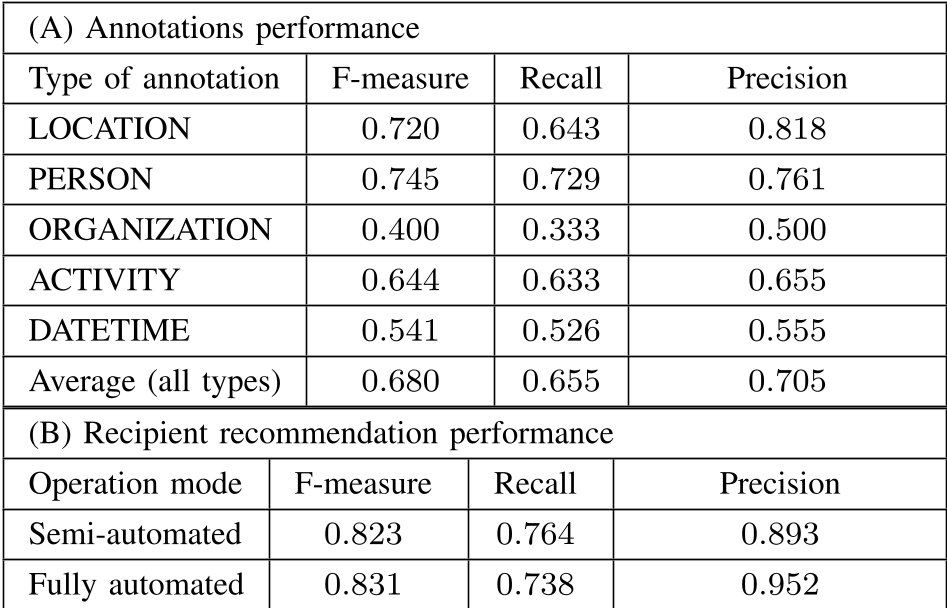
- Annotation Performance: The NER ensemble performed best at identifying People (F-measure 0.745) and Locations (0.720), while struggling slightly with Organizations (0.400).
- Recommendation Accuracy: Remarkably, even with imperfect automated annotations, the Fully Automated mode achieved a Precision of 0.952. This suggests that high-level policies are resilient to minor errors in entity extraction.
Critical Analysis & Conclusion
Takeaway
This work marks a significant shift from "Security-centric" privacy (protecting credit card numbers) to "Reputation-centric" privacy (protecting social standing). It proves that semi-automated agents can effectively mirror human sharing intent.
Limitations
The primary bottleneck remains the complexity of defining the initial rules. While SWPL is expressive, writing logical predicates is still beyond the "average user." The authors acknowledge this and suggest that Machine Learning should be used in the future to "learn" these rules from a user’s historical behavior.
Future Outlook
As we move into the era of LLMs, the "NER" stage of this pipeline could be replaced by a transformer-based model capable of understanding nuance and sentiment, potentially pushing the F-measure even closer to a perfect 1.0. This paper provides the foundational logic framework of how such an AI-driven privacy assistant should behave.