
The Lurker's Advantage: Why Tagging Content Might Not Make You Smarter
Does content categorization lead to knowledge building? An experiment in a social bookmarking service
This paper investigates whether active content categorization (tagging) in a social bookmarking service, Uxmarks.com, enhances a user's perception of knowledge building. Through statistical analysis of usage logs and a survey (n=84), the study assesses the correlation between "posting" behavior and self-reported learning.
TL;DR
A common assumption in social platform design is that doing leads to learning. We gamify tagging, favoriting, and posting to push "lurkers" into becoming "posters." However, research conducted on the social bookmarking service Uxmarks.com reveals a surprising truth: active participation through content categorization has no statistically significant impact on a user's perception of knowledge building. In the world of information repositories, the passive reader may be gaining just as much as the active tagger.
Problem & Motivation: The "Participation Inequality" Myth
In Human-Computer Interaction (HCI), "lurkers" are often viewed as a problem to be solved through engagement strategies like Gamification. Designers assume that by forcing users to categorize or tag a digital artifact (the "Externalization" process), they stimulate deeper cognitive reflection—specifically Assimilation and Accommodation of new information.
The authors of this study questioned this "logic of participation." Does the act of labeling a link (a relatively low-effort cognitive task) actually lead to a higher perception of learning, or is the value of the platform derived simply from the consumption of curated content?
Methodology: The Wikimarks Approach
To test this, the researchers built Uxmarks.com, a social bookmarking service for the HCI community. It utilizes the "Wikimarks" concept:
- Social Selection: Content is fetched from social networks.
- Collaborative Categorization: Users apply tags to organize the content.
- Extrinsic Motivation: A leaderboard (Gamification) rewards users for categorization.
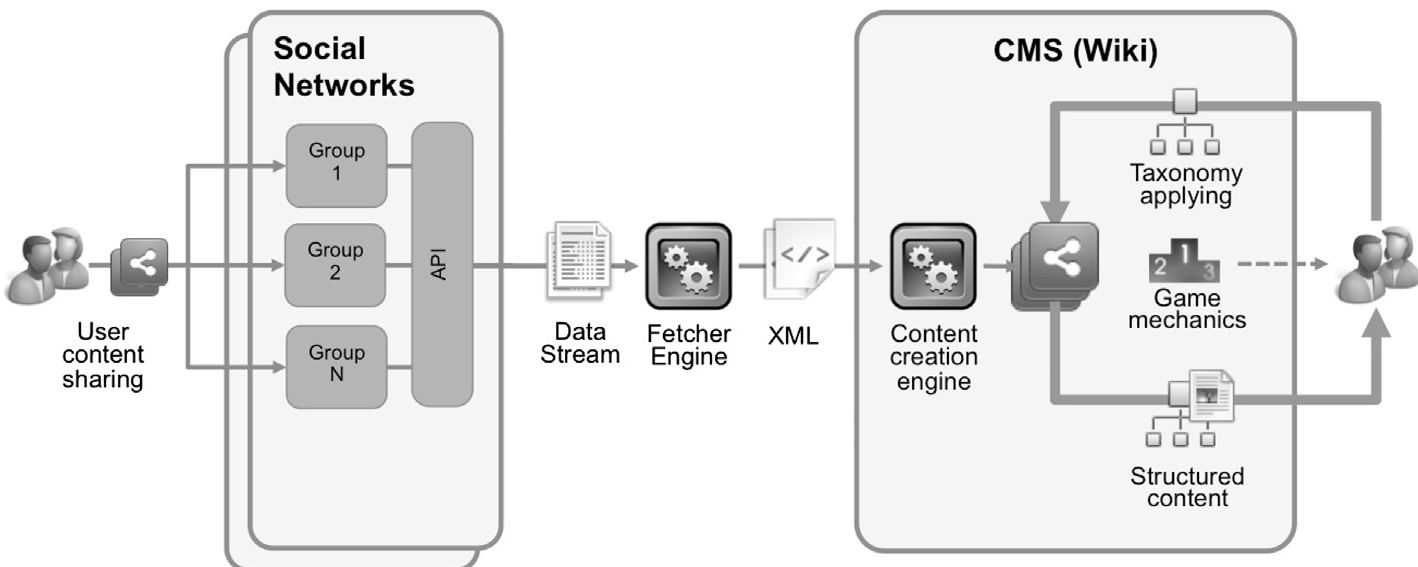
The researchers tracked User Participation (iUP) via system logs (points earned) and measured Personal Knowledge Building (iPKB) through a survey based on three factors:
- Acquisition of new knowledge (Assimilation).
- Increment of existing knowledge.
- Modification of existing knowledge (Accommodation).
Experiments & Results: The "Participation-Knowledge" Gap
The analysis included 84 unique users. Using Pearson’s Product-Moment Correlation, the researchers looked for a link between how much a user tagged (iUP) and how much they felt they learned (iPKB).
The result? Pearson’s r = 0.1988. Statistically, this means the correlation was non-significant. A user at the top of the leaderboard felt they learned no more than a user who never tagged a single link but simply browsed the site.
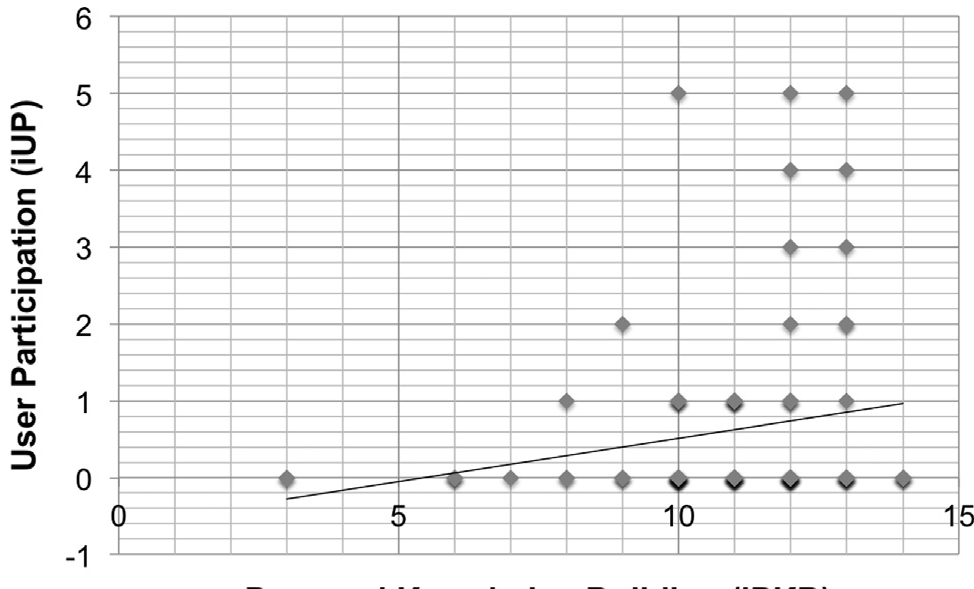
Key Insights from the Data:
- The Content is King: Knowledge building is likely derived from the relevance of the links found in the repository, not the act of tagging them.
- Gamification Limits: Leaderboards are excellent at driving interaction volume but are indifferent to cognitive outcomes.
- Pedagogical Lurking: This study validates earlier theories that "pedagogical lurking"—reading and reflecting without posting—is a highly effective learning strategy.
Critical Analysis & Conclusion
Takeaway
Active participation (posting) and passive consumption (lurking) are equally beneficial in knowledge-oriented communities. For designers, this suggests that "engaging" a user is not synonymous with "educating" a user.
Limitations
The study relied on "perception" of knowledge rather than objective testing (like a pre- and post-test on UX concepts). Furthermore, categorization is a low-cognitive-load task. If the "posting" behavior involved writing detailed summaries or critiques, the results might have differed significantly.
Future Outlook
This work serves as a warning for the "Gamification of Everything." In systems designed for learning, we must move beyond tracking simple actions like tagging and start incentivizing deeper forms of interaction—such as synthesis and debate—if we want the leaderboard to truly reflect knowledge growth.