
VoiKiosk: Bridging the Literacy Gap Through the World Wide Telecom Web
Content creation and dissemination by-and-for users in rural areas
This paper introduces VoiKiosk, a voice-based information system designed for content creation and dissemination by low-literacy users in rural India. Leveraging high mobile penetration, it creates a "VoiceSite" ecosystem accessible via phone calls, achieving significant rural engagement with over 20,000 calls during a four-month pilot.
TL;DR
VoiKiosk is a voice-activated information portal designed for rural communities where traditional internet and literacy are barriers. By repurposing mobile phones into "VoiceSites," the system enabled 900+ villagers in India to create, share, and consume locally relevant content—scaling from agricultural advice to an accidental social network—entirely through speech.
Context: The Internet's "Last 3 Billion" Problem
Despite the global tech boom, over 80% of the world's population (at the time of the study) lacked internet access. In rural India, where textual illiteracy is high, text-based services like SMS and web browsing are essentially useless. The researchers recognized that while these populations couldn't read or write, they were number-literate and vocal. VoiKiosk was born from a simple insight: If the web is for the literate, the "Telecom Web" must be for the vocal.
Methodology: Designing for Low-Literacy and High Patience
The researchers collaborated with the Byrraju Foundation to implement a system based on the VoiGen framework. The architecture allows users to "author" audio messages that are stored and indexed, similar to how HTML files are hosted on a web server.
The Participatory Design Pivot
Early testing revealed critical UI/UX gaps:
- The "Beep" Necessity: Users didn't know when to start talking. The team added auditory cues (beeps) after every prompt, which significantly reduced user frustration.
- Descriptive Guidance: Unlike Western users who prefer brief prompts, rural users preferred long, descriptive instructions (e.g., "Press 1 for Health, Press 2 for Agriculture") because it reduced cognitive load.
- Human Resilience: Users were surprisingly patient, often listening to 40+ advertisements just to reach the recording menu, suggesting a high perceived value of the service.
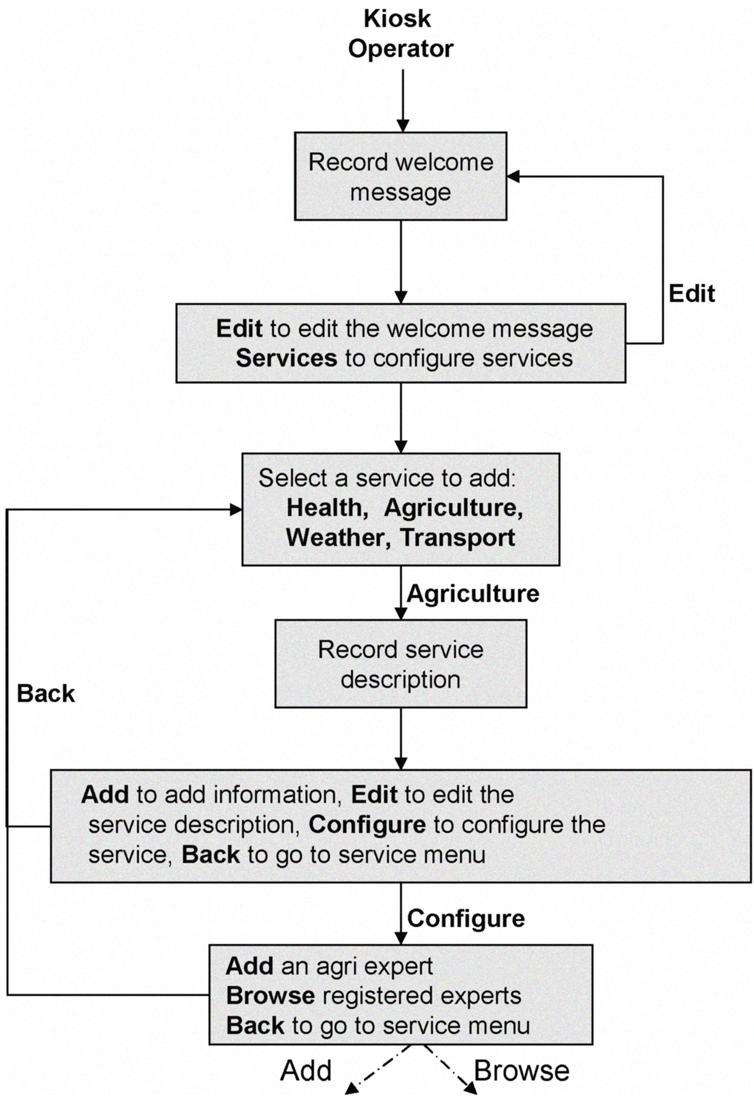 Figure 1: The operational flow shows how different users (Kiosk Operators, Experts, and Villagers) interact with the VoiceSite.
Experiments & Results: An Accidental Social Network
The 4-month pilot in Juvvala Palam yielded 20,499 calls. While the system was designed for "utilitarian" information like crop prices and doctor schedules, the Advertisements section (36.5% of traffic) took on a life of its own.
- Beyond Micro-Business: While intended for mechanics and drivers, the community used it for matrimonial profiles, greeting grandparents, and even political "thank you" notes.
- User Engagement: The average call lasted 83 seconds, but some users engaged for up to 49 minutes, proving the "VoiceSite" concept was sticky.
- Viral Growth: Without aggressive marketing, the user base grew through word-of-mouth, eventually attracting callers from neighboring villages.
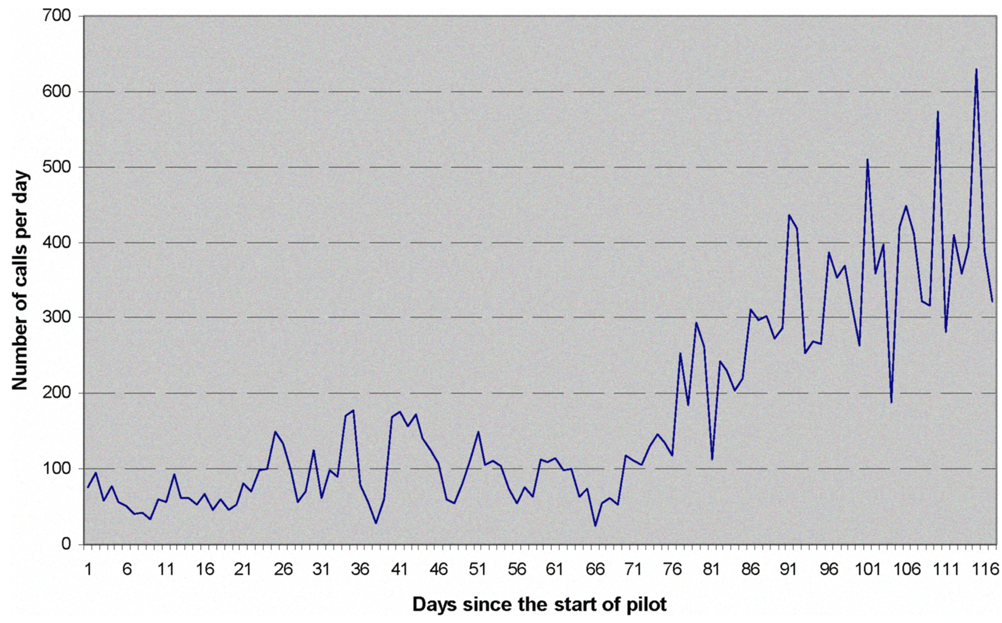 Figure 2: The steady increase in calls per day demonstrates the system's growing social and economic integration.
Critical Insights & Future Outlook
The VoiKiosk study proves that local relevance is the "killer app" for rural development. When people are given a platform to speak in their own tongue about their own village, they don't just use the technology—they adapt it.
Key Takeaways:
- Voice is the Interface of Inclusion: Speech-based systems bypass the literacy barrier and capitalize on the existing cultural oral tradition.
- Social Networking is Universal: The drive to connect socially (matrimonials, child greetings) is just as strong in a village of 4,000 as it is on global platforms like Facebook.
- Efficiency vs. User Preference: The study showed that while keypad shortcuts (DTMF) improved efficiency, users initially needed—and preferred—voice-only navigation until they became "power users."
Limitations: The system still required a "Kiosk Operator" (VCO) to manage specific sections, and background noise remains a challenge for automated silence detection during recordings. As mobile data becomes cheaper, the next frontier for this work is merging these voice-driven insights into multimodal (voice + visual) hybrid systems.
Summary by Senior Academic Tech Editor: This work remains a seminal case study in HCI for Development (HCI4D), showcasing that technical "simplicity" often requires the most sophisticated human-centric design.