
TSGNN: Why Content Semantics are the Missing Piece in Social Cascade Prediction
Content Matters: A GNN-Based Model Combined with Text Semantics for Social Network Cascade Prediction
TSGNN is a novel Graph Neural Network (GNN) framework for information cascade prediction that integrates textual user-generated content (UGC) with social structure. By combining a Biterm Topic Model (BTM) for short-text semantics with a gated activation mechanism, it achieves State-of-the-Art (SOTA) performance on Weibo and Twitter datasets, reducing Mean Relative Square Error (MRSE) by up to 10%.
Executive Summary
TL;DR: Predicting how a tweet goes viral usually focuses on who follows whom. TSGNN proves that what is being said is just as important. By fusing short-text topic modeling with Graph Neural Networks, this model sets a new SOTA by simulating how specific topic triggers "activate" users across a social graph.
Positioning: This work moves beyond purely topological GNNs (like CasCN or DeepCas) by re-introducing Content Semantics into the equation. It is a refinement of the "influence-activation" paradigm, emphasizing that diffusion is a socio-technical process where text acts as the catalyst.
The "Structure-Only" Pitfall
In the world of information diffusion research, we have seen a massive shift toward Graph Neural Networks. These models are excellent at capturing the "structural virality" of a cascade. However, they often treat the information itself as a "black box" or a static node attribute.
The authors argue that this is a mistake. Users don't retweet just because their friends did; they retweet because the content resonates with them. Previous attempts to use text (like LDA or TF-IDF) were often too clunky for the short, noisy nature of social media posts.
Methodology: Coupling Textual Triggers with Social Influence
TSGNN’s architecture consists of three sophisticated components designed to mimic the psychology of a retweet:
- Biterm Topic Embedding (TE) Module: Standard LDA fails on short texts like tweets. TSGNN uses the Biterm Topic Model (BTM) to find "coherent topics." It then treats the sequence of topics as a path, feeding them into an RNN with an Attention mechanism to highlight the most "infectious" segments of the message.
- The TSGNN Layer: This layer performs neighborhood aggregation. It doesn't just sum up neighbor features; it scales them by the activation probability of those neighbors, representing the real-time spread of influence.
- Gated Activation Unit (GAU): This is the brain of the model. It takes three inputs to decide if a user will "activate" (retweet):
- Content Influence: From the TE module.
- Social Influence: From the GNN aggregation.
- Self-Activation: A latent parameter representing offline or external factors.
 Note: The model jointly processes the cascade graph and the topic paths derived from text.
Why It Works: The "Topic Coherence" Insight
One of the most striking findings in the paper is the "Less is More" principle in text semantics.
The authors found that tweets focused on fewer, highly coherent topics are significantly more predictable and likely to trigger cascades. When they increased the number of "valid topics" beyond 2, the model's performance actually plateaued or dropped. This suggests that clear, focused messaging is a primary driver of social contagion.
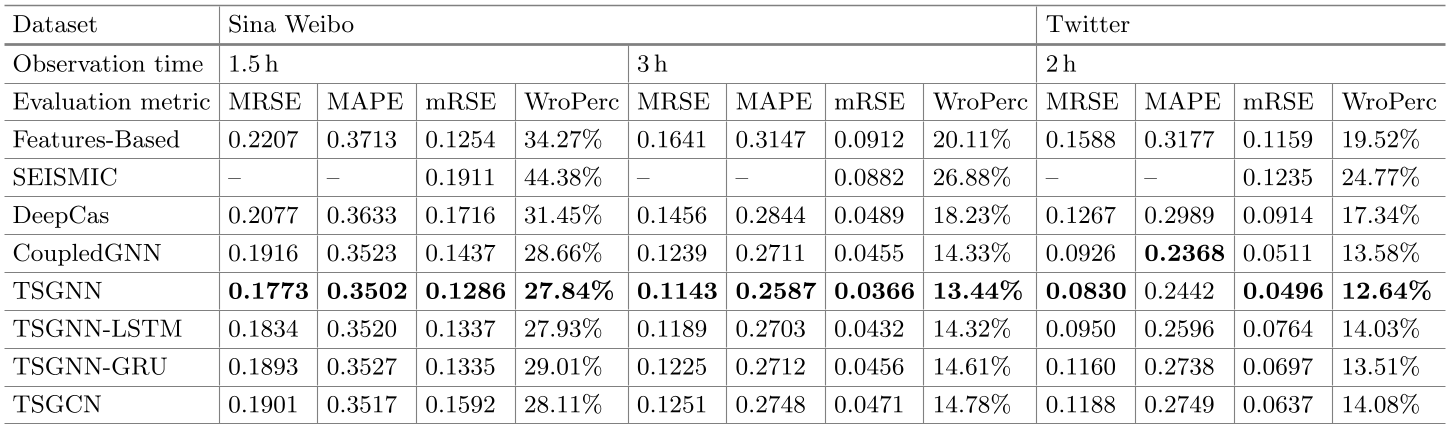 As shown in Table 2, TSGNN outperforms previous SOTA models like CoupledGNN across all metrics (MRSE, MAPE, mRSE).
Experimental Validation
The model was tested on two massive real-world datasets: Sina Weibo and Twitter.
- Accuracy: On Twitter, the MRSE was reduced to 0.0830, a significant leap over CoupledGNN's 0.0926.
- Ablation: Removing the Topic Embedding (TE) module caused a sharp decline in accuracy, proving that content isn't just "noise"—it's a critical signal.
- Stability: The authors used a DropEdge mechanism to prevent the GNN from over-smoothing, ensuring the model stays robust even on dense social graphs.
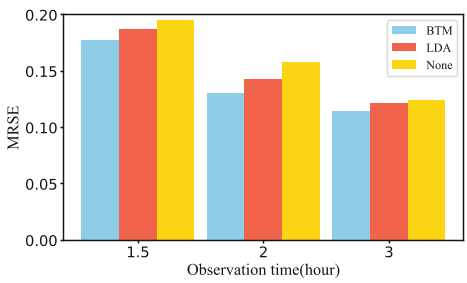 Figure 2c highlights how removing the text module or the attention mechanism negatively impacts the error rate.
Conclusion and Future Outlook
TSGNN is a powerful reminder that in social networks, content is king. By integrating a short-text-aware topic model into a gated GNN architecture, humans' retweet behaviors can be modeled with far greater precision.
Limitations: The current model relies on an observation window (T). In the future, moving toward a purely "asynchronous" or "continuous-time" GNN could allow for real-time viral forecasting the moment a tweet is posted.
Takeaway for Practitioners: If you are building a recommendation engine or a rumor detection tool, don't just look at the graph. Use specialized topic models like BTM to extract the "semantic DNA" of the content—it might be your most valuable feature.