
Message Passing vs. Sparse Reconstruction: Decoding User Preferences in Social Graphs
Content preference estimation in online social networks: Message passing versus sparse reconstruction on graphs
This paper proposes and evaluates two distinct strategies—Distributed Message Passing and Centralized Sparse Reconstruction—for estimating unknown content preferences in online social networks (OSNs) using a partial set of known nodes. The study demonstrates that decentralized message passing based on graph affinity outperforms sparse reconstruction, which struggles with the non-smooth nature of social preference data.
TL;DR
How do you predict what a user likes when you only have data for 25% of the network? This paper evaluates two paradigms: a distributed message-passing approach that mimics social influence, and a centralized sparse reconstruction approach that treats preferences as a compressible signal. The verdict? Local gossip is far more accurate than global mathematical "smoothing."
Background & Motivation
In Online Social Networks (OSNs), user preference data is the "gold" that drives recommendation engines and traffic engineering. However, most profiles are incomplete. The research intuition here is twofold:
- Homophily: Neighbors in a social graph are more likely to share preferences.
- Graph Signal Processing: Preferences can be viewed as a function over a graph, potentially sparse in some transform domain (like Wavelets).
The author seeks to determine which mathematical framework captures this intuition more effectively.
Methodology: The Core Strategies
1. Distributed Message Passing (The "Gossip" Strategy)
This approach models preferences as a Markov Random Field. Each node performs a local computation, then exchanges "messages" with neighbors. The update rule is a weighted expectation: This leverages the Inductive Bias that affinity (edge weights) correlates with preference similarity.
2. Sparse Multi-Regularized Reconstruction (The "Compressed Sensing" Strategy)
This is a centralized optimization problem. Unlike standard compressed sensing, the author proposes MulRegRec, which adds constraints to ensure the result is a valid probability distribution (non-negative and summing to 1): To solve this complex multi-constraint problem, the paper utilizes the Split Bregman method, an iterative technique for variable splitting.
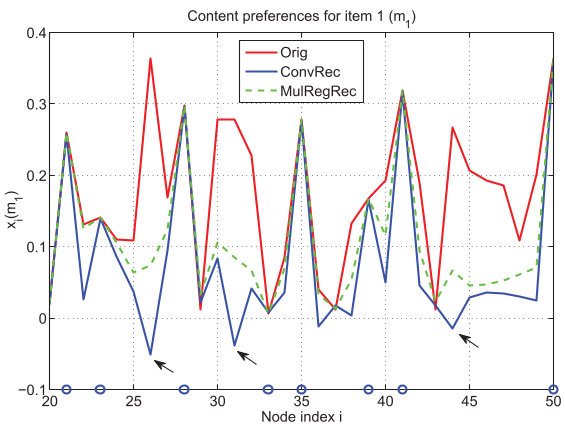 Figure 2: Comparison between original data (Red), conventional reconstruction (Blue), and the proposed Multi-Regularized reconstruction (Green).
Experiments & Convergence Analysis
The paper provides a rigorous Graph Laplacian analysis. It proves that the convergence speed of the message-passing algorithm is governed by the spectral gap—the distance between the two largest eigenvalues of the transition matrix.
Key Findings:
- Connectivity Matters: As the number of edges increases, the number of iterations required for convergence drops sharply.
- The Sparsity Failure: As seen in the figure above, both sparse reconstruction methods (ConvRec and MulRegRec) performed poorly. While MulRegRec fixed the "negative preference" bug of ConvRec, both failed to track the ground truth accurately.
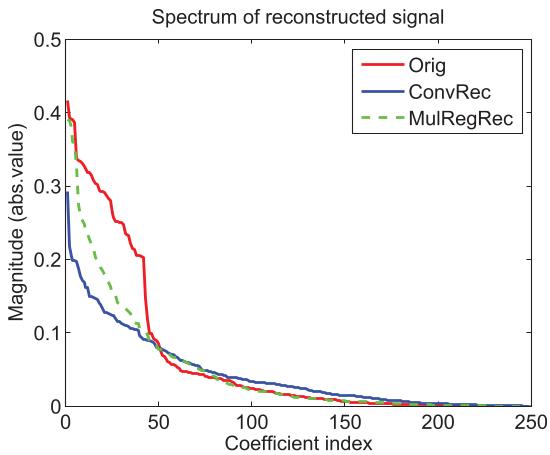 Figure 3: The Wavelet Spectrum reveals why sparse methods fail—the original signal (Blue) lacks the "smoothness" (rapid decay) that these algorithms assume.
Critical Insights & Conclusion
The most striking takeaway is the failure of the smoothness assumption. In classical signal processing, we assume natural signals are "low-frequency" or smooth. However, social preferences are "spiky." A user might love Action movies while their closest friend loves Horror, despite frequent interaction.
Limitations:
- Small Scale: The experiments were conducted on graphs of 50 nodes. Real OSNs involve millions of nodes, where centralized ADMM/Split Bregman would face massive scaling issues.
- Dynamic Graphs: Social networks evolve; the paper assumes a static graph structure.
Final Word:
If you are building a recommendation system, don't rely solely on global signal transforms. The local message-passing architecture is not only more computationally scalable but also more aligned with the "non-smooth" reality of human preference.