
Harmonizing the Social and Transport Layers: A Context-Adaptive Approach to Media Delivery
8980_Context-Adaptive Information Flow Allocation and Media Delivery in Online Social Networks.
This paper proposes a context-adaptive framework for optimizing media delivery in Online Social Networks (OSNs) by integrating social-layer data (contacts and content preferences) into transport-layer operations. The methodology includes a linear programming model for flow allocation, a tracker-based P2P peer selection mechanism, and a utility-based packet scheduler, achieving up to 8 dB PSNR improvement in video delivery and significantly higher content discovery speeds.
TL;DR
Researchers have developed a framework that breaks the wall between social network data and underlying network transport. By leveraging user preferences and social contacts, they've engineered a system that maximizes information flow efficiency, accelerates P2P content discovery by 7x, and boosts video streaming quality (PSNR) by up to 8 dB.
Background: The Hidden Gap in Network Operations
We live in an era where platforms like YouTube and TikTok dominate bandwidth. However, our routers and transport protocols are "socially blind"—they treat data packets the same regardless of whether they are being shared between close friends with identical tastes or random strangers. This paper argues that by using Context-driven Flow Allocation, we can significantly reduce network costs and improve user experience.
The Core Insight: Cross-Layer Optimization
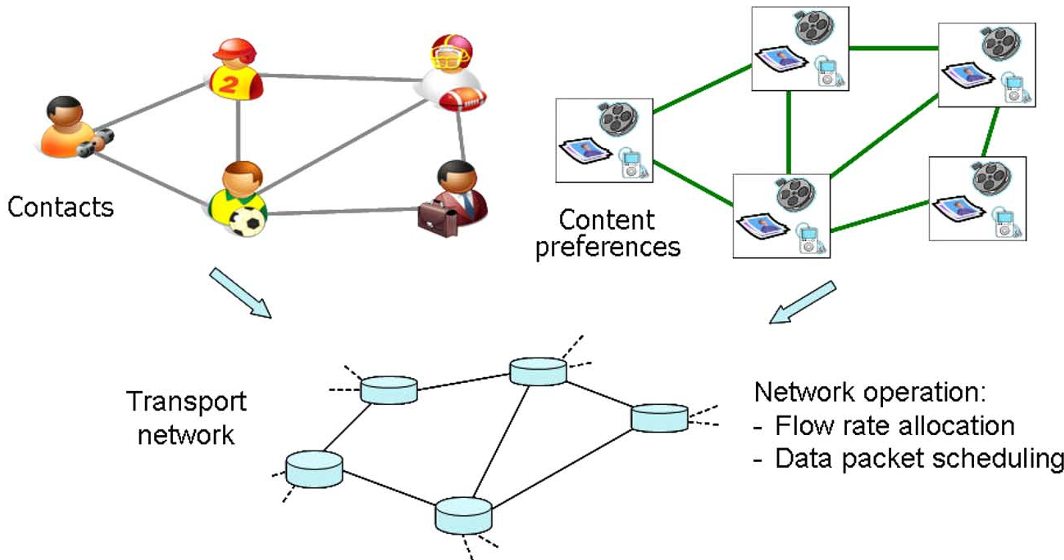
The authors propose that the transport layer should be driven by the "context" of the social layer. This context includes:
- Social Graph Neighbors (): Who are your contacts?
- Content Preferences (): What are you likely to download?
- Network Cost (): The physical latency/cost of the path.
Methodology Deep Dive
1. Maximizing the Information Flow-Cost Ratio
The authors formulate a Linear Programming problem (P1) aimed at maximizing the total expected information flow divided by the network cost.
Unlike standard max-flow problems, this version weights the flow by —the probability that a node is actually interested in a specific asset. For practical use, they also designed a distributed version that uses message passing and scaling factors to avoid the need for a central "god-view" controller.
2. The Intelligent P2P Tracker
Standard P2P trackers (like BitTorrent) often give you a random list of peers. This paper's tracker calculates a similarity score (): Where is the correlation between user interests and is the physical distance. This ensures you connect to peers who are "close" both socially and geographically.
3. Context-Aware Packet Scheduling (Con-Aw)
When streaming video, not all packets are equal. The Con-Aw scheduler calculates the Importance () of a packet based on:
- Sensitivity: How much will the video quality drop if this packet is lost?
- Rarity: How many of my neighbors actually have this packet?
- Urgency: How close is the playback deadline?
Experimental Validation: Does it Work?
The results are compelling across three main dimensions:
- Efficiency: The social-aware optimization (Opt) maintains a massive lead over "No Social Network" baselines, as it doesn't waste bandwidth on content users likely don't want.
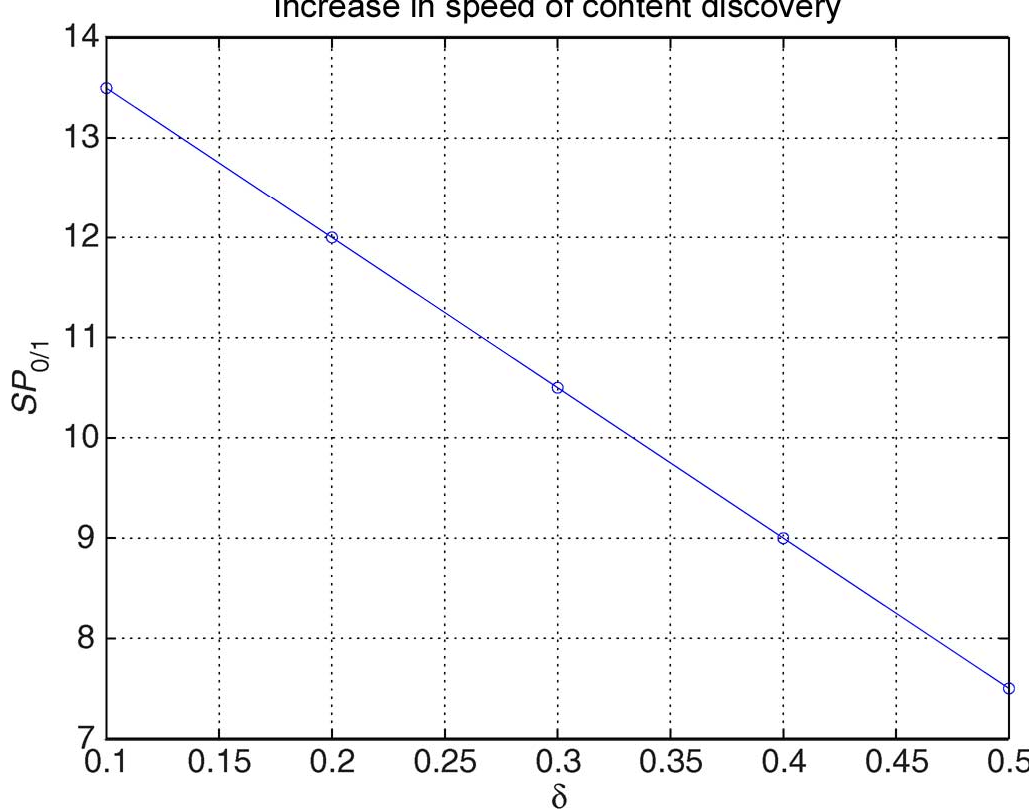
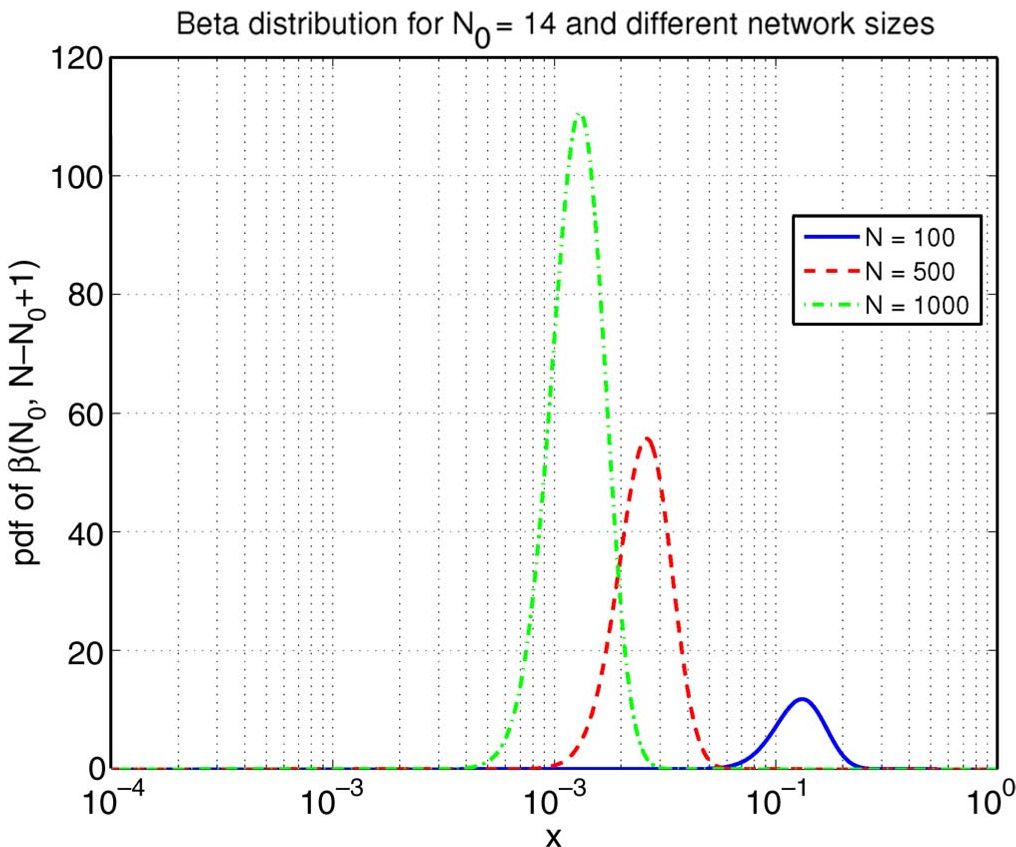
- Discovery Speed: The likelihood of finding content is vastly improved. As shown in the simulation, content discovery is more than 7 times faster than random selection at typical network scales.
- Streaming Quality: In video tests using the Foreman sequence, the "Con-Aw" scheduler outperformed the standard "Earliest Deadline First" (EDF) by 4 dB PSNR, a difference clearly visible to the human eye.
Critical Analysis & Future Outlook
The primary strength of this work is its holistic synthesis of social science (preference correlation) and hard network engineering (linear programming and packet erasure channels).
Limitations: The study relies heavily on synthesized social data since real-world OSN datasets (with full transport-layer metrics) are notoriously difficult to obtain due to privacy and proprietary concerns. Furthermore, the "Distributed Optimization" assumes nodes will cooperate honestly in sharing their preference vectors.
Conclusion: This paper serves as a blueprint for Content Delivery Networks (CDNs) and ISPs. By moving away from "blind" delivery to "context-aware" intelligence, we can build a much more efficient Internet.