
Beyond Appearance: Context-Aware Visual Descriptors for Video Spam Filtering
A Context-aware Description for Content Filtering on Video Sharing Social Networks
The paper introduces Bag-of-Topic-Differences (BoTD), a novel context-aware visual descriptor for filtering spam in video-sharing social networks. By representing video-responses as vector differences relative to a "thread landmark" (the original video) in a normalized SVD-latent space, the method achieves SOTA detection performance on diverse "in-the-wild" datasets.
Executive Summary
TL;DR: The paper tackles the elusive problem of video spam—where a video's "spamminess" depends entirely on where it is posted. By shifting from absolute visual descriptors to a Bag-of-Topic-Differences (BoTD) approach, the authors enable a system to understand the thematic relationship between a response and its parent thread. This method improves detection accuracy (AUC) from a coin-flip level (0.57) to a professional-grade 0.93 in real-world scenarios.
Background: Positioned as a pioneer in Content-Based Visual Information Analysis for social network moderation, this work moves away from easily spoofed user metadata and focuses on the "unforgeable" visual content itself.
The "Soccer in a Ballet Thread" Problem
Traditional spam filters look for "trash" content. However, on platforms like YouTube, spam is often high-quality video that is simply unrelated to the discussion.
- Prior Work Failure: Methods using User Profiles or Frequency of Posting fail because "power spammers" often mix legitimate and spammy behavior.
- The Semantic Gap: A "Bag-of-Visual-Words" (BoVW) approach treats all visual features as absolute. In a global feature space, a soccer video always looks like a soccer video, whether it's a legitimate response to a FIFA clip or an advertisement in a cooking tutorial.
Methodology: The Geometry of Context
The core insight is that Legitimacy = Proximity to Landmark. The authors define the "original video" that starts a thread as the Landmark.
1. Topic Normalization (SVD/LSA)
The raw visual word space is "anisotropic"—meaning distances in one direction don't mean the same thing as distances in another. The authors apply Singular Value Decomposition (SVD). This does two things:
- It creates a Latent Semantic Analysis (LSA) space where "visual topics" (patterns of co-occurring visual words) are identified.
- It decorrelates features, making the space isotropic so that mathematical "distance" accurately reflects "thematic distance."
2. The Vector Difference
Instead of feeding the video's absolute coordinates to a classifier, the authors calculate: This "Bag-of-Differences" centers every thread at the origin (0,0). The classifier no longer has to learn what "Soccer" or "Cooking" looks like; it only has to learn that "Legitimate videos stay close to the origin, while spam drifts away."
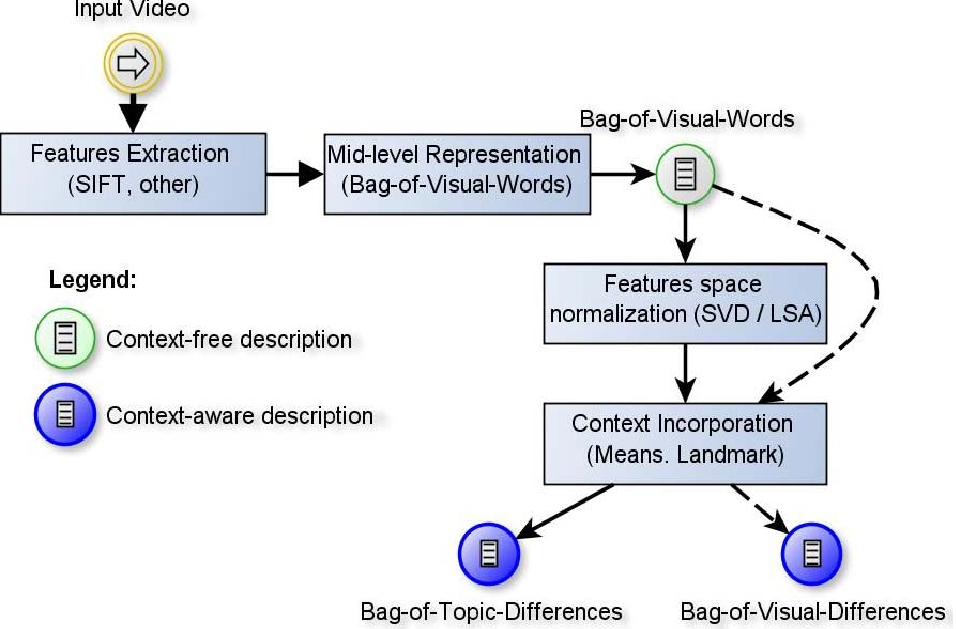 Figure 1: The proposed BoTD pipeline: From SIFT features to normalized topic differences.
Experiments & Results
The authors tested the theory on two datasets: Controlled (synthetic themes) and In-the-Wild (real YouTube threads).
- Performance Leap: In the real-world dataset, the BoVW baseline was nearly useless (AUC 0.577) because it couldn't generalize across diverse themes. The BoTD model achieved 0.936 AUC.
- Generalization: The model successfully identified spam in threads it had never seen during training, proving that the "relative distance" metric is a universal indicator of spam.
 Figure 2: On the "In-the-Wild" dataset, our BoTD approach (top curve) shows a massive lead over traditional BoVW.
Critical Analysis & Conclusion
Takeaway: This paper provides a robust framework for contextual moderation. By delegating context-awareness to the feature engineering stage (via SVD and differences), the classification task becomes significantly simpler and more robust to training data scarcity.
Limitations:
- The model relies on a single "Landmark." If the original video is visually unrepresentative of the intended topic, the entire thread's filtering fails.
- SIFT/BoVW is computationally expensive compared to modern neural embeddings (like CLIP), though the logic of "vector differences" remains highly applicable to modern latent spaces.
Future Outlook: Integrating this visual "thematic distance" with audio and metadata signals would likely yield a near-perfect spam detection system.