
MCLRE: Solving the Event Recommendation Cold-Start Crisis with Contextual Learning
Context-Aware Event Recommendation in Event-based Social Networks
The paper introduces MCLRE (Multi-Contextual Learning to Rank Events), a hybrid recommendation framework designed for Event-Based Social Networks (EBSNs) like Meetup.com. It combines social, content, geographical, and temporal signals using a Learning-to-Rank (LTR) approach to achieve SOTA performance in highly sparse environments.
TL;DR
Recommending events is fundamentally harder than recommending movies or books because events are "objects of the future"—they have no history. This paper presents MCLRE, a hybrid model that leverages Social, Content, Spatial, and Temporal contexts. By treating these as features in a Learning-to-Rank framework, the authors achieved a massive 79% improvement over previous state-of-the-art methods, effectively "solving" the cold-start problem for new events.
The "Future Item" Paradox
In classic recommendation systems (Netflix, Amazon), we rely on a matrix of past interactions. But in Event-Based Social Networks (EBSNs) like Meetup:
- Events are short-lived: Once it happens, it's gone.
- Future focus: We only care about events that haven't happened yet—meaning they have zero attendance history.
- Extreme Sparsity: The RSVP matrix is 99.99% empty.
Traditional Matrix Factorization (MF) models break down here because they cannot project a "new" event (with no RSVPs) into the latent space.
Methodology: The Power of Five Contexts
The authors argue that if we can't look at the event's history, we must look at its circumstances. They designed five specialized models to extract "relevance scores":
- Social-Aware (Group Dynamics):
- Group Frequency: Follows the intuition that if you attend many events in a "Python" group, you'll likely attend the next one.
- Multi-Relational Model: Uses MRBPR to factorize the relationships between Users, Groups, and Events simultaneously.
- Content-Aware: A Bag-of-Words (TF-IDF) model comparing event descriptions to a user's past interests, weighted by a Time Decay function (older interests matter less).
- Location-Aware: Uses Kernel Density Estimation (KDE) to map a user's "geographical footprint." If an event falls within a high-density area of your past activity, it gets a high score.
- Time-Aware: Models the "temporal profile" (e.g., Saturday nights vs. Monday mornings) as vectors.
The "Glue": Learning to Rank (LTR)
Instead of just averaging these scores, the authors use Coordinate Ascent to learn a ranking function . This treats each context as a feature and optimizes the NDCG@10 metric directly, allowing the model to learn which context is most important for a specific city or user.
Experimental Breakthroughs
The team crawled 52 months of data from Meetup.com across three major US cities.
1. Crushing the Baselines
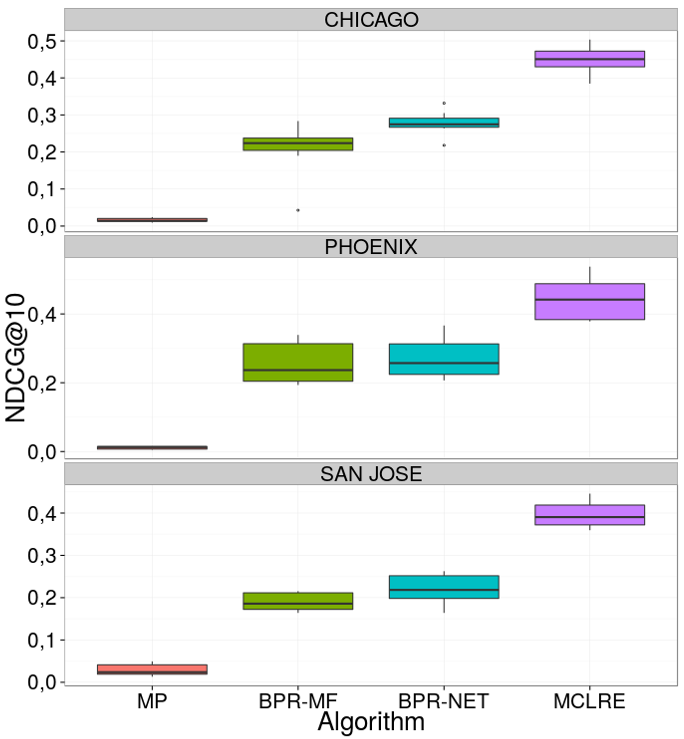
MCLRE didn't just win; it dominated. In San Jose, the median NDCG@10 was 79% higher than BPR-NET, a popular social-regularized matrix factorization model.
2. Defeating the Cold-Start
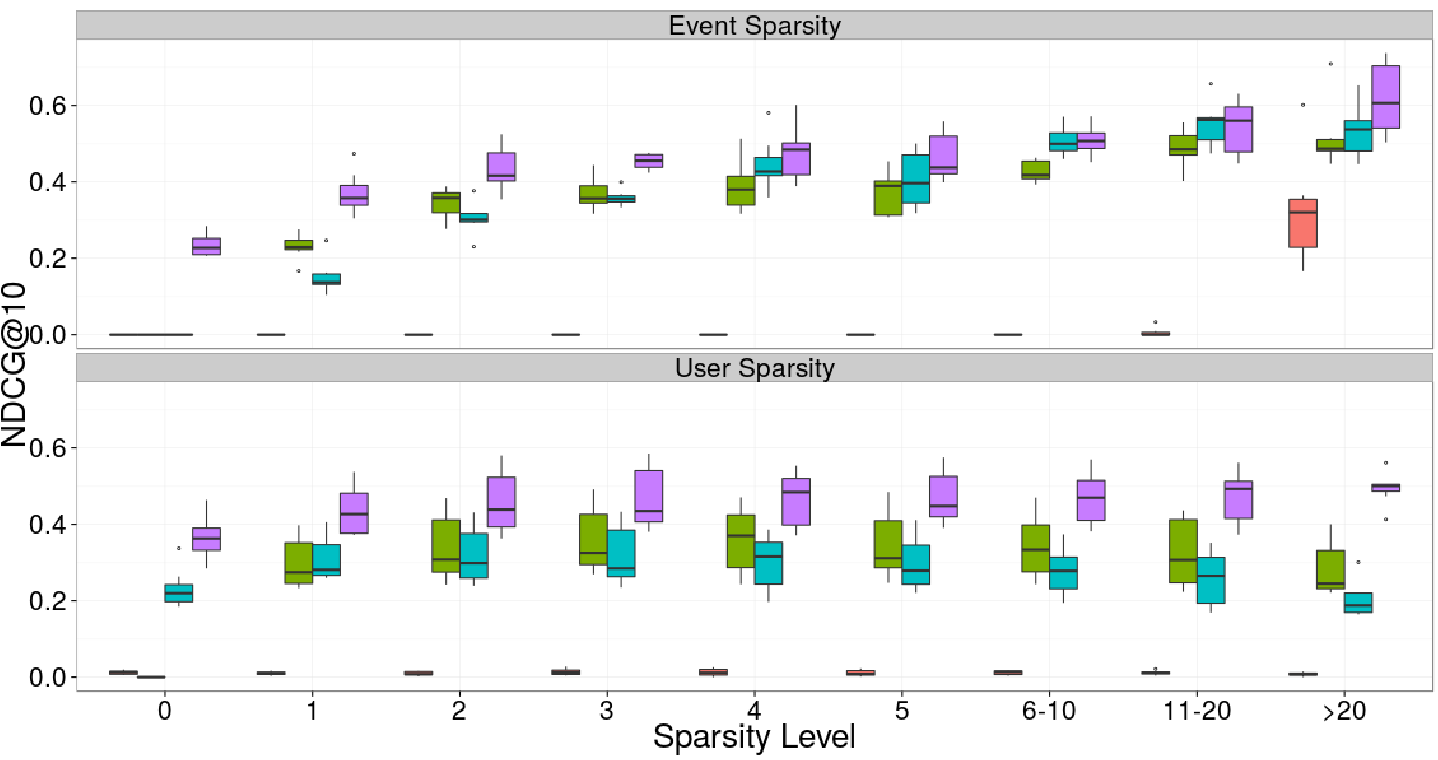
The most impressive result is the "Sparsity Robustness" test. When they isolated "Cold-Start Events" (those with 0 previous RSVPs), almost all traditional models (MF, BPR) flatlined with 0 accuracy. MCLRE maintained a high performance level because its Content and Social (Group) features don't require event history.
Critical Insight: Social Groups > Everything Else
An ablation study revealed that Social Context (Group membership) is the single most powerful predictor in EBSNs. Users don't just go to "Music" events; they go to events hosted by the "Jazz Enthusiasts of Chicago."
Conclusion & Future Outlook
This work shifts the paradigm from "latent interaction modeling" to "contextual signal fusion." For product designers, the takeaway is clear: if you are dealing with ephemeral content (events, flash sales, news), stop trying to build a better Collaborative Filter. Instead, focus on the social anchors (groups/communities) and spatial-temporal constraints that define human behavior.
Future Directions: The authors suggest exploring Deep Learning architectures and extending the model to cross-platform data like Facebook Events.