
RWCFR: Bridging the Gap Between Physical Location and Social Connections
Context Aware Friend Recommendation for Location Based Social Networks using Random Walk
The paper introduces RWCFR, a context-aware friend recommendation algorithm for Location-Based Social Networks (LBSNs) that utilizes a Random Walk with Restart (RWR) mechanism. It outperforms baseline popularity-based and expert-based methods by fusing social relations, personal preferences, and spatial context into a dynamic subgraph.
TL;DR
RWCFR (Random Walk based Context-aware Friend Recommendation) is a novel algorithm designed for Location-Based Social Networks (LBSNs). By dynamically constructing a subgraph that captures a user’s current spatial context and social ties, and applying a Random Walk with Restart (RWR) mechanism, it provides highly personalized friend recommendations that outperform traditional popularity and expert-driven baselines.
Backgound: The Context Gap in Social Discovery
Traditional social networks recommend friends based on mutual connections. However, in the era of mobile mobility, where you are is often just as important as who you know. Existing LBSN recommendation methods often suffer from two flaws:
- Context Blindness: They ignore the user's current location, suggesting friends from across the globe rather than potential connections nearby.
- Model Rigidity: Many Collaborative Filtering (CF) approaches use complex tensors or matrices that require massive re-computation whenever a new check-in or user is added.
RWCFR shifts the focus to Local Contextual Subgraphs, allowing for efficient, real-time social discovery.
Methodology: The Power of Local Subgraphs
The core innovation of RWCFR lies in its two-phase approach: Dynamic Subgraph Construction and Random Walk Ranking.
1. Constructing the Contextual Subgraph
Instead of walking the entire social graph (which is computationally prohibitive), RWCFR filters the world based on the user's "vicinity." It extracts:
- Personal Spatial Context: Locations the user has visited in the area.
- Social Spatial Context: Locations visited by the user's current friends or local experts.
- Place Friends: Users who frequent the same spots as the target user.
- Local Experts: Identified using a HITS (Hyperlink-Induced Topic Search) algorithm, where locations are "authorities" and users are "hubs."
 Note: The image illustrates the complex interplay between users, locations, and social ties in the LBSN model.
2. Random Walk with Restart (RWR)
Once the subgraph is built, the algorithm initiates a random walk starting from the "current user" node.
- At each step, the walker has a probability to jump to a neighbor and to restart at the original user node.
- This ensures the recommendation stays focused on the user’s immediate context while exploring the local network.
- The final friend list is ranked by the "visit count" of each user node after the walk reaches a steady state.
Experiments & Results
The authors tested RWCFR against three datasets: Brightkite, Gowalla, and Foursquare. They compared it with:
- PBFR: Popularity-based (most friends in the region).
- FBFR: Friend-based (friends-of-friends).
- EBFR: Expert-based (recommendations from local power-users).
Key Findings
- Superiority: RWCFR consistently achieved the highest Precision, Recall, and F-Measure across all datasets.
- Stability: Unlike PBFR, which fluctuates based on regional density, RWCFR's multi-criteria fusion (combining popularity, social ties, and spatial history) provides a stable performance profile.
- Efficiency: Because the subgraph is local, it can be queried efficiently through graph databases without updating global tensors.
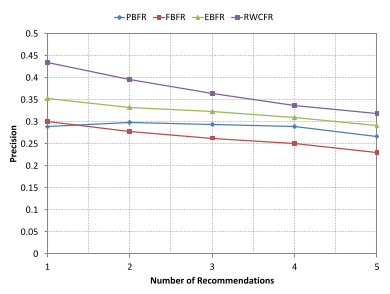 The charts above demonstrate RWCFR's performance lead over baselines in various metrics.
Critical Insight & Conclusion
The success of RWCFR proves that spatial proximity is a powerful proxy for social compatibility. By treating "visiting the same place" as a social link (a "place friend"), the authors effectively bridge the gap between physical behavior and digital identity.
Takeaway: For developers of social apps, the lesson is clear: don't just look at the social graph. By leveraging local experts and spatial context through dynamic subgraphs, you can create a far more engaging and relevant "friend discovery" experience.
Limitations: The model currently treats all visits as equal (undirected/unweighted). Future work could improve this by weighting links based on visit frequency or time spent at a location (dwell time), adding another layer of nuance to the recommendation engine.