
CAKZ: Capturing the "How" and "Why" of Expertise in Business Emails
Context Aware Knowledge Zoning: Traceability and Business Emails
The paper introduces Context Aware Knowledge Zoning (CAKZ), a novel framework for identifying "knowledge zones" within professional email corpora in project environments. By integrating Pragmatic Linguistics (Speech Acts) with organizational context (roles and competencies), the authors aim to automate the traceability of problem-solving expertise in geographically distributed teams.
TL;DR
In the fast-paced world of industrial projects, crucial decisions and expertise are often buried in thousands of emails. This paper presents Context Aware Knowledge Zoning (CAKZ), a method that uses linguistic pragmatics and organizational roles to automatically locate problem-solving zones in email threads. By modeling who knows what (competencies) and who is asking for what (speech acts), the researchers aim to build a "Project Memory" that survives long after the team has disbanded.
Background: The Hidden Value in Digital Dust
Most institutional knowledge isn't found in formal manuals; it lives in the chaotic back-and-forth of everyday communication. For middle-sized, distributed projects, email remains the primary "trace" of why a certain technical path was taken. However, typical NLP tools treat emails as bags of words, ignoring the fact that a message from a Chief Architect carries different "knowledge weight" than a routine coordination email.
The Core Insight: Integrating Context and Pragmatics
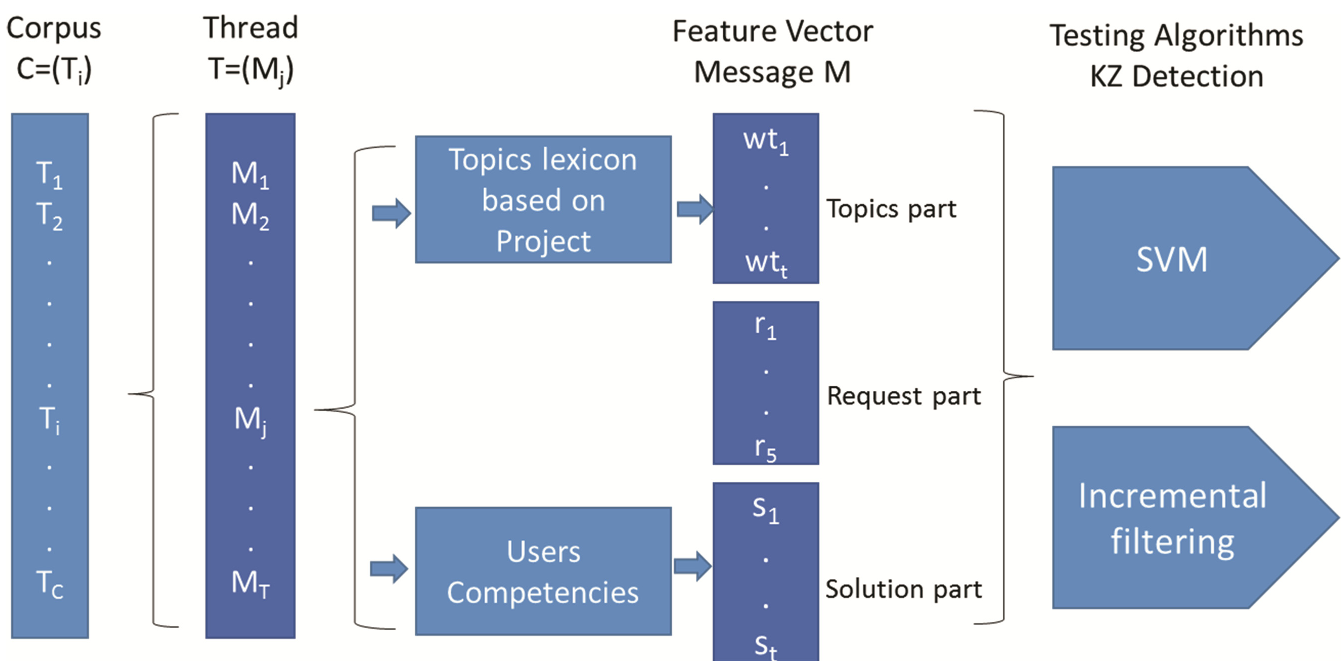
The authors argue that knowledge is most visible during problem-solving. To find these moments, they developed a system that looks beyond keywords, focusing on three specific pillars:
- Linguistic Pragmatics: Using the work of Searle and Austin, they identify "Speech Acts." For instance, a "Direct Request" (e.g., "Do X") or an "Indirect Request" (e.g., "Could you please check...?") serves as a trigger for a knowledge-rich exchange.
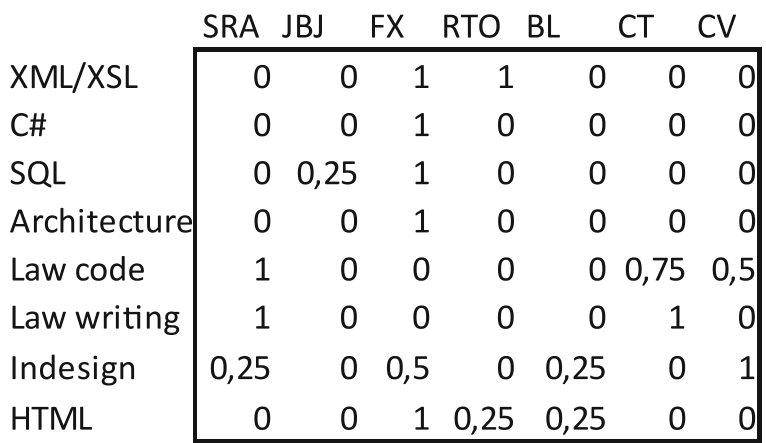
- Competency Modeling: They map participants to a competency matrix (ranging from novice to expert). If an expert in XML responds to a query about a schema error, that zone is flagged as high-value knowledge.
- Topic Zoning: Instead of unsupervised clustering, they use a project-specific dictionary (XML, BDD, Workflow) to ensure the system stays relevant to the business domain.
Methodology: Filtering vs. Machine Learning
The paper compares two distinct approaches to process the feature vectors:
- Support Vector Machines (SVM): A supervised learning approach.
- Incremental Filtering: A heuristic-driven approach that pipelines topic detection, request identification, and competency matching.
Interestingly, the SVM struggled significantly. In real-world projects, the amount of "knowledge-rich" data is often too small and unbalanced for traditional supervised learning. The Filtering Algorithm, by following the logical flow of a thread (Request -> Competency Match -> Response), proved more effective in capturing the nuances of project communication.
Results & Performance Analysis
Testing on a longitudinal software development project revealed a classic challenge in Knowledge Engineering: Noise.
- Precision (0.38): The system frequently flagged false positives where someone with high competency sent a message that didn't actually contain a solution.
- Recall (0.55): The system caught over half of the expert-verified knowledge zones, which is a significant step forward from basic keyword searching.
The authors observed that knowledge and routine coordination are often "interweaved," making it difficult to find clear boundaries for where a "zone" begins and ends.
Critical Insight: Why This Matters for the Future of AI
While this paper predates the current LLM revolution, its core philosophy is more relevant than ever. Current AI often hallucinate because they lack a model of human organizational context.
The CAKZ approach suggests that to build a truly useful "Project Brain," we must:
- Incorporate Roles: Understand the hierarchy and influence of the speaker.
- Identify Intent: Differentiate between a social greeting and a technical commitment.
- Link to Expertise: Validate information based on the proven skills of the source.
Conclusion
The study concludes that detecting knowledge "zones" is subjective and delicate. However, by moving from "Text Processing" to "Context Processing," the CAKZ model provides a blueprint for how companies can stop losing their most valuable asset: the collective intelligence found in their digital conversations.