
Legal Citation Recommendation: How Deep Learning Navigates the Maze of Mass Adjudication
Context-aware legal citation recommendation using deep learning
The paper presents a context-aware legal citation recommendation system tailored for the Board of Veterans’ Appeals (BVA). It evaluates four machine learning approaches—Collaborative Filtering, Text Similarity, BiLSTM, and RoBERTa—achieving a state-of-the-art Recall@5 of over 83% using deep neural models.
TL;DR
Researchers from Carnegie Mellon and Stanford have tackled the bottleneck of legal research in mass adjudication. By training deep learning models (BiLSTM and RoBERTa) on over 1 million Veterans’ Appeals decisions, they created a system that predicts the correct legal citation with over 83% accuracy (Recall@5). Their findings suggest that the specific wording of a legal argument—the "local context"—is far more important for accurate citation than global case metadata.
Context is King: Moving Beyond Citation Lists
In the legal world, a citation is not just a reference; it is the foundation of authority. Traditionally, recommendation systems used Collaborative Filtering—essentially saying, "Cases similar to yours often cite Brown v. Board." However, this creates a "cold-start" problem: if you haven't started citing yet, the system has nothing to go on.
The authors argue that the Motivation for a citation is hidden in the sentences immediately preceding it. Instead of looking at the whole case, the model looks at the specific paragraph the lawyer is currently drafting.
Methodology: Classifying Law
The researchers treated citation recommendation as a large-scale classification task.
- Normalization: They mapped thousands of messy, varied legal strings (e.g., "18 U.S.C. § 46") into a clean vocabulary of 4,287 unique authorities using regular expressions and the Caselaw Access Project (CLA) metadata.
- The Models: They compared traditional Bag-of-Words (Text Similarity) against deep architectures:
- BiLSTM: A recurrent network reading context in both directions.
- RoBERTa: A Transformer-based model utilizing self-attention to capture long-distance semantic dependencies.
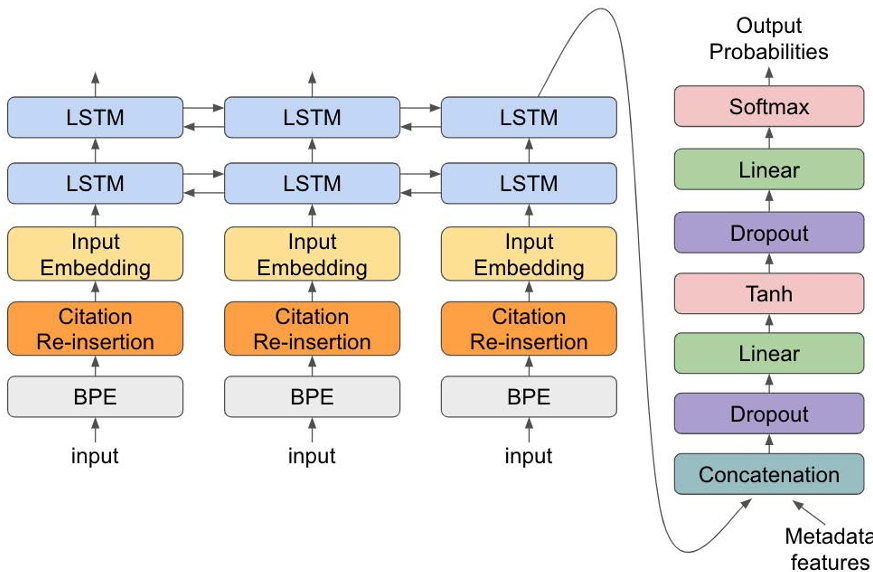 Figure 1: The RoBERTa classification architecture used to map context to a citation vocabulary.
Experiments and Results
The Results were clear: Deep Learning wins.
- Text Similarity (Baseline): ~41% Recall@5.
- RoBERTa/BiLSTM: ~83% Recall@5.
Interestingly, the researchers found that for "dumb" models, adding metadata like the Year or Issue Area provided a huge boost. But for RoBERTa, the benefits were negligible. This suggests that deep models are "reading between the lines" and inferring the legal issue and time period directly from the lawyer's writing style and vocabulary.
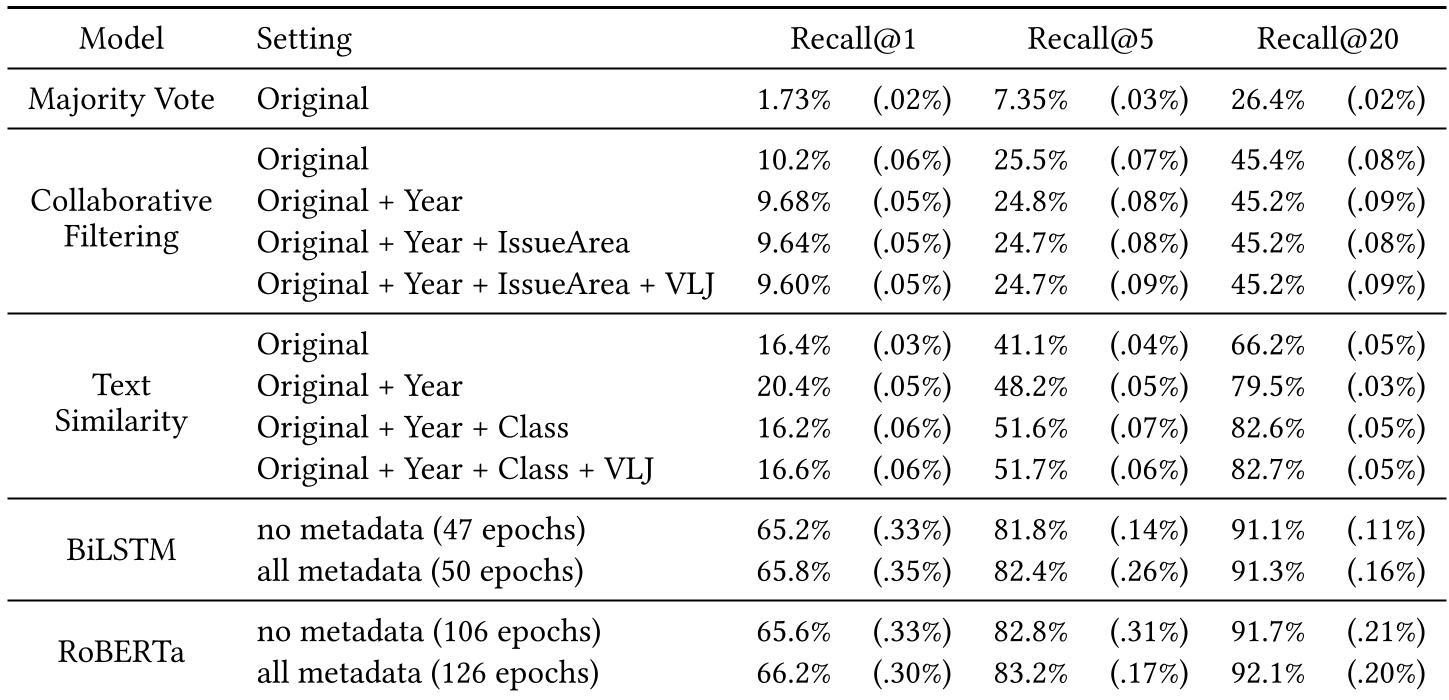 Table 1: Comparison of baseline vs. neural models. Note the massive jump in performance when moving to deep learning.
The Limits of Memory: Forecast Windows
The authors also conducted an Ablation Study on distance. As you might expect, if the citation is 100 words away from the current context, the model’s accuracy drops. However, even at a distance of 128 tokens, the models maintained a Recall@5 of 66%, proving they aren't just memorizing common phrases but actually learning "conceptual neighborhoods."
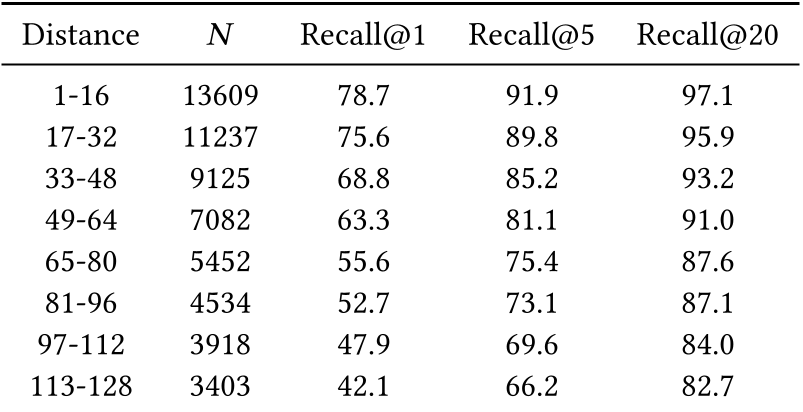 Table 2: Decay in recall as the target citation moves further away from the input context.
Critical Insight: Why RoBERTa didn't crush BiLSTM
One surprising finding was that RoBERTa (pretrained on general English) was barely better than BiLSTM (trained from scratch on law). This highlights a common hurdle in AI for Law: general-purpose language models like those trained on Wikipedia or Books don't necessarily "understand" the specific jargon and logical structure of legal precedents. Future work likely lies in domain-specific pretraining.
Conclusion
This study proves that automated citation tools can significantly lower the barrier for high-quality legal drafting. By releasing the BVA Corpus, the authors have provided a new benchmark for the community to move toward a future where AI handles the "legal research grunt work," allowing judges and lawyers to focus on the nuances of justice.
Takeaway: If you are building legal AI, focus on the text. Metadata is a useful crutch for simple models, but high-capacity neural networks can find everything they need in the prose itself.