
AlphaMF: Solving the Cold-Start Crisis in Event-Based Social Networks
Context Aware Matrix Factorization for Event Recommendation in Event-Based Social Networks
This paper introduces AlphaMF, a Context-Aware Matrix Factorization model designed for event recommendation in Event-based Social Networks (EBSNs). It provides a unified framework that combines collaborative filtering on implicit feedback with a linear model of multifaceted contextual features (spatial, temporal, semantic, social), achieving a significant 11% accuracy improvement over state-of-the-art baselines on real-world datasets like Meetup.
TL;DR
Recommending offline events (like those on Meetup or Facebook Events) is notoriously difficult because events are ephemeral—they appear and expire quickly, leaving little time for traditional recommendation algorithms to "learn." This paper introduces AlphaMF, a unified model that fuses Matrix Factorization with a Linear Contextual Model. By balancing latent user-event interactions with seven dimensions of explicit context (spatial, temporal, social, etc.), AlphaMF outperforms existing SOTA methods by a remarkable 11%.
Problem & Motivation: The "Short Life" Challenge
In traditional recommendation systems (like Netflix or Amazon), items like movies or books have long shelf lives. If you miss a movie today, you can watch it next year. However, Event-based Social Networks (EBSNs) operate under different rules:
- Short Life Time: Recommending an event after it starts is useless.
- Severe Cold-Start: New events arrive with zero or very few RSVPs, giving Collaborative Filtering (CF) nothing to work with.
- Implicit Feedback: We only know if a user said "Yes" or "No" (RSVP), not how much they liked it on a scale of 1-5.
The authors recognized that while Matrix Factorization is great at finding hidden patterns, it fails on new items. Conversely, content models are good for new items but miss niche user preferences. AlphaMF was designed to bridge this gap.
Methodology: The Alpha Hybrid Approach
The core innovation is the AlphaMF formulation, which combines two distinct modeling philosophies into a single objective function.
1. The Matrix Factorization Component
Standard MF maps users and events into a shared "latent space." If a user's vector and an event's vector are close, a recommendation is made. This captures the "vibe" of the user-event interaction that words can't describe.
2. The Linear Contextual Feature Model
To beat the cold-start problem, the authors engineered features across seven categories:
- Semantic: Using TF-IDF to match event descriptions with user history.
- Spatial: Measuring the "Great-circle distance" between user locations and event venues.
- Temporal: Mapping user availability (morning/afternoon/evening) to event schedules.
- Social: Tracking both Online (shared groups) and Offline (shared past events) friendships.
3. Fusing with "Alpha"
The final score is a weighted sum: Where is the MF score and is the contextual score. The parameter allows the model to shift its "trust" between latent patterns and explicit features.
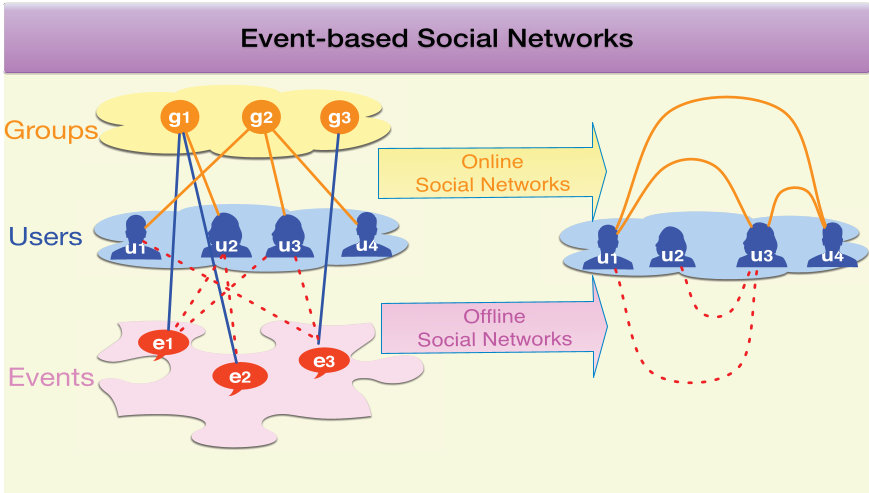 Fig 1: The heterogeneous structure of EBSNs connecting users, groups, and events.
Experiments & Results: Crushing the Baselines
The authors tested AlphaMF on a large-scale Meetup dataset covering three major US cities.
Quantitative Performance
AlphaMF consistently outperformed strong baselines like BPR-MF (Bayesian Personalized Ranking) and C-MDM.
- Accuracy: Achieved over 80% accuracy across all cities.
- The 11% Gap: The jump from the best baseline to AlphaMF was over 11%, proving that context isn't just a "nice-to-have"—it's essential for EBSNs.
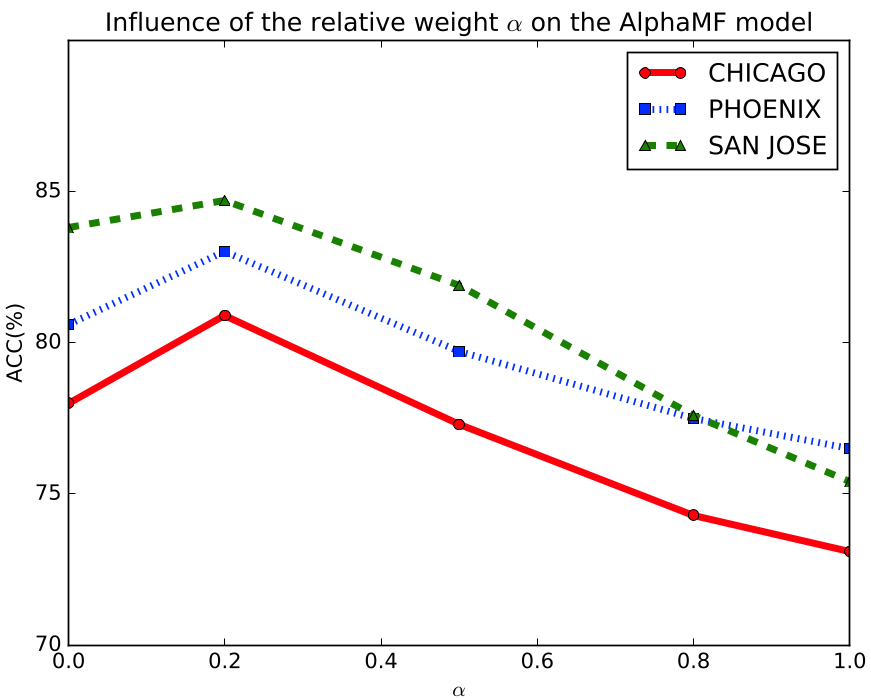 Fig 2: AlphaMF shows a clear performance lead in Chicago, Phoenix, and San Jose.
The Power of "Alpha"
The experiment found that the optimal value was 0.2. This is a profound insight: it suggests that in event recommendation, 80% of the decision weight should come from explicit context, and only 20% from latent matrix factorization. This confirms that for ephemeral items, "what" and "where" matter much more than "hidden collaborative patterns."
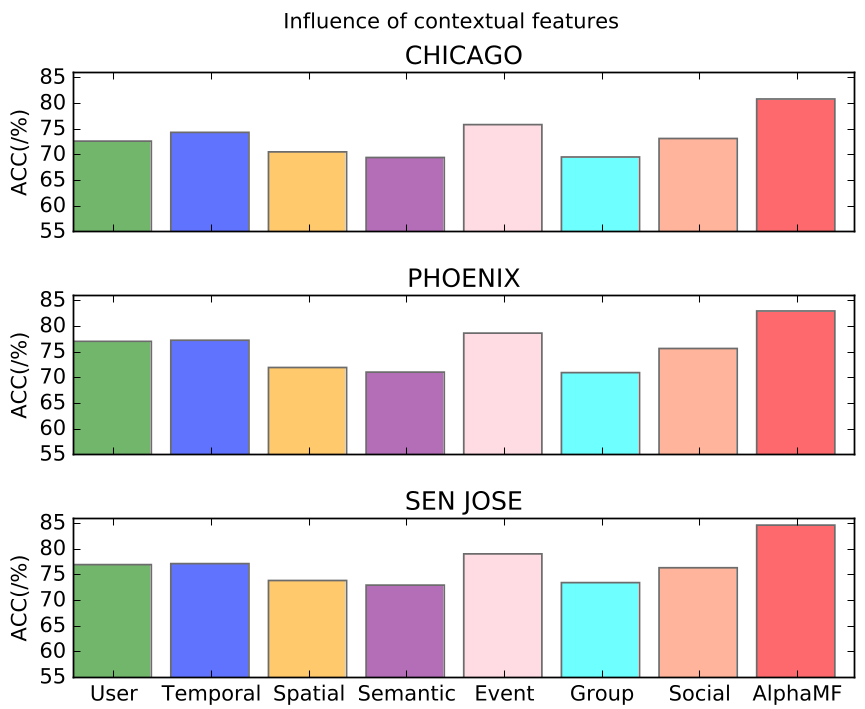 Fig 3: Individual feature analysis shows that Event, User, and Temporal features provide the strongest signals.
Critical Insight & Conclusion
AlphaMF succeeds because it doesn't try to replace Matrix Factorization; it regulates it. In a domain where data is sparse and items expire, the linear contextual model acts as a "safety net" that provides high-quality recommendations even when the user-item matrix is nearly empty.
Future Outlook: While AlphaMF uses a linear combination, the next logical step—as noted by the authors—is exploring Deep Neural Networks to capture non-linear interactions between these features. For developers building social or local discovery apps, the takeaway is clear: prioritize spatial and temporal context over complex collaborative filtering when dealing with real-world events.