
CPIR: Reconnecting Your Digital Memories Across Social Networks
18647_Context-Aware Personal Information Retrieval From Multiple Social Networks.
The paper introduces CPIR (Context-aware Personal Information Retrieval), an algorithm designed to automatically retrieve relevant previously-seen web information (PWI) for users during online conversations across multiple social networks. It leverages a two-step ranking approach involving participatory context expansion and implicit-topical graph ranking, achieving significant SOTA improvements on real-world FriendFeed datasets.
TL;DR
In the age of information fragmentation, we often "lose" the links we've shared or posts we've written across different social platforms. This paper presents CPIR (Context-aware Personal Information Retrieval), a system that acts as an automated "memory assistant." By analyzing the context of an ongoing online conversation, it can proactively surface your most relevant past posts from Twitter, Facebook, or Delicious to help you respond more effectively.
The Problem: The "Tip-of-the-Tongue" Syndrome in Social Media
We have all been there: you are in a heated debate or a helpful discussion on a social network, and you know you read or shared a perfect article about this topic two years ago. But where was it? Was it a tweet? A Facebook share?
Prior works in Personal Information Retrieval (PIR) mostly focused on desktop search (files, emails). However, social media presents three unique challenges:
- Short & Ambiguous Context: A single tweet doesn't give a search engine enough "keywords" to find a relevant deep-dive article.
- Platform Fragmentation: Our digital life is split between various Social Networking Services (SNSs).
- The "Noise" Factor: Social media data is notoriously messy, filled with slang, abbreviations, and low-signal content.
Methodology: Tapping into Collective Intelligence
The authors propose that the "context" of a conversation isn't just the text of the post—it's the people involved. Their method, CPIR, uses two clever insights to bridge the gap:
1. Participatory Context (Query Expansion)
Instead of just searching with the initial post, CPIR expands the query by looking at the replies and the past PWIs of everyone in the thread. It uses KL-Divergence with a customized smoothing method (incorporating WordNet) to find the semantic "essence" of the conversation.
2. Implicit-Topical Context (Graph Ranking)
The algorithm builds a graph where vertices are documents (PWIs) and edges represent similarities. It then runs a Markov Random Walk.
- The Intuition: If multiple people in a conversation have shared documents that are similar to each other, those documents are likely the "core topic" of the session.
- Result: This ranks the user's personal documents not just by how they match a keyword, but by how "important" they are to the specific conversation's topic.
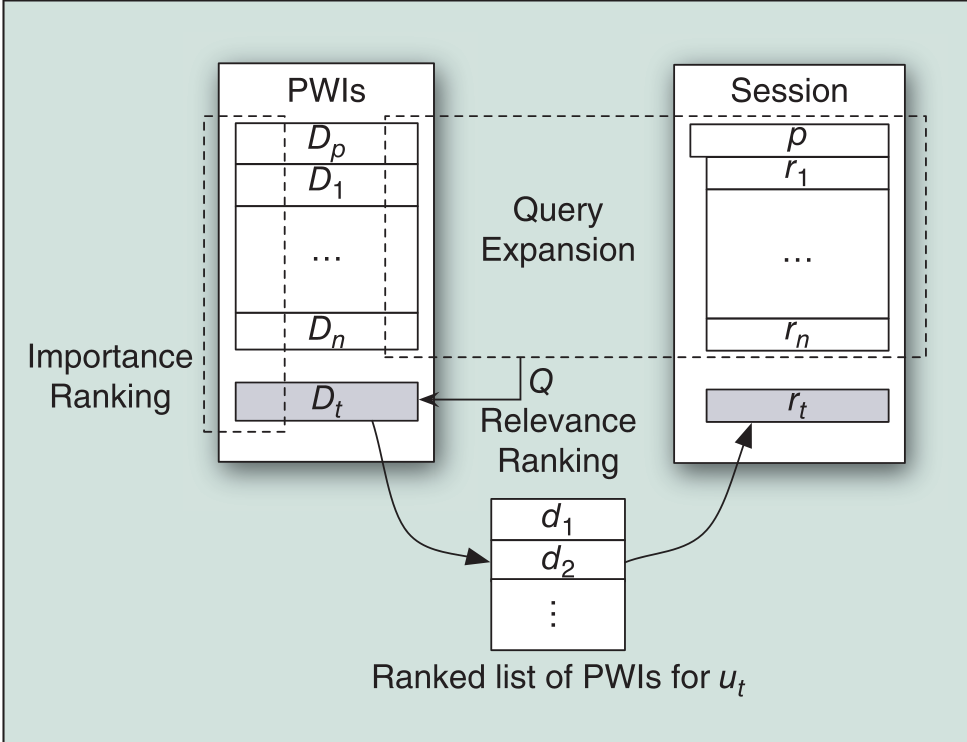 Figure 1: The CPIR Framework: Combining Query Expansion with Graph-based Importance Ranking.
Experimental Results: Proving the Value
The researchers tested CPIR on a real-world dataset from FriendFeed, a service that specifically aggregates multiple social streams.
- Performance Leap: CPIR achieved a Precision@1 of 0.80, meaning the very first recommendation was relevant 80% of the time. This is a massive jump from the 64.7% achieved by standard keyword-based searching.
- Graph Utility: The addition of "Graph Ranking" (the importance score) consistently improved the Mean Average Precision (MAP), proving that the "importance" of a document in a social network is just as vital as its "relevance."
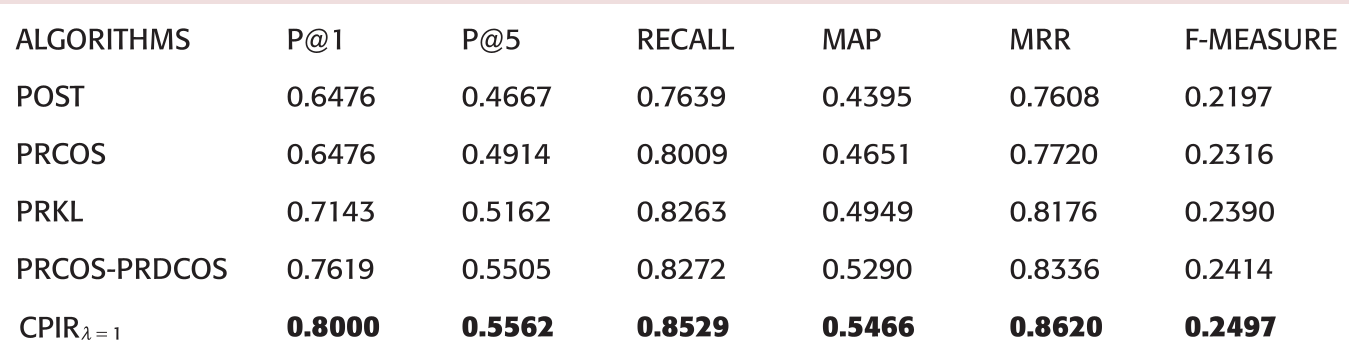 Table 1: CPIR significantly outperforms traditional posting-based and cosine-similarity baselines.
Critical Insight: Beyond Personal to Social
The most profound takeaway here is that Personal Information Retrieval is no longer a personal task.
In the Web 2.0 era, the most effective way to index your memory is to look at the collective activity of your social circle. By treating a conversation as a "session" and using the collective PWIs of participants as a semantic anchor, CPIR overcomes the inherent brevity of social media.
Limitations and Future Work
While powerful, CPIR relies on linear combinations of scores. The authors suggest that Fuzzy Logic or Clustering-based techniques (like Fuzzy C-means) could better handle conversations with multiple shifting topics. Additionally, "Document Recency" (how old a post is) remains a factor to be more deeply integrated into the ranking weight.
Conclusion
CPIR represents a shift from "Search" to "Proactive Recommendation" in the personal information space. As our digital shadows continue to grow across dozens of platforms, algorithms that can synthesize our social context to remind us of what we’ve forgotten will become indispensable tools for knowledge workers and social butterflies alike.