
Beyond 2D Matrices: Context-Aware POI Recommendation via Socially Regularized Tensor Factorization
Context-aware Point-of-Interest Recommendation Using Tensor Factorization with Social Regularization
This paper introduces a context-aware Point-of-Interest (POI) recommendation framework based on Non-negative Tensor Factorization (NTF) and social regularization. By modeling check-in data as a third-order tensor (User-Location-Time) and incorporating social network constraints, the method significantly outperforms traditional Matrix Factorization and linear fusion approaches in recommendation accuracy.
TL;DR
Point-of-Interest (POI) recommendation is no longer just about who likes what; it’s about when and with whom they explore. This paper moves beyond traditional 2D Matrix Factorization by employing Non-negative Tensor Factorization (NTF) to model the ternary relationship between Users, Locations, and Time. By adding Social Regularization, the authors leverage social ties to smooth latent factors, achieving superior performance on real-world datasets compared to standard collaborative filtering and linear fusion models.
The Multi-Dimensional Challenge: Why 2D is Not Enough
Modern Location-Based Social Networks (LBSNs) like Foursquare or Brightkite provide more than just check-in counts. They offer a rich tapestry of:
- Spatial Clusters: Users frequent locations near their home/office or clusters of entertainment spots.
- Temporal Rhythms: A user might visit a gym in the morning but a bar at night.
- Social Influence: Friends often share similar tastes, though their overlapping check-in locations might be surprisingly low (often less than 10%).
Existing SOTA methods often treat these as "side information" to be appended to a User-Item matrix. This approach ignores the intrinsic high-order interaction between time and location preference.
Methodology: The Power of Tensors
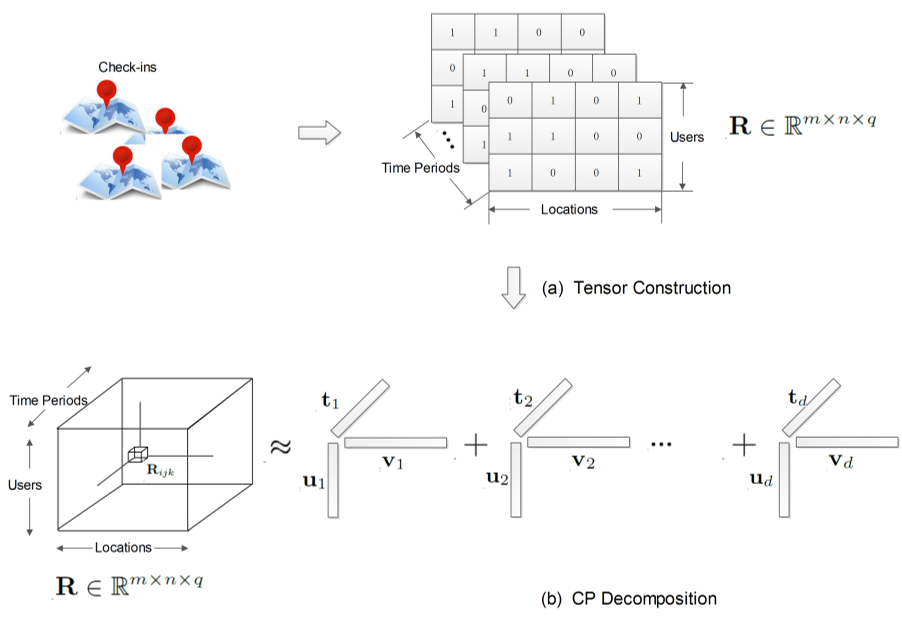
The authors propose a unified model where check-in data is represented as a third-order tensor (User Location Time).
1. CP Decomposition
Instead of a simple dot product of two vectors, the preference for user at location during timeframe is approximated via CP Decomposition: This decomposes the massive, sparse tensor into three compact factor matrices: U, V, and T.
2. Social Regularization
To address the cold-start problem and improve latent representation, a social regularization term is added. It forces the latent features of socially connected users to be similar: This is elegantly integrated into the objective function using a Laplacian Matrix (L), allowing for efficient optimization via alternating minimization.
Experimental Insights
The model was validated against the Brightkite dataset, comparing it to non-contextual (NMF, UCF, ICF) and partial-context (Friendship-aware, Time-aware, Geographic-aware) models.
- The Superiority of Tensors: The tensor model significantly outperformed the Linear Integration Model (LIM). While LIM simply sums the probabilities from different contexts, the tensor approach uncovers the latent "hidden dependencies" between the dimensions.
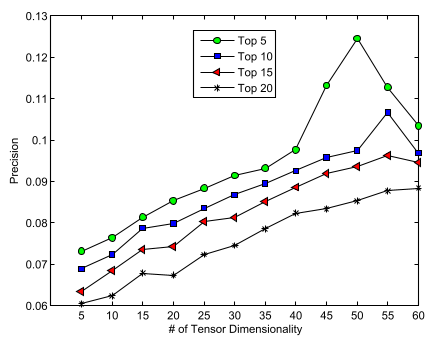
- Optimal Latent Factors: The authors found that increasing the dimensionality () improves performance up to a point (), after which over-fitting begins to degrade accuracy.
Critical Perspective
Strengths
- Unified Framework: Unlike modular systems that require complex hyperparameter tuning for each "context," the tensor approach is mathematically elegant and unified.
- Explainability through Rank: The latent factors in provide a way to see groups of users and locations that behave similarly across time.
Limitations
- Sparsity: Tensors are even sparser than matrices. While CP decomposition handles this, the computational cost of higher-order optimization can grow significantly.
- Static Context: The time dimension here is discretized. Future work could benefit from continuous time modeling or Recurrent Neural Networks (RNNs) to capture sequential check-in patterns.
Conclusion
This paper serves as a seminal demonstration of how Tensor Factorization can effectively replace matrix-based models in LBSN tasks. By integrating Social Regularization, the authors provide a robust solution to the sparsity and context-dependence inherent in human mobility data. For practitioners, the key takeaway is clear: when data has three or more core dimensions, stop flattening it—start factorizing it.