
Beyond the Algorithm: Merging Context and Social Circles in UGC Recommendations
3792_Context aware recommendations for user-generated content on a social network site.
The paper introduces a context-aware recommendation system specifically designed for User-Generated Content (UGC). It combines a content-based "Tag Cloud" algorithm with "Social Recommendations" from a user's snack network (Facebook integration) to address the information overload on video-sharing platforms.
TL;DR
The explosion of User-Generated Content (UGC) has made finding relevant videos a "needle in a haystack" problem. This paper proposes a hybrid approach that moves beyond simple history logs. By combining a Tag Cloud-based algorithm with Social Recommendations from friends and Context Awareness (mood, location, time), the authors aim to deliver suggestions that are not just accurate, but also novel and socially relevant.
The Problem: The UGC Sparsity Trap
Standard recommendation engines (like early collaborative filtering) fail in the world of YouTube and Metacafe for two reasons:
- Data Sparsity: With millions of videos uploaded daily, most items have zero or few ratings.
- Context Neglect: A user's preference for a video changes depending on whether they are at work, at home, or feeling "sad" vs. "cheerful."
Existing systems act as if the user exists in a vacuum. The authors argue that your social circle and your current environment are the missing pieces of the personalization puzzle.
Methodology: The Tag Cloud Engine
The core of the system is the Tag Cloud Recommendation Algorithm. Instead of just matching keywords, it builds a statistical profile of a user's tastes across different rating levels.
1. The Mathematical Intuition
The system tracks how often a user gives a rating to a video with a specific tag . This is represented as . To prevent "popular" tags from drowning out specific interests, the authors use a Personalized Correction Factor:
This is a "Personalized TF-IDF." It gives more weight to tags that are unique to the user's profile, favoring novelty over generic popularity.
2. Architecture & Social Integration
The system, dubbed PersonalTV, was integrated into Facebook. This allows the engine to pull "Social Recommendations" — suggestions directly from a user's friends.
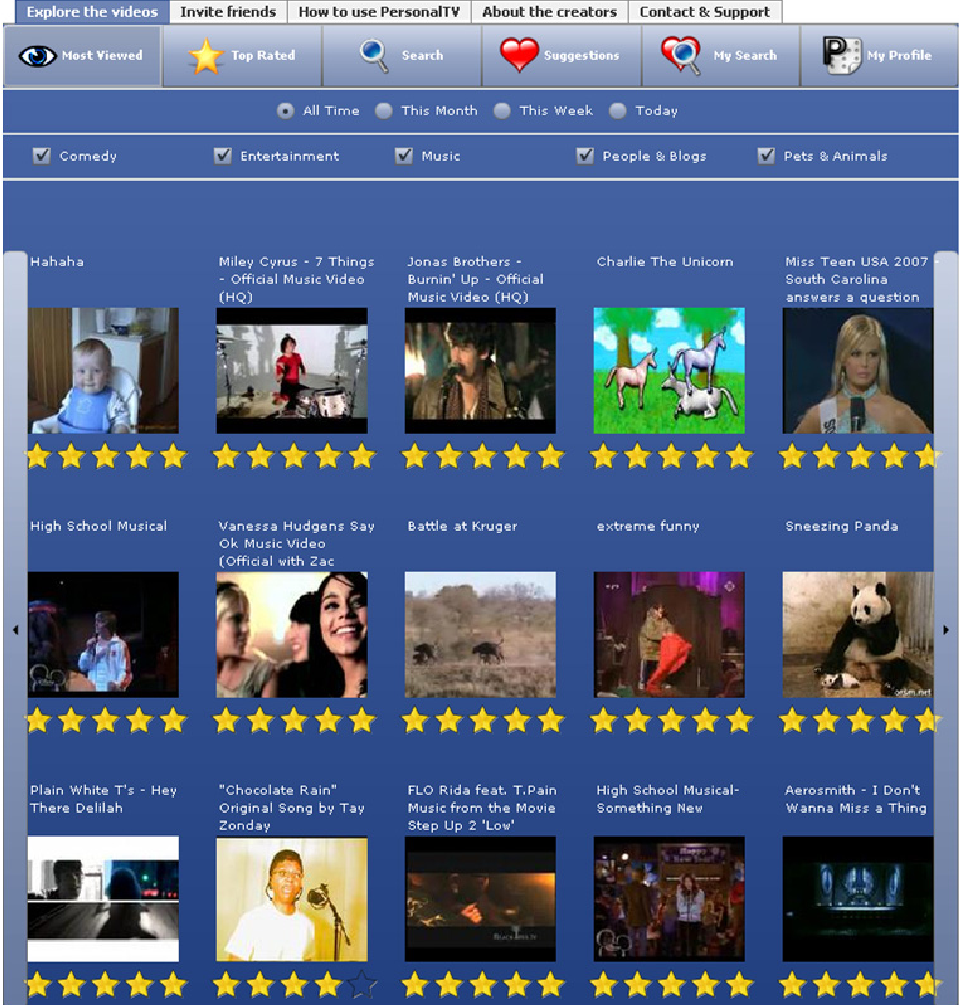 Figure: The PersonalTV interface showing recommended content segments.
Context: The Final Frontier
One of the paper's most forward-thinking components is the Context Logger. Users can manually input their location (e.g., "At Home"), their mood, and their environment (e.g., "In a group").
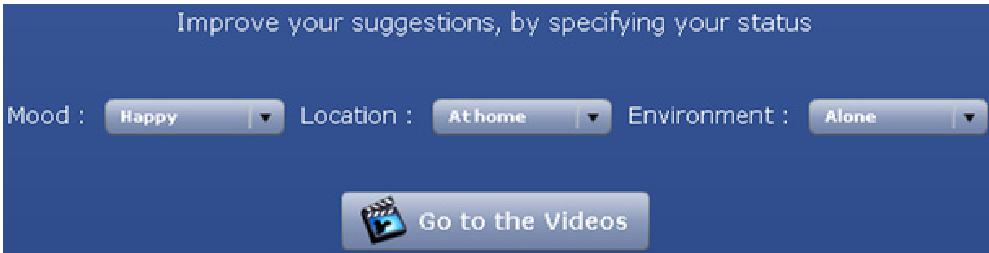 Figure: The UI allows users to select context, which the system then uses to map consumption patterns to specific situations.
The insight here is simple but powerful: we don't watch the same things at 8:00 AM on a Monday as we do at 10:00 PM on a Saturday. By logging these variables, the system creates a dataset that can predict preferences based on the situation, not just the user ID.
Critical Analysis & Results
The authors move the goalpost from "Accuracy" to "User Appreciation and Novelty."
- Innovation: Using a frequency correction factor derived from the user's own profile rather than the global document frequency is a clever way to handle specific niche tastes in UGC.
- The Social Advantage: By involving friends, the system taps into "Trust." We are more likely to watch a video if a friend recommended it than if a "black-box" algorithm did.
- Limitations: At the time of writing, the "Context" collection was manual. For this to reach mass-market appeal, the system needs to transition to passive sensing (GPS for location, biometric or sentiment analysis for mood).
Conclusion
This work serves as an early blueprint for the "Smarter" recommenders we see today. It highlights that the future of content discovery isn't just about better math—it's about better human understanding. By bridging the gap between who we are (Profile), who we know (Social), and where we are (Context), we can finally conquer the "overabundance" of the digital age.