
Beyond the Microtask: How Social Networks Save Complex Crowdsourcing
15147_Context-Aware Reliable Crowdsourcing in Social Networks.
Summary
Problem
Method
Results
Takeaways
Abstract
The paper proposes a context-aware reliable crowdsourcing framework designed for complex tasks by leveraging social network structures. It introduces a methodology where assigned principal workers autonomously recruit assistant workers from their social circles, achieving state-of-the-art efficiency and reliability in both simplex and multiplex social networks.
## TL;DR
Static crowdsourcing platforms like Amazon Mechanical Turk struggle with complex projects because they treat workers as isolated nodes. This paper introduces a **context-aware approach** that treats workers as social entities. By allowing workers to autonomously recruit "assistant workers" from their own social networks, the system offloads task decomposition from the requester and solves the "cold start" reputation problem for new workers.
## The Innovation: From Isolated Workers to Collaborative Clouds
The fundamental problem in modern crowdsourcing is the **Complexity-Reliability Paradox**. Large tasks require expert decomposition (which requesters often can't do), and reliability typically requires redundant assignments (which is expensive and vulnerable to sybil attacks).
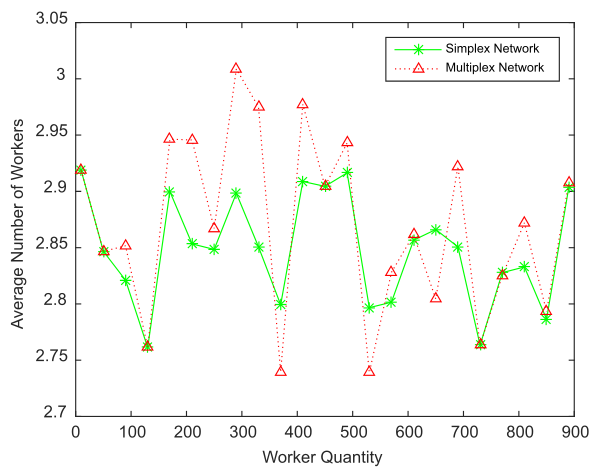
The authors' key insight is that workers are already talking. By formalizing these social ties into **Simplex** (single type of link) and **Multiplex** (varied link types like professional vs. casual) networks, the system can leverage a worker’s "Contextual Crowdsourcing Value."
## Methodology: The Power of the Social Tree
Instead of a central server deciding every micro-allocation, the system identifies a **Principal Worker** based on:
1. **Self-Owned Value**: Individual skills and reputation.
2. **Contextual Value**: The latent potential of their social neighbors to fill skill gaps.
### Autonomous Task Execution
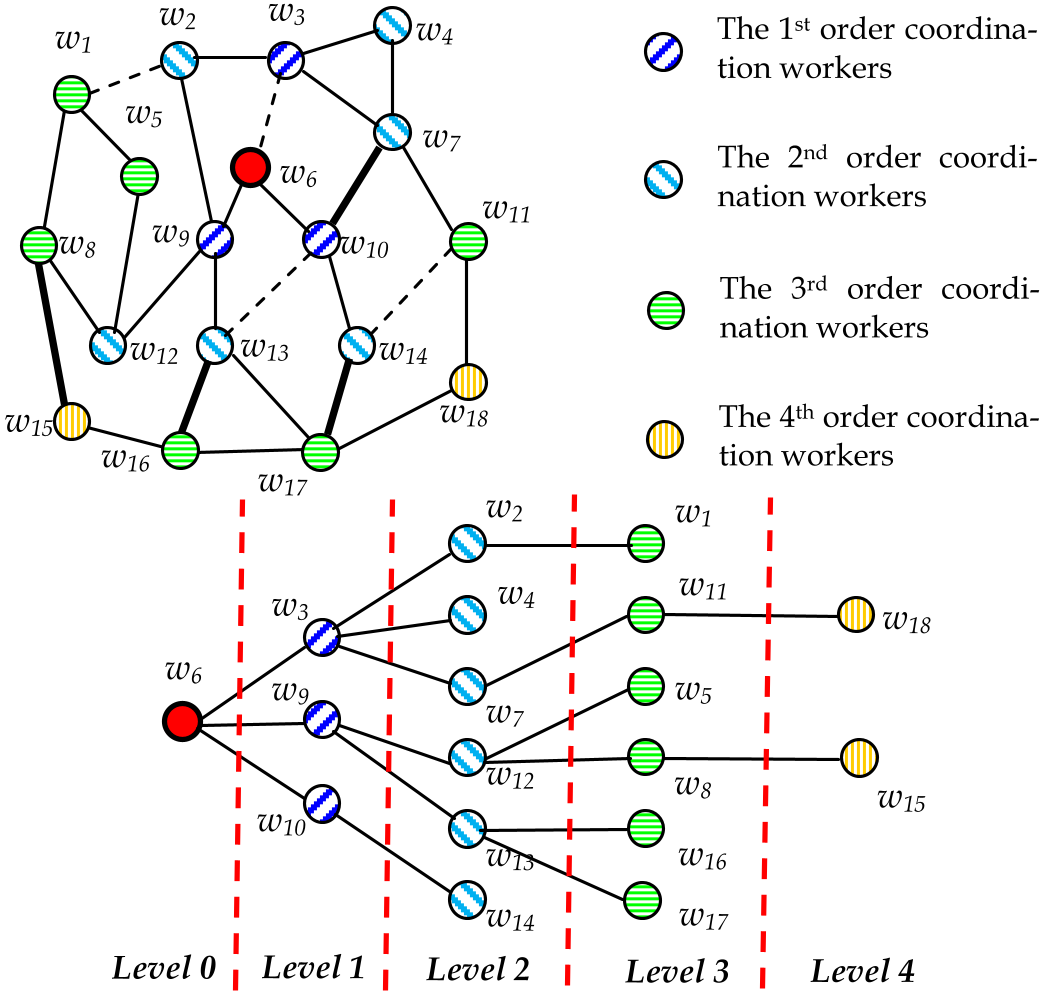
Once assigned, the Principal Worker builds a **Coordination Tree**. Using a breadth-first search logic, they recruit assistants. This process is governed by a "Credit" system—a internal social currency that tracks past favors between friends, ensuring reliable cooperation even when monetary rewards are low.
## Experimental Proof: Scaling with Complexity
The researchers validated their model against a real-world dataset from *Freelancer* mapped onto a *Facebook* social graph.
### Reliability in the Face of Malice
A standout result is the **Contextual Reputation Mechanism**. Standard systems fail when a worker is new (transient). In this model, if you are friends with high-reputation experts, your initial "contextual reputation" is elevated. This allows the system to remain robust even when up to 80% of the crowd is unreliable.
### Throughput and Accuracy
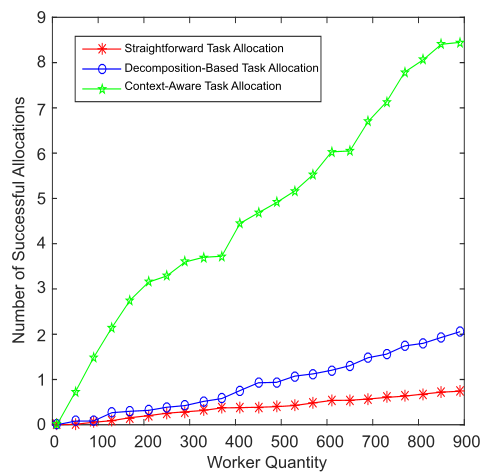
As tasks grew in complexity (requiring more than 5 distinct skills), the traditional "straightforward" or "decomposition-based" approaches saw success rates plummet. The context-aware approach maintained high accuracy by dynamically pooling social resources.
## Critical Analysis & Conclusion
**The Takeaway**: This work shifts the paradigm of crowdsourcing from "Human Computation" to "Social Coordination." It reduces the cognitive load on the task requester and utilizes the inherent trust within social groups to filter out malicious actors.
**Limitations**: The model assumes a static social network. In the real world, links break and form constantly. Furthermore, the NP-hard nature of finding "optimal" teams means we must rely on the heuristics provided (like Algorithm 2/4), which may leave some efficiency on the table in hyper-complex multiplex networks.
**Future Outlook**: The next frontier is **Dynamic Adaptation**. As social networks evolve, crowdsourcing protocols must learn to "route" tasks to emerging professional clusters in real-time.