
Dynamic Defense: Context-Aware Security for the SNS Era
Context-Aware Security model for Social Network Service
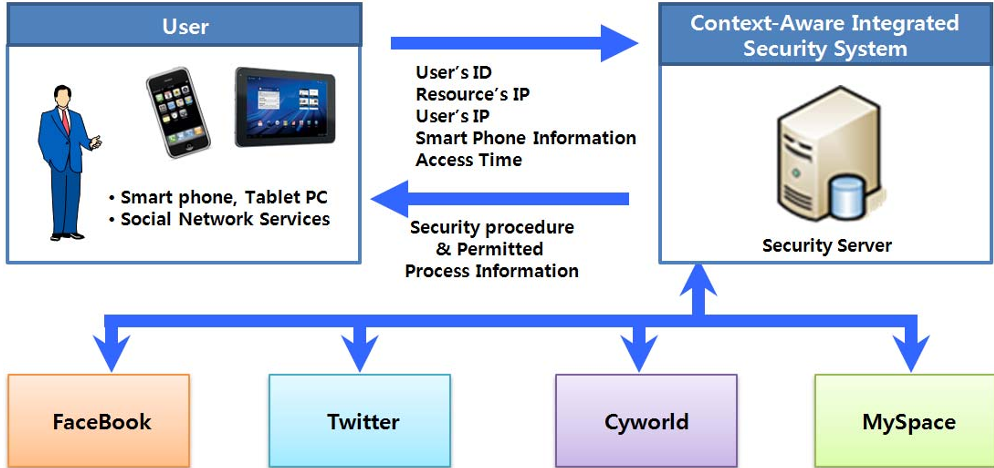
This paper proposes a Context-Aware Security model tailored for Social Network Services (SNS) on smartphones. It integrates Fuzzy Logic and Multi-Attribute Utility Theory (MAUT) within an OSGi-based framework to provide dynamic, context-sensitive authentication and access control.
TL;DR
This study presents a context-aware security architecture for SNS on smartphones that replaces rigid login screens with dynamic, intelligence-driven access control. By leveraging Fuzzy Logic to handle environmental ambiguity and MAUT for risk-based decision-making, the system adapts security levels in real-time based on location, time, and device health.
Problem & Motivation: The Static Security Trap
The explosion of Social Network Services (SNS) has forced users to juggle multiple IDs and passwords, creating a "usability vs. security" paradox. Conventional security is binary—you are either in or out. However, smartphone contexts are fluid. A user accessing sensitive data from a secure office on a full battery represents a different risk profile than a user on a public Wi-Fi with 10% battery in a remote location.
Existing systems suffer from:
- High Management Overhead: Users struggle with password fatigue.
- Lack of Adaptability: Security remains static regardless of environmental threats.
- System Rigidity: Updating security protocols often requires system restarts.
Methodology: Intelligence via Fuzzy Logic and MAUT
The core of this paper is its three-pronged approach to intelligent security:
1. The OSGi Architecture
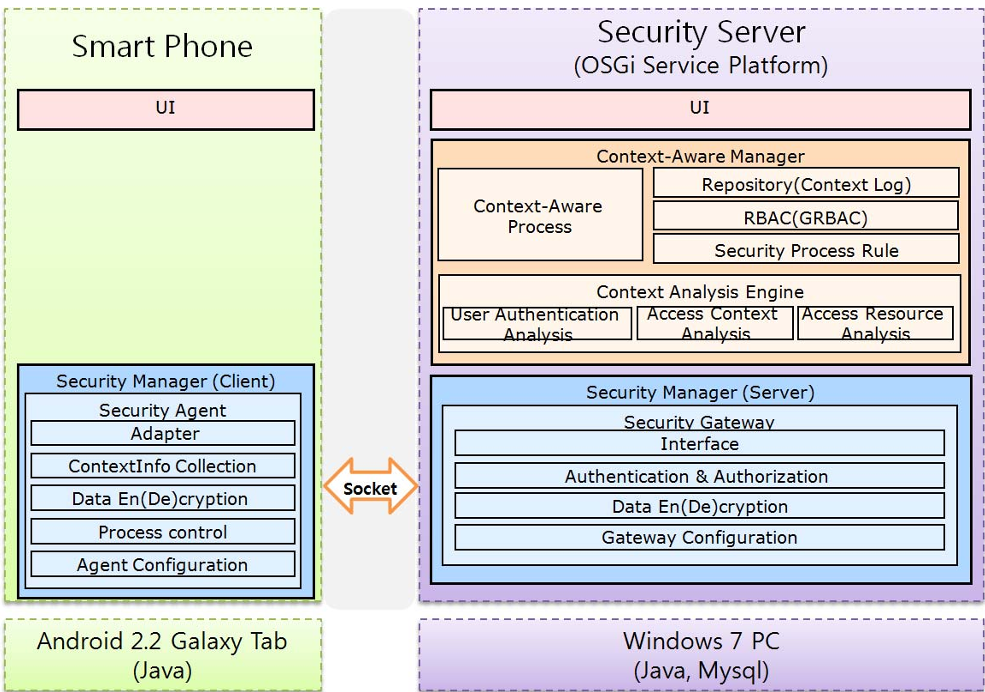
The system is built on an OSGi (Open Service Gateway initiative) platform. This allows the security manager to plug in "Context Bundles" (e.g., Location Analysis, Device Performance) dynamically. If a new threat emerges, a new bundle can be deployed without interrupting current services.
2. Fuzzy Logic for Ambiguity
Context data like "battery level" or "signal strength" is subjective. The authors use Fuzzy Logic to transform these into quantitative values. For example, a 1GHz CPU and 90% battery are fuzzified to a "Good" performance state (), which simplifies high-level decision making.
3. MAUT for Security Level Determination
Multi-Attribute Utility Theory (MAUT) is the "brain" of the system. It doesn't just treat all context data equally; it applies weights () and utility functions () to determine a precise security level. This ensures that critical attributes (like location) have a higher impact on the final authentication requirement (e.g., triggering an OTP) than less critical ones.
Experiments & Results: Scenario-Based Validation
The authors validated the model using five distinct user scenarios ( through ).
- User A (Safe): In-office, working hours, high battery Simple ID/Password.
- User C (Threat): Outside office, off-hours, 10% Battery Access Denied (preventing data loss during potential device shutdown).
- User D (MFA): Outside office, off-hours, high battery OTP Required (Multi-Factor Authentication).
The system achieved its goal of maintaining high usability: the baseline response time overhead was recorded at only 0.1ms, proving that sophisticated context-aware logic doesn't necessarily lead to a sluggish user experience.
Critical Analysis & Conclusion
Takeaway
The integration of Fuzzy Logic and MAUT provides a mathematically rigorous way to handle the "messy" data of the real world. By utilizing the OSGi platform, the authors successfully balanced the intensive computational needs of security with the limited resources of mobile devices.
Limitations & Future Work
While the OSGi approach is modular, it is somewhat dated compared to modern microservices or containerized mobile environments. Future research should look into Machine Learning (ML) for automated weight adjustment in the MAUT algorithm, allowing the system to learn from past security breaches rather than relying solely on pre-defined administrator rules.
Insight for the Industry
This work pre-dates the modern "Zero Trust" movement but aligns perfectly with its core tenet: "Never trust, always verify." For developers building SNS applications, moving toward a utility-based security model can significantly reduce fraud while simultaneously improving user experience through "invisible" authentication for low-risk scenarios.