
Beyond Triples: Scaling Context-Aware Tensor Decomposition for Social Networks
Context-aware tensor decomposition for relation prediction in social networks
The paper introduces two novel frameworks, CARTD and CRSVD, for context-aware relation prediction in social networks. By extending traditional matrix factorization to handle n-ary relations (n > 3), these methods integrate contextual data like temporal sequences and item attributes to achieve SOTA performance in recommendation tasks using the GetGlue dataset.
Executive Summary
TL;DR: This paper introduces two alternative architectures—CARTD and CRSVD—designed to overcome the "sparsity wall" and computational bottlenecks of n-ary relation prediction. By decomposing high-order tensors into coupled low-order matrices, the authors successfully integrate temporal and sequential context into social network recommendations, achieving significant gains over standard collaborative filtering.
Background Positioning: This work bridges the gap between classic Latent Factor Models (like SVD) and Statistical Relational Learning. It moves beyond the limitations of ternary (3-way) tensors to handle complex n-way interactions, making it a robust framework for real-world production environments where context defines the user experience.
Problem & Motivation: The Sparsity Wall
In modern social networks, a "like" isn't just a binary link between a user and a movie. It is often a function of context: What was the last movie watched? What is the current month? What device is being used?
Mathematically, this transforms a 2D matrix (User-Item) into an n-way tensor. While Tensor Factorization (e.g., PARAFAC) is theoretically sound, it faces two lethal issues in n-ary settings:
- Extreme Sparsity: With 5+ dimensions, the probability of observed data existing for a specific combination of contexts is nearly zero.
- Computational Complexity: Traditional decomposition scales poorly as modes increase.
The authors' insight was to stop trying to solve the "entire" tensor at once and instead model the pairwise interactions between the primary entity and each context mode.
Methodology: Two Paths to Efficiency
1. CARTD (Ranking-Driven Approach)
CARTD is designed for the task of Ranking. Instead of predicting an absolute rating, it models a ranking criterion. It assumes that an entity should be ranked higher than if was interacted with in a context and was not.
- Architecture: It decomposes the n-ary tensor into additive factorized matrices. Every context mode interacts independently with the entity of interest.
- Optimization: It uses Bayesian Personalized Ranking (BPR), optimized via bootstrapped gradient descent, which is much faster than standard SGD for sparse tensors.
2. CRSVD (Probabilistic Graphical Approach)
CRSVD treats relation prediction as a density estimation problem.
- Architecture: It uses a Bayesian Network to represent dependencies. For instance, rather than a single massive tensor, it models and separately.
- Mechanism: The resulting contingency tables are smoothed using Regularized SVD. The final probability is the product of these local smoothed models, effectively using independence assumptions to simplify the latent space.
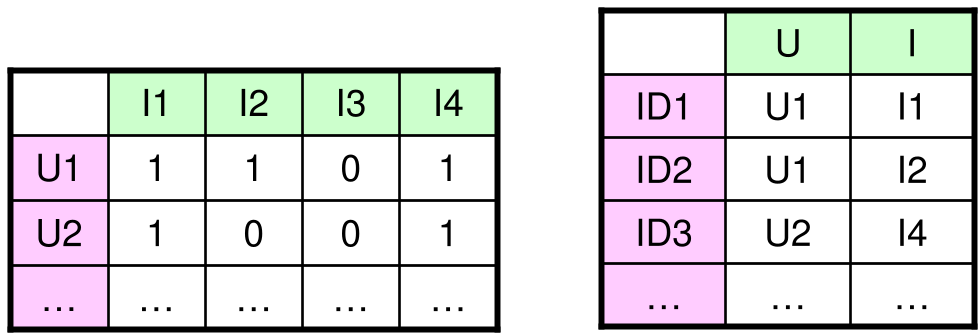 Figure: Difference between Object-Oriented (Left) and Relation-Oriented (Right) sampling.
Experiments & Results
The models were tested on real-world data from GetGlue, containing over 3,000 users and 9,000 movies.
Key Performance Insights:
- Context Matters: Adding "Last Movie Watched" and "Month" improved all metrics (AUC, HitRatio, nDCG) compared to baseline collaborative filtering.
- The Trade-off:
- CRSVD is the "Sprinter": It is nearly 10x faster to train and dominates the top-10 recommendation metrics (HitRatio).
- CARTD is the "Marathon Runner": It yields better Global Ranking (AUC), meaning it is more accurate at positioning items correctly across the entire catalog.
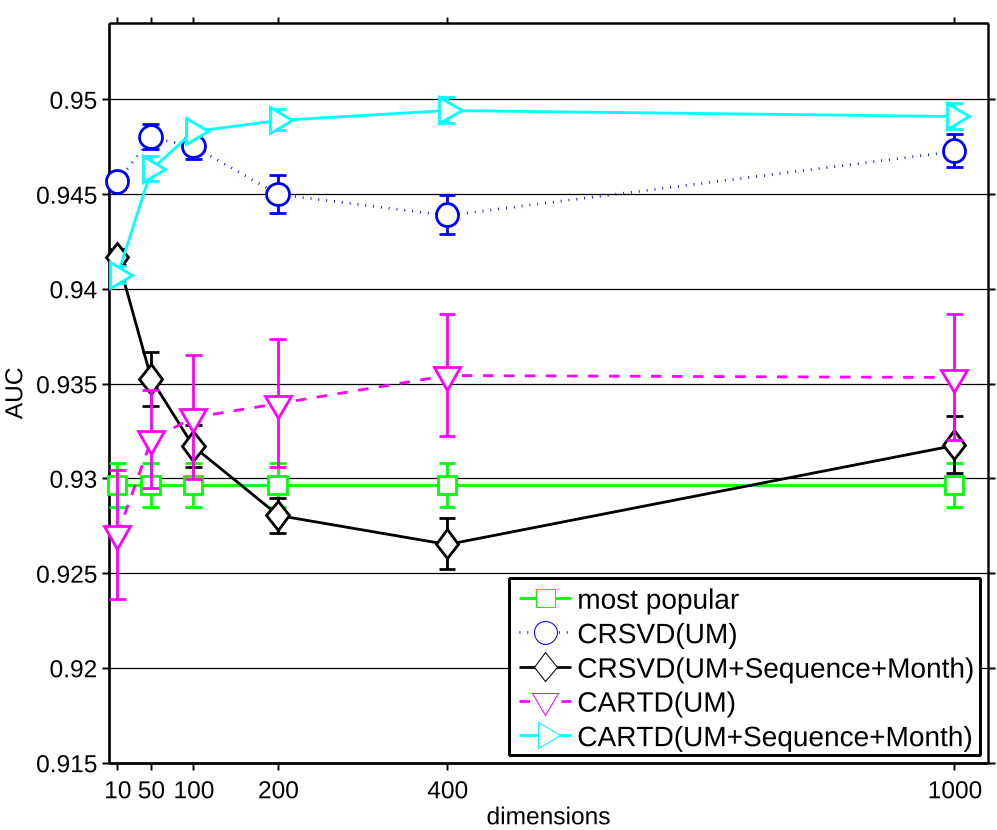 Figure: AUC values showing CARTD's steady improvement with higher factorization dimensions.
Critical Analysis & Conclusion
Takeaway
The core contribution is the realization that coupled low-order factorizations are "good enough" approximations for n-ary relations. CRSVD’s use of independence assumptions provides a highly efficient way to "stack" context without retraining the entire model, while CARTD’s ranking loss ensures high-quality list generation.
Limitations
- Independence Assumption: CRSVD assumes contexts (like time and sequence) are independent given the movie. In reality, these are often correlated.
- Cold Start: While context helps, the models still rely on latent factors, meaning new users or items with zero history remain a challenge.
Future Outlook
This work paves the way for Dynamic Social Network Analysis. By representing time and sequence as tensor modes, researchers can now model how user preferences evolve without falling into the computational trap of traditional higher-order models.