
H-SCAN-K: Decoding Trust in the Social Jungle via Context-Aware Extraction
Context-aware trust network extraction in large-scale trust-oriented social networks
This paper introduces H-SCAN-K, a heuristic algorithm designed to extract high-quality, context-aware trust networks from large-scale Online Social Networks (OSNs). By integrating complex social impact factors and bidirectional search, it enables reliable trust evaluation between non-adjacent users, outperforming prior SOTA methods like H-SCAN.
TL;DR
In the vast expanse of Online Social Networks (OSNs), determining whether you can trust a stranger—like a tennis coach recommended through friends—is a complex computational puzzle. This paper presents H-SCAN-K, a heuristic algorithm that can extract high-utility trust networks from massive datasets like Epinions and Enron. By considering social context (who lives near whom? who is an expert?), it achieves 4x higher utility than previous state-of-the-art methods while maintaining high efficiency.
The Problem: The NP-Complete Trust Gap
When a source user () wants to evaluate a target () who is several "hops" away, they rely on a trust network of intermediate participants. However, extracting such a sub-network from a graph with millions of nodes is an NP-Complete problem.
Traditional approaches fall into two traps:
- Context Blindness: Methods like Breadth-First Search (BFS) treat every link equally, ignored the fact that a recommendation from a tennis expert is worth more than one from a car mechanic in a sports context.
- Scalability Walls: Exhaustive searches (TTL-BFS) suffer from exponential time complexity, essentially "timing out" before they reach relevant nodes 4+ hops away.
Methodology: Thinking Like a Social Psychologist
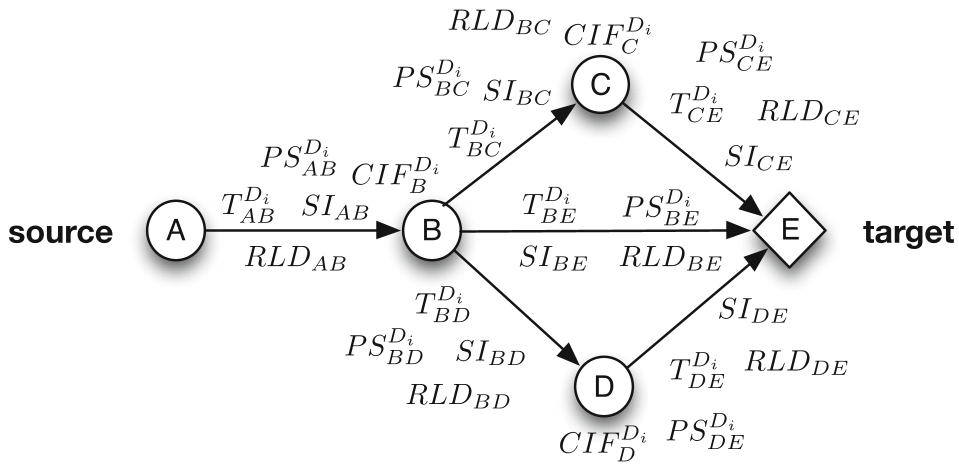
The authors argue that trust isn't just a number; it's a multi-dimensional "social context." They define QoTN (Quality of Trust Network) based on five pillars:
- Trust & Social Intimacy: History of direct interactions.
- Community Impact (CIF): Does this person have high expertise or social influence?
- Preference Similarity: Do and share common interests?
- Residential Distance: Physical proximity often correlates with higher real-world interaction probability.
The H-SCAN-K Architecture
The core innovation lies in the Heuristic Social Context-Aware Search. Unlike the previous H-SCAN, H-SCAN-K introduces:
- Bidirectional Search: Searching forward from the source and backward from the target simultaneously to meet in the middle.
- Marginal Node Optimization: It prevents the algorithm from missing "diamonds in the rough" (nodes just outside the top-K list with high potential) and trims "dead ends" (nodes that look promising but have no outgoing connections).
 Above: The influence of social context (location, preferences) on the probability of social connections.
Experimental Showdown: H-SCAN-K vs. The World
The researchers tested their algorithm on the Enron email dataset and Epinions trust network.
1. Efficiency vs. Quality (Performance Ratio)
Using a metric called the Performance Ratio (Utility / Execution Time), H-SCAN-K dominated its predecessors. While Random Walk and High-Degree searches struggled to find meaningful paths, H-SCAN-K identified high-trust paths in seconds.
2. Overcoming the Depth Barrier
While BFS methods became computationally infeasible at 4 hops, H-SCAN-K successfully navigated networks with over 100,000 links, delivering consistent results even as the search depth increased—effectively leveraging the "small-world" nature of human connections.
 Table showing H-SCAN-K+HS2 delivering superior performance ratios across different network IDs.
Critical Insight & Conclusion
The brilliance of H-SCAN-K is that it doesn't just treat social networks as dry mathematical graphs; it treats them as environments. By mapping social psychological principles (like preference similarity and social intimacy) into heuristic search weights, it bridges the gap between human intuition and algorithmic efficiency.
Future Outlook: As we move toward a "Web 3.0" or highly decentralized social ecosystem, algorithms like H-SCAN-K will be vital for automated recommendation systems where verifying the credibility of information is the ultimate currency.
Limitations: The model assumes that social context data (like location or expertise) is readily available. In an era of increased privacy constraints, mining these features remains a secondary challenge that needs to be addressed parallel to the search efficiency itself.