
MCTSE: Enhancing SIoT Security through Multi-Dimensional Contextual Trust
Context-Aware Trustworthy Service Evaluation in Social Internet of Things
The paper proposes the Mutual Context-aware Trustworthy Service Evaluation (MCTSE) model for Social Internet of Things (SIoT). It addresses the limitations of traditional trust models by integrating multi-dimensional contexts—device status, environment, and task types—to improve the accuracy of service provider and consumer evaluations.
Executive Summary
TL;DR: The Mutual Context-aware Trustworthy Service Evaluation (MCTSE) model introduces a paradigm shift in SIoT security by moving beyond static QoS metrics. By evaluating devices based on their Status (e.g., battery), Environment (time/place), and Task Type, it provides a robust framework that outperforms traditional models by over 10% in success rate, specifically thwarting sophisticated malicious attacks.
Background Positioning: This work builds upon the foundational SIoT concepts of Atzori et al., addressing a critical gap in existing subjective and objective trust models that fail to account for the situational "why" behind device behavior.
The "Context" Gap: Why Current SIoT Trust is Broken
Imagine a smartphone (Device A) and a tablet (Device B) both offering a video recording service. Standard trust models might rate them equally based on past performance. However, if Device A is currently at 5% battery (Status) or is about to leave the event premises (Environment), its actual trustworthiness for a long-duration task is near zero.
Existing literature typically overlooks these nuances, treating trust as a one-size-fits-all score. This lack of granularity creates vulnerabilities:
- Contextual Blindness: Dishonest devices can "farm" reputation on easy tasks and exploit it for high-value malicious actions.
- Static Analysis: Failure to account for the variance in behavior over time makes systems susceptible to "On-Off" attacks.
Methodology: The MCTSE Framework
The MCTSE model operates on a triple-context axis. It doesn't just ask "Is this device good?" but "Is this device good for this task, at this time, in this state?"
1. Conceptual Architecture
The authors define trust as a vector in a three-dimensional space:
- (Status): Energy levels and computational capacity.
- (Environment): Spatio-temporal availability.
- (Task Type): Categorical task requirements (e.g., Data sensing vs. Video processing).
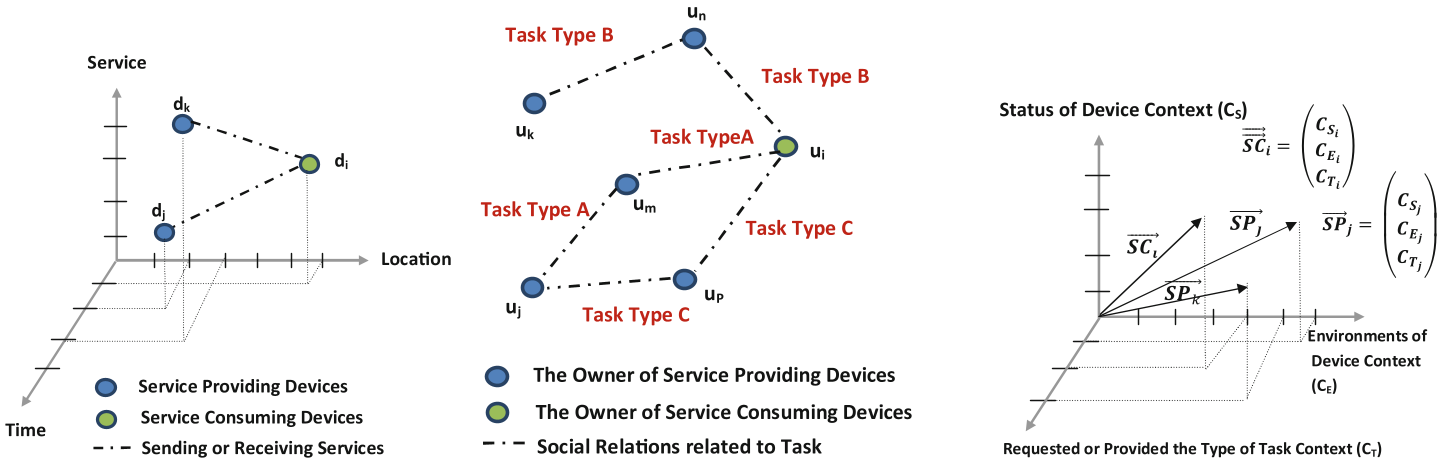
2. The Mutual Evaluation Mechanism
Unlike "top-down" models, MCTSE is mutual. Both the Service-Consumer () and Service-Provider () evaluate each other. The trust score () is a weighted combination of:
- Context-aware QoS Similarity (CQoSST): A cosine similarity between the expected requirements and the advertised capabilities.
- Context-aware Social Similarity (CSST): Analyzing friendship, community interest, and ownership relations between the device owners.
- Historical Variance: A crucial "penalty" term using . If a device's feedback score oscillates wildly (an indicator of On-Off attacks), its trust value is aggressively suppressed.
Experimental Validation: Resilience in Action
The researchers tested the model against 600 simulated devices, subjecting it to four classic attack vectors: Bad-Mouthing (BMA), Ballot-Stuffing (BSA), Self-Promoting (SPA), and On-Off (OOA).
Success Rate Comparison
The MCTSE model consistently maintained a higher success rate in selecting trustworthy services compared to the SOA and SubM/ObjM baselines.
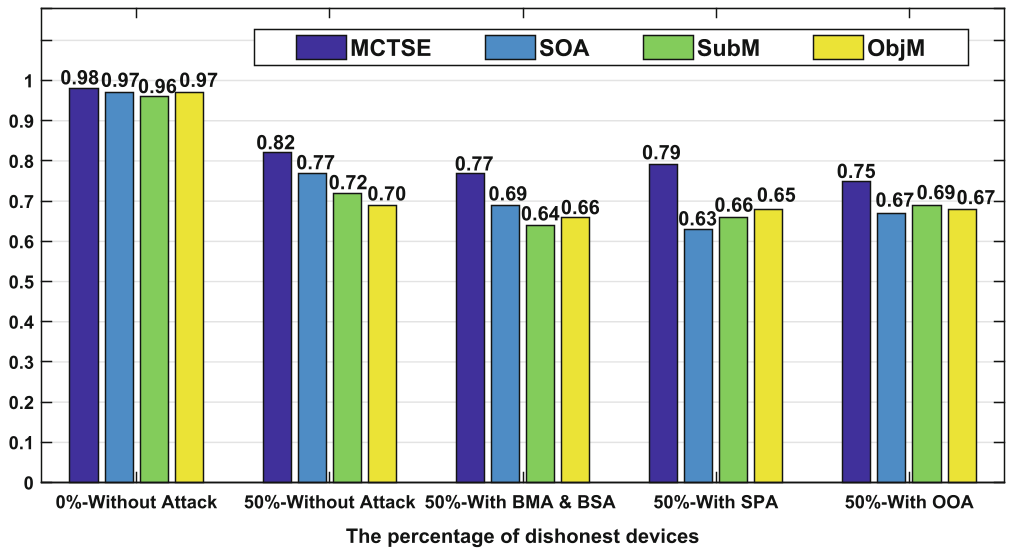
Devising an "Anti-Virus" for Trust
The most impressive result lies in the model's response to On-Off Attacks. When a device behaves well to gain trust and then shifts to malicious behavior, MCTSE’s variance mechanism detects the inconsistency immediately, dropping the trust score faster than traditional models which rely solely on simple moving averages.
Critical Insight & Conclusion
Takeaway: The core contribution of this paper is the mathematical formalization of "trust variance." By treating inconsistency as an explicit indicator of malice, MCTSE solves one of the hardest problems in IoT security: the "semi-honest" participant.
Limitations: The study relies on a synthetic dataset (Facebook-based user nodes). Real-world IoT behavior involves noisier data and heterogeneous network latencies that might impact the real-time calculation of cosine similarities.
Future Outlook: The integration of these context-aware metrics into a Recommendation System (MCTSR) is the next logical step, potentially enabling an automated, self-healing service marketplace in the SIoT.