
Beyond the Individual: Merging Pervasive Computing with Social Smart Spaces
Context-Aware User Preferences in Systems for Pervasive Computing and Social Networking
This paper introduces a framework for integrating context-aware user preferences across Pervasive Computing and Social Networking paradigms. By extending the concept of Personal Smart Spaces (PSS) into Cooperating Smart Spaces (CSS), the authors propose a system that learns both individual and community-level preferences to automate environment personalization.
TL;DR
This research tackles the convergence of Pervasive Computing and Social Networking. It moves beyond the "smart home" bubble to create "Cooperating Smart Spaces" (CSS) that understand not just what you want, but what your community prefers. By leveraging machine learning for preference extraction, the system can proactively adjust environments—like a "Proactive Disco" that changes music based on who is on the dance floor.
Contextual Intelligence: The Missing Link
For years, pervasive computing focused on the Personal Smart Space (PSS)—a bubble of devices (phones, laptops, smart sensors) that followed an individual. While effective for personal automation, it ignored a fundamental human reality: we are social creatures.
The authors argue that the next frontier is the integration of social graphs into our physical environment. The challenge is twofold:
- Learning without burdening: Users won't manually set thousands of rules; the system must infer them from behavior.
- Scaling to Communities: How do you define the "preference" of a group of 50 students in a lounge?
The Methodology: PSS to CSS
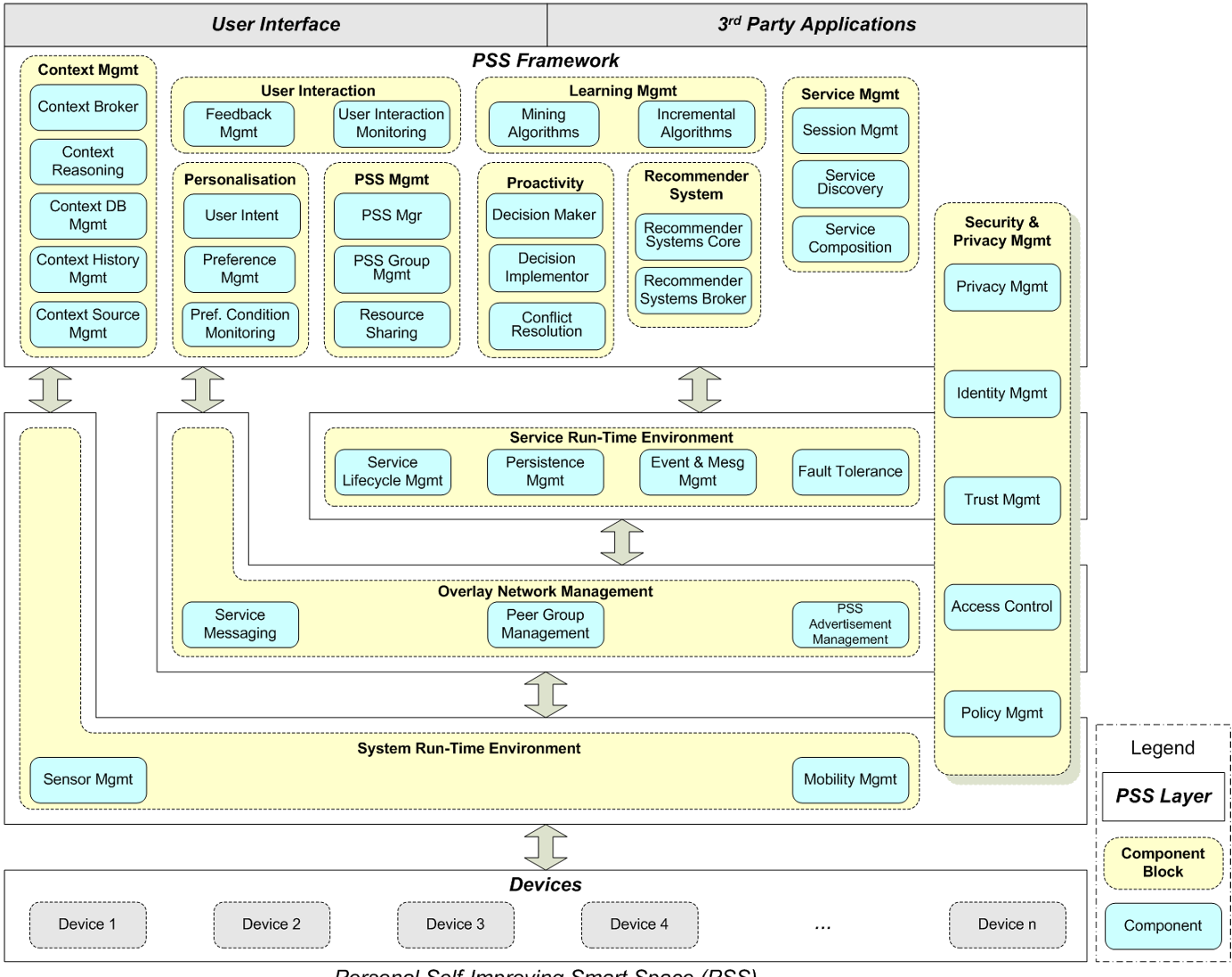
The core innovation is the transition from the PSS to the Cooperating Smart Space (CSS). This architecture allows devices to not only talk to their owner but to interact with "Foreign PSSs" to share services and context.
The Personalisation Subsystem
The system uses a dual-engine approach to decide what to do:
- Preference Manager: Manages explicit or learned rules (e.g., "If it's 9 PM and I'm in the living room, dim the lights").
- User Intent: Predicts sequences of actions based on historical patterns (e.g., "The user just grabbed their keys and it's Monday morning; they are likely heading to their 9 AM lecture").
Learning Collective Behavior
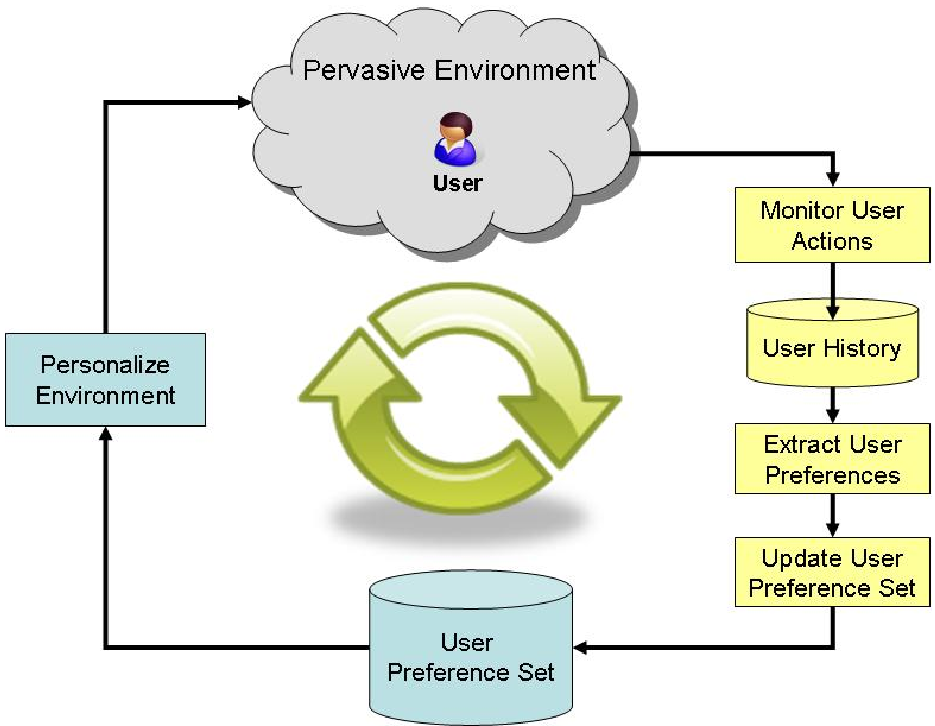
Capturing preferences is done through a two-speed learning process:
- Deep Data Mining (Offline): Analyzes long-term history, usually performed when the system is idle (e.g., at night).
- Incremental Learning (Online): Fast updates that respond to recent changes or resolve immediate conflicts.
Experiments: Proving the Proactivity
The authors tested their theories through a "TV Preference" experiment and a "Social Storyboard" evaluation.
- Precision: The system reached 100% accuracy in predicting TV channel preferences based on location (home vs. work) within just two learning iterations.
- The "Experience Effect": One of the most striking findings was the shift in user trust. Before trying the system, only 47% of participants wanted a system to take decisions for them. After seeing it in action, this jumped to 77%. This suggests that "proactivity anxiety" can be overcome through reliable, high-quality automation.
Deep Insight: Community Inheritance
The paper introduces a fascinating concept: Preference Inheritance. Just as a programmer inherits classes in code, a student joining a "Computer Science" community could automatically inherit the community's preference for the best lunch spot or preferred study ambient noise levels. This drastically reduces the "Cold Start" problem for new users in smart environments.
Critical Analysis & Conclusion
While the paper presents a robust vision, two challenges remain:
- Conflict Resolution: If the "Community Preference" says "Play Jazz" but the "Individual Preference" says "Silence," who wins? The authors point toward "Proactivity Subsystems" and arbitration, but the social cost of these decisions is high.
- Privacy/Scalability: Moving preference data to the cloud for community analysis (as mentioned in the Societies project update) introduces significant privacy hurdles.
The Takeaway: Personalization is no longer a solo sport. The transition from PSS to CSS represents a shift toward a world where our social identity and physical context are computationally linked, enabling environments that adapt to "us" as much as they adapt to "me."