
Connecting the Real World: Context-Driven Discovery in Mobile Social Networks
Context-Driven Mobile Social Network Discovery System
The paper introduces the "Context-driven Mobile Social Network Discovery System," a mobile platform designed to detect and recommend nearby social activities (Themes) in real-time. By leveraging a weighted context-quantization mechanism and a C/S architecture, it achieves proactive social resource discovery on smart mobile devices.
TL;DR
Social networking is moving from the desktop to the street. This paper presents a system that doesn't just wait for you to search for friends; it actively senses your environment (proximity via WiFi, calendar, and past habits) to recommend "Themes"—live social events happening right around you. By using a smart weighting algorithm, it filters out the noise and helps you build lasting professional and personal relationships in real-time.
Background & Motivation: Beyond the Digital Screen
While platforms like Facebook have revolutionized online interaction, they often fail to bridge the gap to physical social communities. We often sit in a cafe or attend a conference completely unaware that a person with our exact interests is sitting ten feet away.
The authors identify two major hurdles in current mobile social systems:
- Information Overload: Web-based systems push too much irrelevant data.
- Context Blindness: Systems don't understand the "here and now"—the specific time, place, and personal state of the user.
Methodology: The Theme Awareness Procedure
The core innovation lies in the Theme Awareness Procedure. The system defines a "Theme" as a bounded social environment (time and space) and an "Actor" as the user.
1. The Multi-Factor Context Model
Instead of relying solely on GPS, the system quantizes context into eight identifiers:
- Environmental: Distance (measured via WiFi RSSI), Calendar Schedulers, Business Card Tags, and Join History.
- Personal: Friend Recommendations, Souvenirs/Incentives, Celebrity Attendance, and Satisfaction Grades.
2. The Learning Weight Mechanism
The system calculates a "Recommendation Score" () for each nearby event. What makes this "Senior Academic" grade is the dynamic adjustment. If a user rejects a recommendation, the system assumes its weights () are misaligned with the user's current priorities and recalculates them based on the user's actual choice.
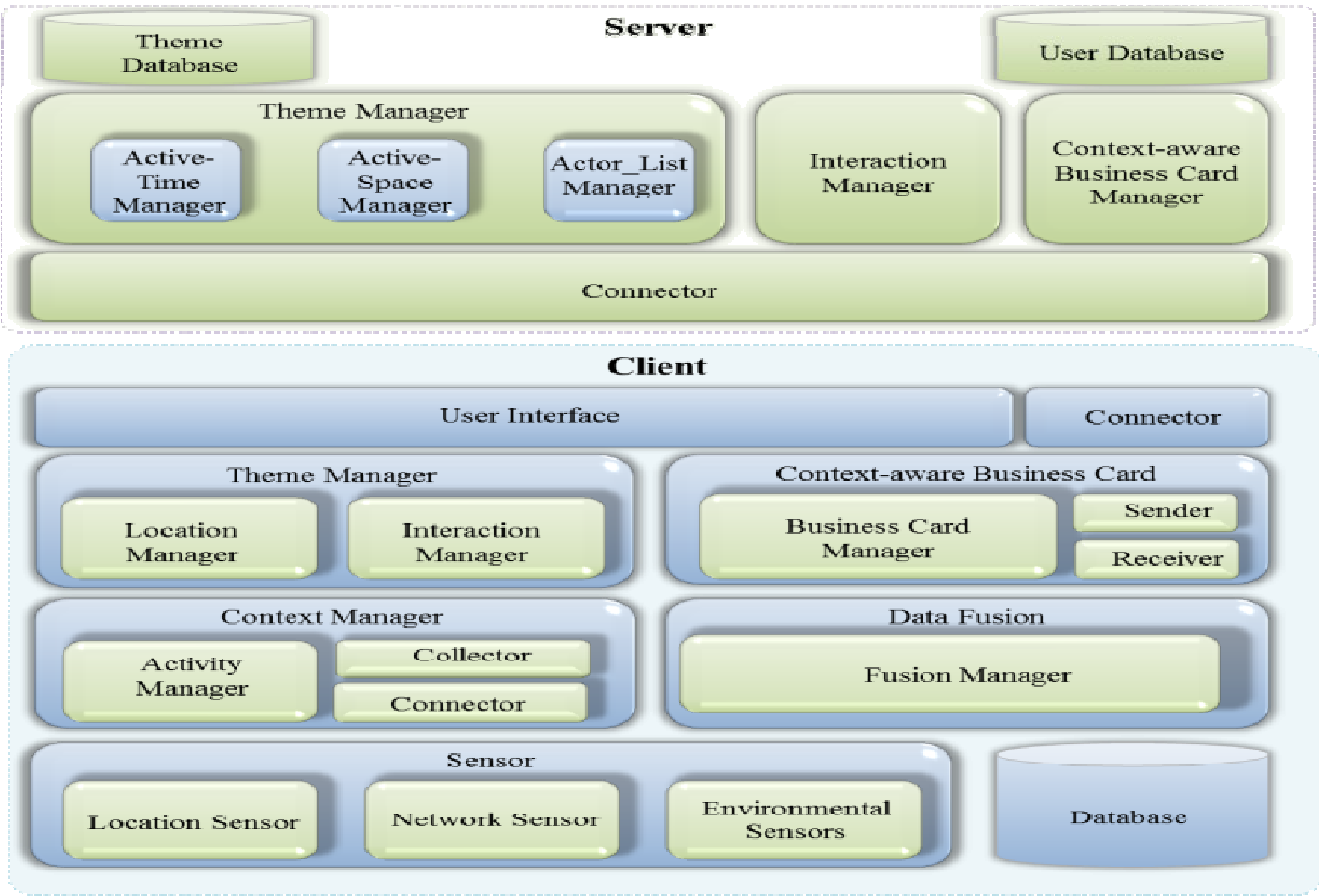 Figure 1: The C/S Architecture showing the interaction between the mobile Sensor/Context Manager and the Server-side Theme Manager.
System Implementation & User Experience
The system was prototyped on the Android platform. A standout feature is the Context-aware Business Card. Unlike a static VCF file, these cards are exchanged within the "Theme" context, automatically recording the where, when, and who of the encounter, making future relationship management significantly easier.
 Figure 2: Implementation on Android, showing the transition from map-based discovery to context-aware exchange.
Critical Insight & Evaluation
The "Academic SOTA" value here is the attempt to solve the Cold Start and Information Relevancy problems in mobile environments. By using WiFi RSSI as a proxy for distance, the system creates a "Geofence" that naturally limits information overload—once you leave the area, the service stops, ensuring your notification tray doesn't get cluttered with distant, irrelevant noise.
Limitations & Future Outlook
While the weighted quantization is elegant, it relies on manual rejection to learn. Future iterations could benefit from Unsupervised Learning to predict user intent even before a rejection occurs. Additionally, as privacy concerns grow, moving the "Context Manager" entirely to edge-processing (on-device) would be the next logical step for such a system.
Conclusion
The Context-driven Mobile Social Network Discovery System represents a shift towards Proactive Computing. By understanding the nuances of a user's environment and schedule, it transforms the mobile device from a communication tool into a social catalyst.