
Beyond the Name Database: Context-Sensitive Gender Inference with Cascading Transformers
Context-sensitive gender inference of named entities in text
The paper introduces a novel context-sensitive gender inference approach for named entities using a "Cascading Transformer" architecture. By modeling the task as a sequence labeling problem rather than a simple database lookup, the authors achieve SOTA results on four new open-source benchmarks (CoNLL-g, Wiki-g, IEER-g, Textbook-g).
TL;DR
Researchers from IIT Kharagpur have moved gender tagging from static database lookups to a dynamic, context-aware sequence labeling task. By introducing the Bidirectional Cascading Transformer, they utilize the surrounding text to distinguish gender for ambiguous names like "Taylor" or "Jordan," outperforming commercial APIs and fine-tuned BERT models.
The Problem with Being "Context-Blind"
For years, gender inference has been "database-reliant." If your name is in a list of 100 million names, the system guesses your gender based on majority statistics. This approach has three fatal flaws:
- Cultural parochialism: Databases often fail on non-Western naming conventions.
- Ambiguity: A name like "Taylor" is statistically female in many databases, but the sentence "Taylor is a kind boy" provides a clear, contradictory signal that database-reliant systems ignore.
- Static nature: Language and naming trends evolve, but databases are expensive to maintain and update.
The authors argue that gender is not just an attribute of a name, but a property of the context in which that name appears.
Methodology: The Cascading Architecture
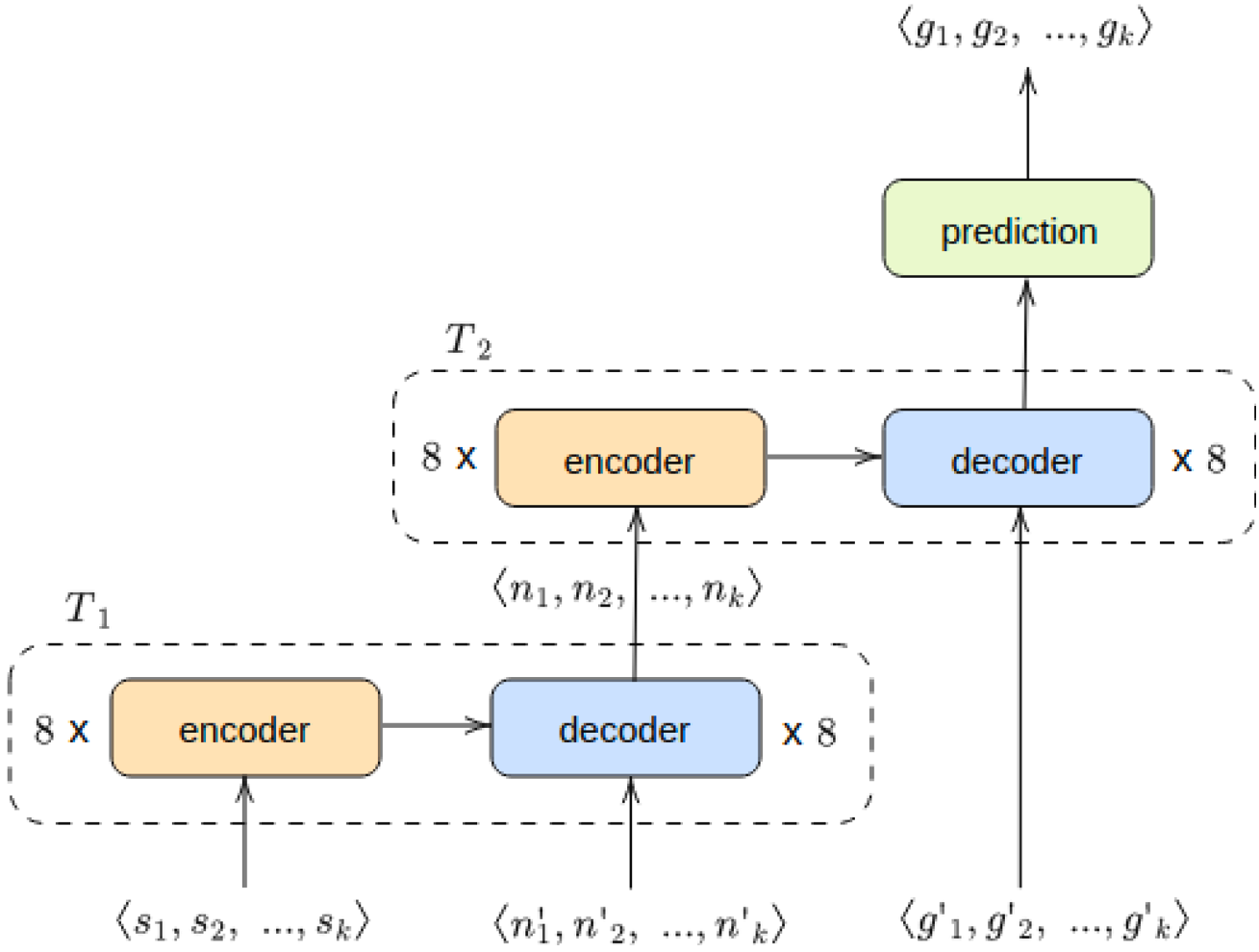
The core innovation is the Cascading Transformer. Unlike a standard transformer that might try to solve everything at once, this model recognizes that gender inference is a two-step hierarchical problem:
- Sub-task: Where are the "PERSON" entities? (NER)
- Main task: Given these persons, what is their gender based on the surrounding words (e.g., pronouns like "he/she" or nouns like "boy/girl")?
Architecture Breakdown
The model uses two connected transformers ( and ):
- : Focused on NER. Its decoder output provides a filtered representation of where names exist.
- : Takes the hidden states from and focuses exclusively on assigning gender tags.
- Bidirectionality: By using a Bidirectional Cascading Transformer (BiCTransformer), the model looks at both preceding and succeeding tokens, allowing the decoder to capture "future" context that might contain a decisive pronoun.
Experimental Results & Performance
The authors benchmarked their model against heavyweight competitors:
- Commercial APIs: Gender Guesser and Genderize.
- Deep Learning Baselines: BiLSTM, Vanilla Transformers, BERT-Base, and BERT-BiLSTM-CRF.
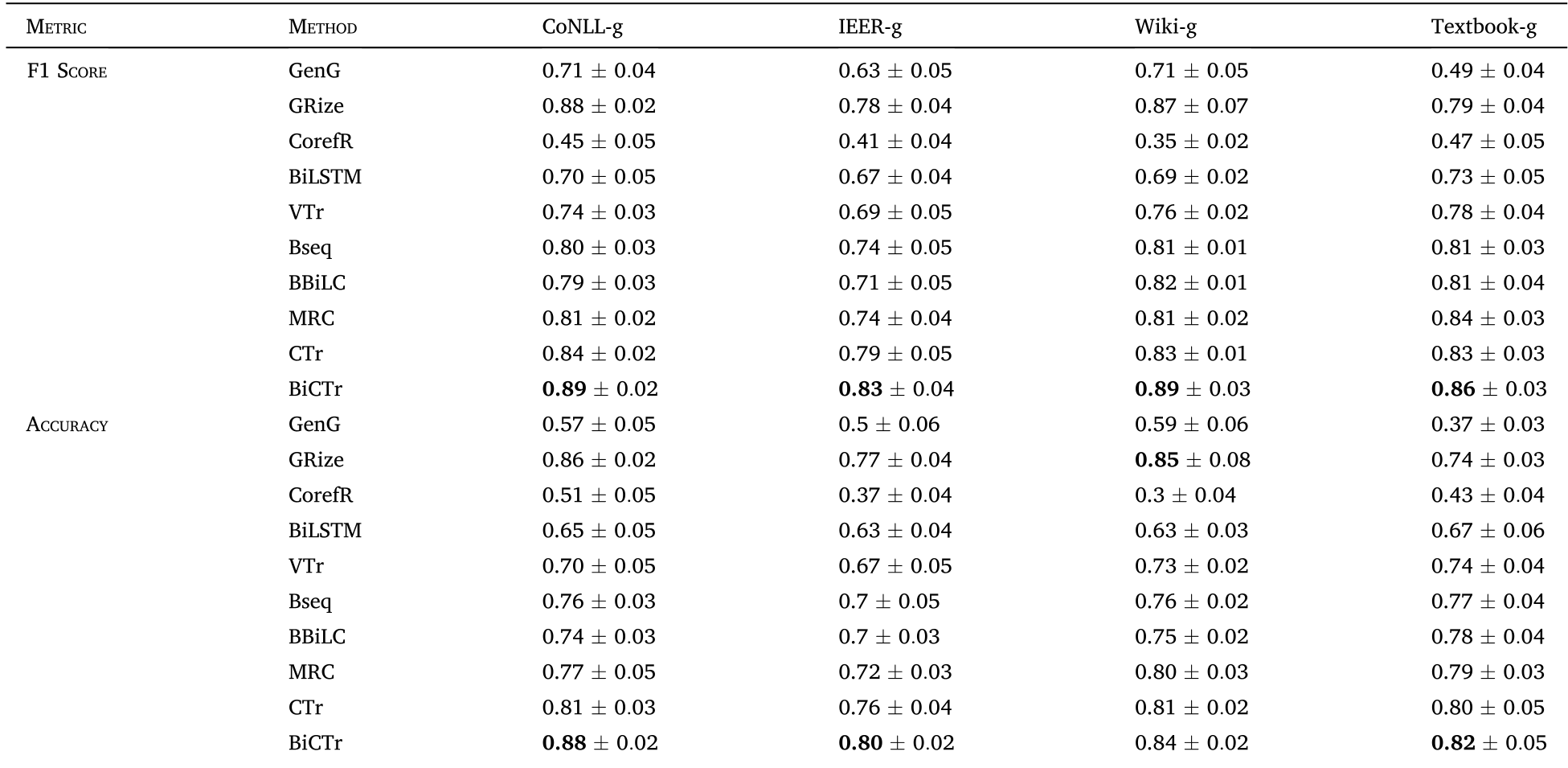
The results across four datasets (CoNLL-g, Wiki-g, IEER-g, and Textbook-g) were decisive.
| Dataset | BiCTransformer (F1) | Genderize API (F1) | BERT Sequential (F1) |
|---|---|---|---|
| CoNLL-g | 0.89 | 0.88 | 0.80 |
| Wiki-g | 0.89 | 0.87 | 0.81 |
| Textbook-g | 0.86 | 0.79 | 0.81 |
Why the "Textbook" Dataset Matters
The most impressive jump was in the Textbook-g dataset. Textbooks contain names from diverse global origins. While commercial databases struggled with this variety (falling to 0.79 F1), the BiCTransformer maintained 0.86 F1 by relying on linguistic structure rather than just a name-list.
Critical Insight: The Gender Bias in Training Data
The authors also performed a "fortuitous" audit of classic NER datasets. They found a massive gender imbalance:
- Male entities: 77% – 86% of the datasets.
- Female entities: Only 12% – 20%.
This imbalance explains why AI models (including NER) are historically better at identifying men than women. By providing these four new gender-tagged datasets, the authors help the community move toward more equitable and accurate NLP.
Conclusion and Limitations
The study assumes a binary gender model for simplicity, which is a noted limitation given the increasing recognition of non-binary identities in modern text. However, as a replacement for the legacy "name-lookup" system, the Cascading Transformer sets a new standard for accuracy by proving that the text surrounding a person is just as important as the name itself.
Future Work: Integrating this into Coreference Resolution systems could significantly reduce errors in tracking "who is who" in complex narratives.