
Beyond Homophily: Using Context Specificity to Decipher Social Network Profiles
Context Specificity Matters: Profile Attributes Prediction for Social Network Users
The paper introduces "Context Specificity," a novel node property for social network attribute prediction (gender, age, occupation, income). It proposes Distr2-CS-XGB, a supervised method utilizing distributional features and context importance, achieving state-of-the-art performance across VK, Twitter, and Pokec datasets.
TL;DR
Predicting a user's age, income, or occupation from social graphs usually relies on the principle of homophily—the idea that you are similar to your friends. However, this paper argues that whom you follow matters less than how specific that follower-set is. By introducing a metric called Context Specificity, the authors provide a way to filter out the noise of "generic" connections (like following the news) and focus on "informative" ones (like a niche yacht club) to significantly improve demographic prediction.
The "Loudness" of Generic Contexts
In the world of Social Network Analysis (SNA), we often use Label Propagation or Graph Neural Networks (GNNs) to fill in missing user profile data. The pain point is simple: Generic neighbors dilute the signal.
If a user follows a major national news outlet, that "edge" tells us nothing about their income level because everyone follows the news. However, if they follow a specific high-end hobbyist group, that edge is a high-signal feature. Prior works like DeepWalk or standard GCNs often struggle to discount these low-information nodes automatically, leading to sub-optimal embeddings.
Methodology: The Math of "Informativeness"
The core contribution is the formalization of Context Specificity (). The authors use the Kullback–Leibler (KL) Divergence to calculate this.
1. The Specificity Metric
The specificity of a node is defined by how much its neighborhood's attribute distribution differs from the global label distribution .
- Low Specificity: A node whose neighbors look exactly like a random sample of the population.
- High Specificity: A node whose neighbors are heavily skewed toward a specific attribute (e.g., almost all are doctors).
2. Distr2-CS Features
The authors propose a new feature vector, Distr2-CS, which aggregates attribute values from a user's 2-step neighborhood. Unlike standard counts, each neighbor's contribution is weighted by its "relative pairwise context specificity."
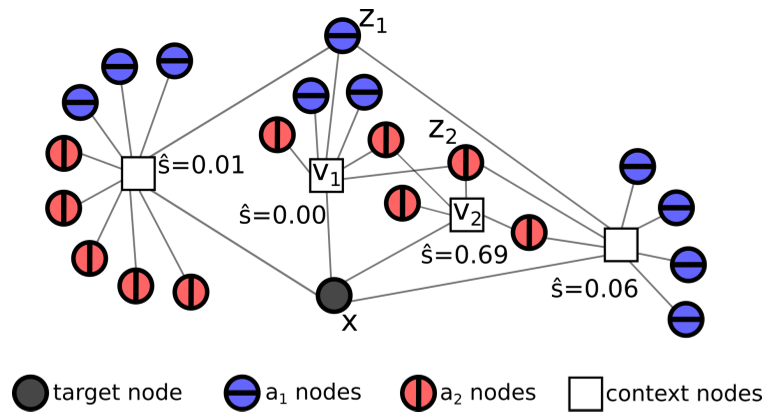 In the figure above, node is highly specific because it connects almost exclusively to "red" nodes, making it a powerful predictor for target node , whereas is generic and thus ignored.
Experiments: Enhancing the Baselines
The researchers didn't just build a new method; they "upgraded" existing ones:
- LP-CS[2]: Label propagation where the second step is weighted by specificity.
- GConv-CS: A GNN where the L2 norm of the learnable embeddings is regularized by context specificity—essentially forcing the model to pay more attention to specific nodes.
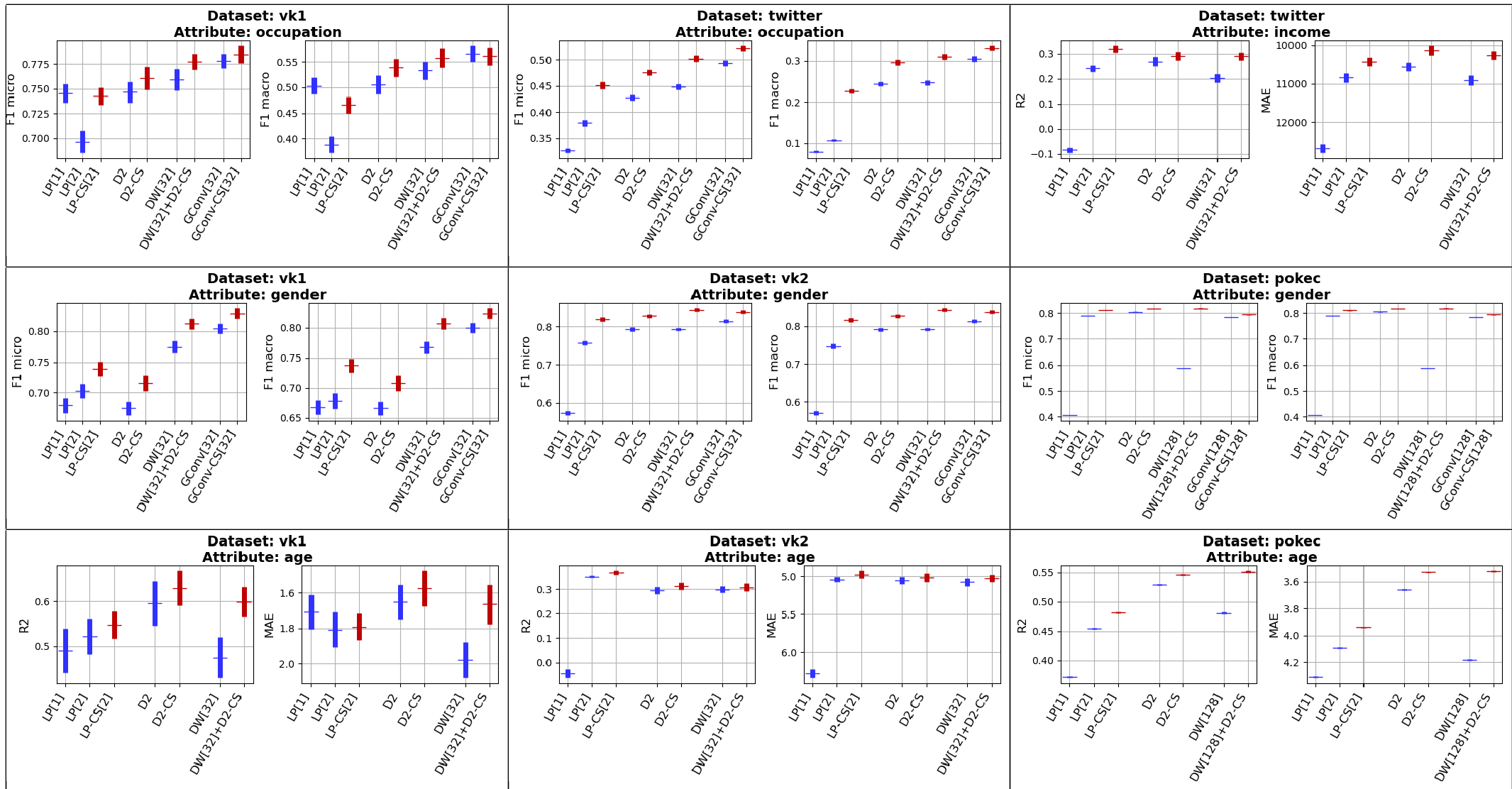
The results across VK, Twitter, and Pokec show a consistent trend: adding Context Specificity (CS) markers consistently pushes the F1-score and values higher. Particularly in gender and occupation classification, the "CS" versions of DeepWalk and GNNs outperformed their "Vanilla" counterparts.
Critical Analysis & Conclusion
The Takeaway
The genius of Context Specificity lies in its simplicity. It treats the social graph not just as a topological structure, but as a distribution of information. By measuring the "surprise" ( divergence) of a node's local community, we can automatically filter the signal from the noise.
Limitations
- Cold Start: The method relies on a "seed set" of labeled nodes to calculate the global distribution. If the initial labels are biased or too few, the specificity calculations might be skewed.
- Computational Overhead: Calculating KL divergence for every node context adds a preprocessing step, though the authors suggest this is manageable for the gains achieved.
Future Work
This framework is ripe for expansion into Multi-modal Learning (combining specificity with text/image features) and Dynamic Graphs, where the "informativeness" of a context might change over time as trends shift.
For developers and researchers in Recommender Systems, this paper is a reminder: It’s not just about who you know, but how unique those connections are.