
CARE: Beyond Single-Object Vision and Single-Answer Dialog
Exploring Contextual-Aware Representation and Linguistic-Diverse Expression for Visual Dialog
The paper introduces CARE (Contextual-Aware Representation and linguistic-diverse Expression), a plug-and-play framework for Visual Dialog. It combines a Contextual-based Graph Embedding (CGE) to merge object-level features with environmental grid features and a Curriculum Contrastive Learning (CCL) strategy to handle multiple semantically identical but linguistically diverse answers, achieving SOTA results on VisDial V1.0 (4.63% NDCG improvement).
TL;DR
Researchers from UESTC have proposed CARE, a novel framework that tackles two major hurdles in Visual Dialog: the lack of environmental context and the rigid "one-answer" training bottleneck. By integrating Contextual-based Graph Embedding (CGE) and Curriculum Contrastive Learning (CCL), the model learns to "see" the background and "understand" that a single question can have many valid, semantically identical answers.
Problem & Motivation: The Silo Effect in Visual Dialog
Current Visual Dialog (VisDial) agents are often "nearsighted." They focus heavily on object regions (bounding boxes) while ignoring the environmental context. For instance, a "man" might be a "fan" if the background is a stadium, or a "player" if the background is a grass field.
Furthermore, these models are typically trained using a single-answer classification loss. In real human conversation, the same meaning can be expressed in dozens of ways. Standard models penalize these "correct but not identical" answers, stifling the model's generalization and linguistic flexibility.
Methodology: The CARE Framework
1. Contextual-based Graph Embedding (CGE)
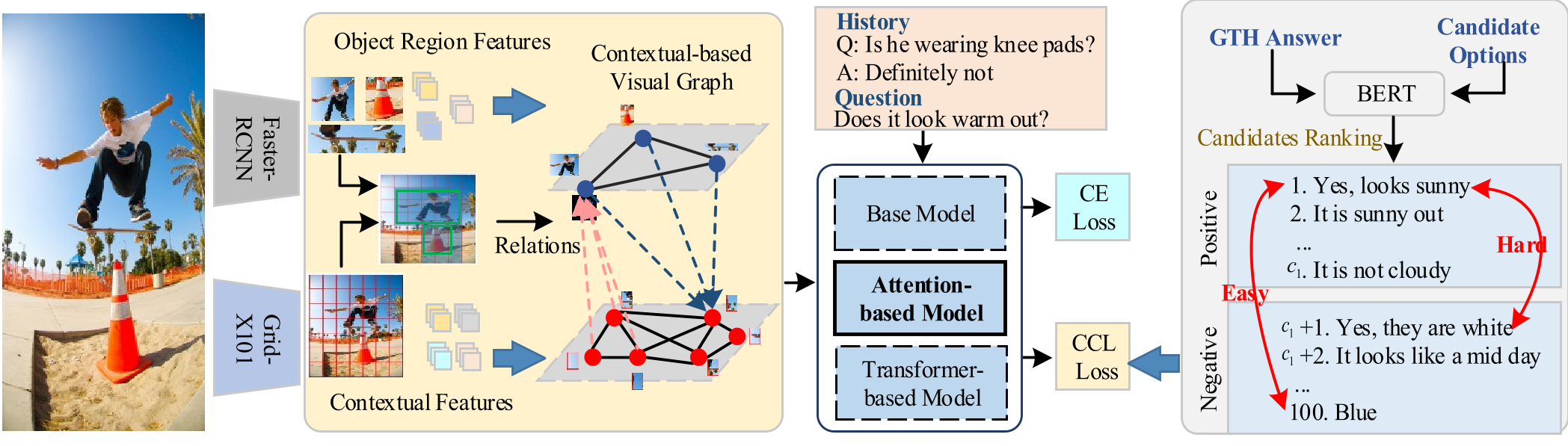
Instead of just looking at isolated objects, CGE creates a bridge between local regions (from Faster R-CNN) and global grid features (from ResNeXt-101).
- Spatial Overlap: The model builds a graph where nodes are connected if an object region overlaps with a grid cell.
- Masked Attention: A specialized multi-head attention mechanism uses this graph to filter out irrelevant background noise, effectively "describing" objects through their surrounding environment.
2. Curriculum Contrastive Learning (CCL)
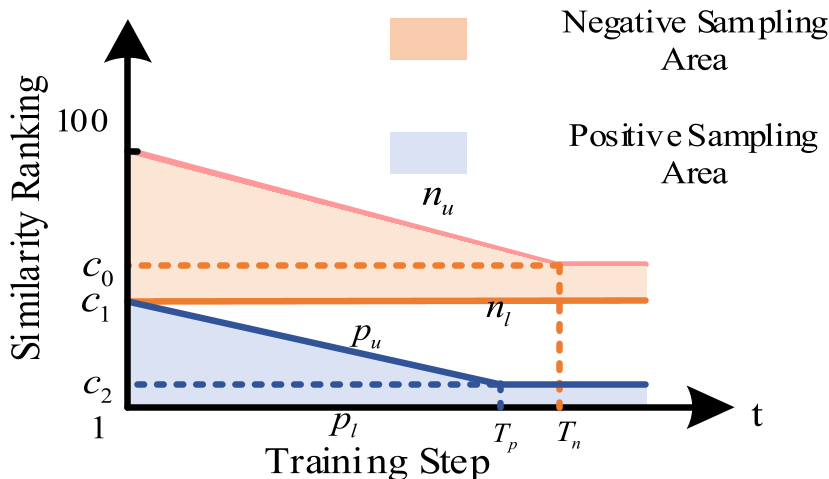
To solve the "single-answer" problem, the authors treat VisDial as a ranking task that evolves.
- Semantic Ranking: They use BERT to rank all 100 candidate answers based on semantic similarity to the ground truth.
- The Pacing Function: Inspired by human learning, the model starts by distinguishing the true answer from obviously wrong choices (easy). As training progresses, it is challenged to distinguish between subtle differences (hard) and to recognize multiple top-ranked candidates as "positive" samples.
Experiments & Results: SOTA Performance
The CARE framework is plug-and-play, meaning it can be added to existing architectures like RvA or MVAN.
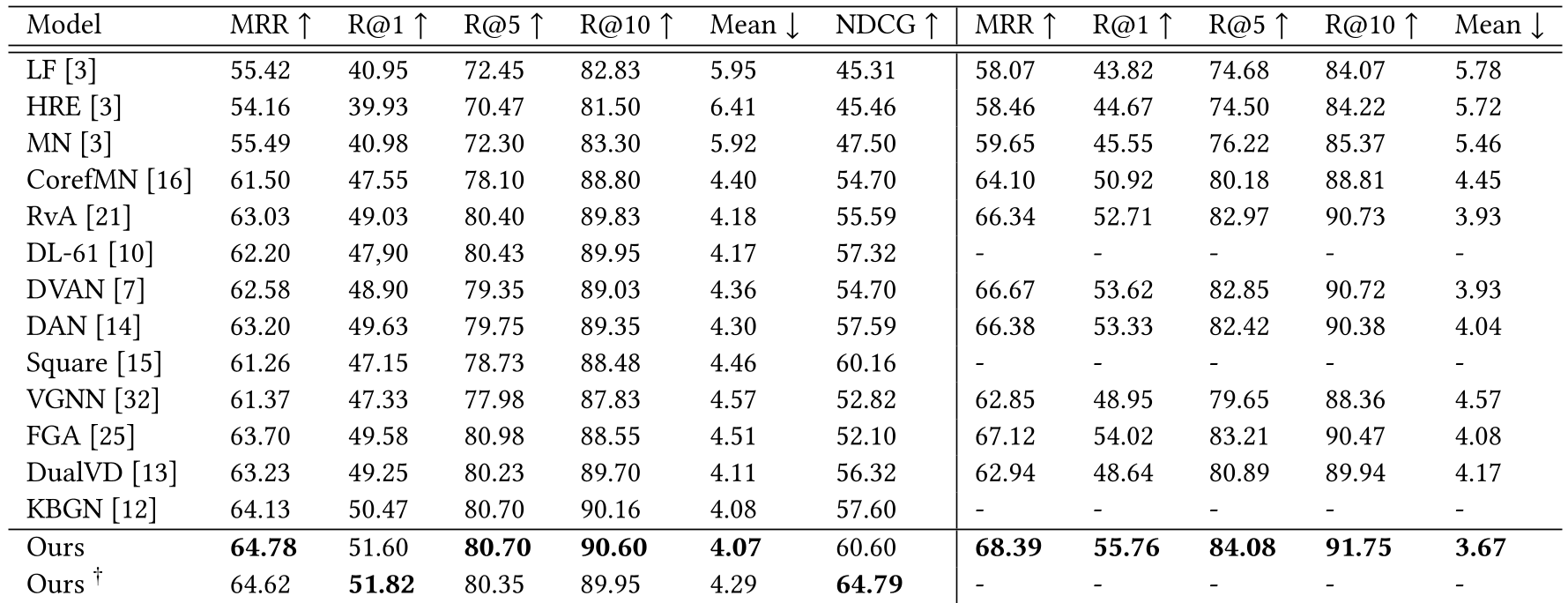
- VisDial V1.0: CARE achieved an NDCG of 60.60%, a massive leap over baseline models. This score specifically measures the model's ability to rank multiple "good" answers highly.
- Contextual Reasoning: In a specialized test on "context-aware" questions (questions about weather, safety, or indoor/outdoor settings), CGE improved R@1 accuracy by 1.69%, proving its ability to leverage background clues.
Visualizing Success
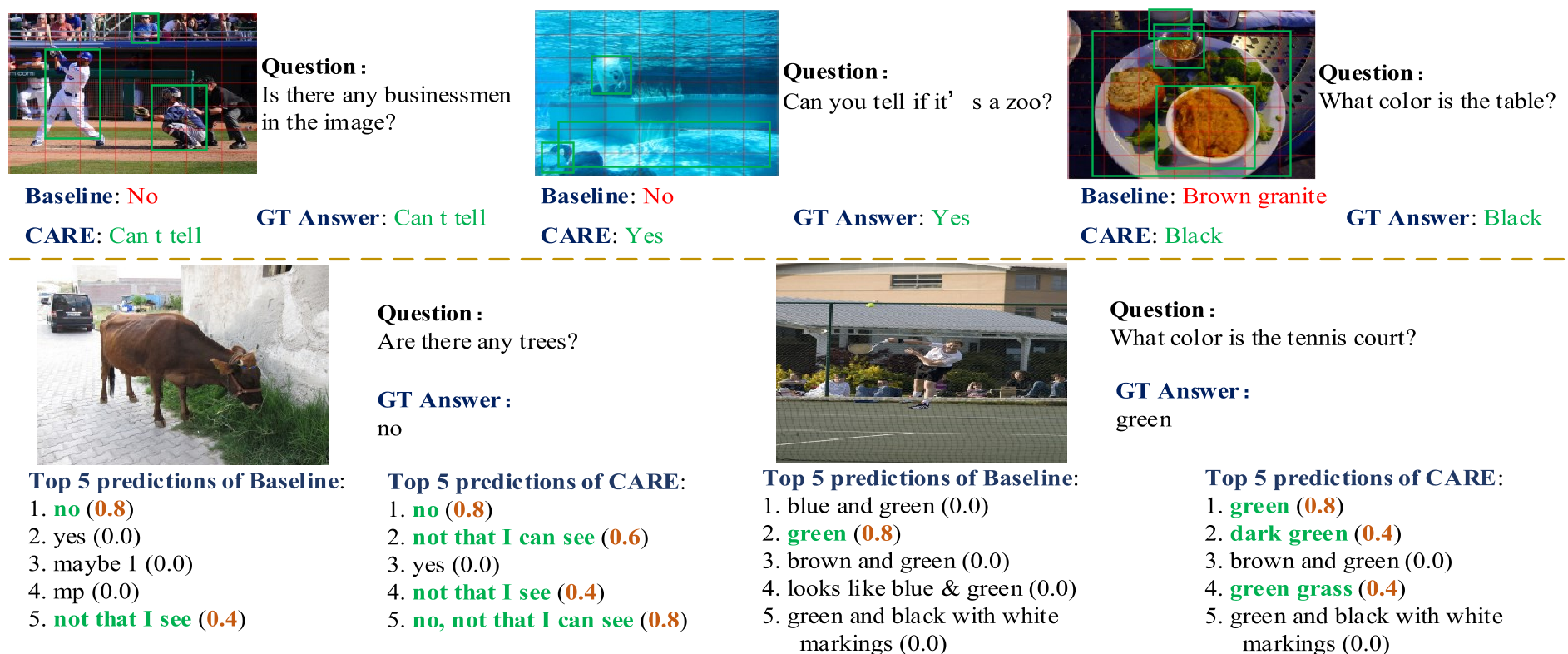
Qualitative results show that CARE identifies colors and locations more accurately. For example, it correctly infers a plate is on a "black table" by looking at neighboring visual contexts, even when the table's shape is fragmented.
Critical Analysis & Conclusion
Takeaway: The real value of CARE lies in its rejection of the "one-hot" label mentality. By using semantic similarity and environmental graphs, it moves the field closer to how humans actually perceive and communicate.
Limitations: While CARE improves generalization (NDCG), adding a generative decoder (Ours†) can sometimes slightly decrease strict ranking accuracy (MRR). This suggests a continuing trade-off between "being exactly right" according to one annotator and "being generally sensible" according to many.
Future Work: This framework could be easily extended to multi-modal pre-training (like CLIP or BLIP) to further enhance its semantic understanding of linguistic diversity.