
Beyond Topology: Leveraging Spatiotemporal Context for Better Link Prediction in LBSNs
Contextual Feature Analysis to Improve Link Prediction for Location Based Social Networks
The paper introduces five new contextual features (CCC, TCFC, TCFCC, CCCP, CCCPR) to enhance link prediction in Location-Based Social Networks (LBSNs). By leveraging spatiotemporal check-in data and common friend details, the authors achieved an improved ROC-AUC score, outperforming previous SOTA results on the Gowalla dataset.
TL;DR
Predicting who will become friends in a digital world is no longer just about "who you know," but "where and when you go." This paper proposes five novel contextual features—anchored in time, place categories, and common friend closeness—that significantly boost the accuracy of link prediction in Location-Based Social Networks (LBSNs). Using the Gowalla dataset, the authors demonstrate that temporal co-location and lifestyle similarity are the "missing links" in traditional social network analysis.
The Evolution of Social Ties: Why Topology Isn't Enough
In the early days of Social Network Analysis (SNA), link prediction was a game of graph theory. If Alice and Bob share many friends, they are likely to connect. However, the rise of LBSNs (Foursquare, Gowalla, Facebook Places) added a vital third dimension: Location.
The authors argue that prior works often over-simplified location. Simply visiting the same park doesn't make you likely friends. But visiting that park at the same time or having common friends who frequently hang out with both of you creates a much stronger Inductive Bias for a future social tie.
Methodology: The "Contextual" Secret Sauce
The core contribution lies in five new features designed to capture the "intensity" and "style" of human interaction:
1. The Temporal Pulse: Common Check-in Count (CCC)
While others looked at shared locations, this paper introduces a 1-hour threshold. If two users check in at the same venue within 60 minutes, it’s not just a coincidence; it’s a potential real-world encounter.
2. Weighted Social Ties: TCFC & TCFCC
Not all common friends are equal. The authors argue that if your common friend is "closer" to you (measured by check-in frequency), they are more likely to act as a bridge.
3. Lifestyle DNA: CCCP & CCCPR
By analyzing "Place Categories," the model determines if users have similar lifestyles. Do they both frequent gyms and libraries? This cosine similarity of check-in habits provides a "semantic" layer to the prediction.

Experiments & SOTA Results
The authors tested their methodology on a massive dataset from Gowalla, categorizing candidates into four groups:
- FOF (Friend-of-Friends): Purely topological candidates.
- PF (Place-Friends): Users who share a location but no friends.
- BF (Both-Friends): The intersection of both.
- WG (Whole Group): All potential pairs.
Key Performance Wins
Using a Bayesian Network classifier, the proposed features consistently outperformed the literature:
- Accuracy Gain: In the FOF category, the AUC rose to 0.948, significantly beating the baseline of 0.918.
- Generalization: Even in the "Whole Group" scenario where data is extremely imbalanced, the model maintained an AUC of 0.955.
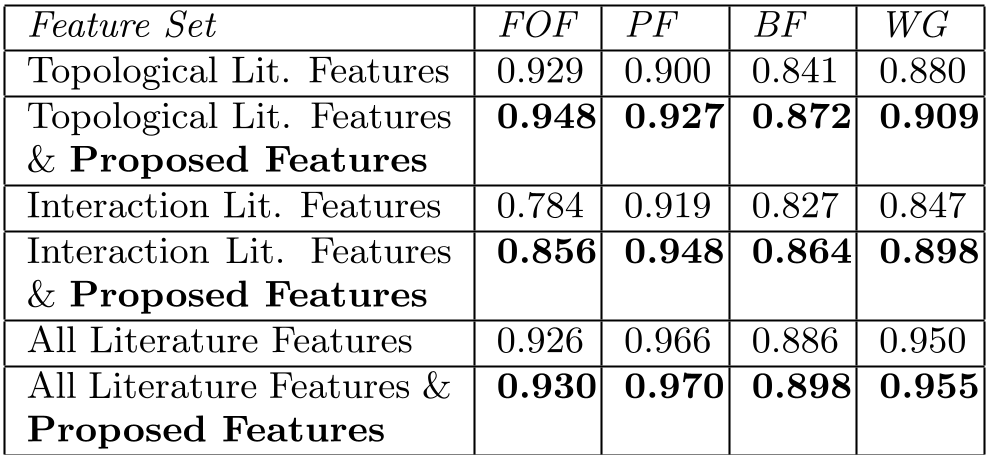
The ablation study (Table 8 in the paper) reveals that CCC (Common Check-in Count) and TCFC (Total Common Friend Closeness) are the most critical features across almost all sub-groups, proving that "immediate context" is king.
Critical Insight: The "Small World" vs. "Physical World"
The most striking takeaway is the performance in the PF (Place-Friends) group. Traditional models struggle here because there are no mutual friends to rely on. By using contextual place data, the authors pushed the AUC to 0.970.
The Lesson for Product Owners: If you are building a recommendation engine for an LBSN, don't just look at a user's contact list. Look at who is standing in the same coffee shop at 8:00 AM every Tuesday. That is where the next social link will be born.
Conclusion & Future Work
The paper successfully demonstrates that augmenting topological data with spatiotemporal context turns a difficult prediction problem into a highly accurate one. While the study relies on classical supervised learning (Bayesian Nets, Random Forest), the features themselves are the stars.
Limitations: The 1-hour threshold for CCC is empirical; future work could explore dynamic temporal windows or use Deep Learning to automatically learn these weights from raw trajectories.