
Beyond the Opt-Out: Why Facebook's Friendship Pages Triggered a Privacy Backlash
Using contextual integrity to examine interpersonal information boundary on social network sites
This study applies Nissenbaum's Theory of Contextual Integrity (CI) to investigate interpersonal privacy concerns on Social Network Sites (SNS). By analyzing 1,463 user comments regarding Facebook's "Friendship Pages," the authors identify how automated data aggregation violates informational norms and social expectations.
TL;DR
Information privacy is often misunderstood as a simple "on/off" switch for data visibility. This paper argues that privacy is actually about Contextual Integrity—the preservation of social norms. By examining Facebook’s "Friendship Pages," the researchers demonstrate that even when no "new" data is exposed, the act of aggregating and decontextualizing social interactions can feel like a profound invasive violation.
The "Communal" Privacy Gap
In the ecosystem of Social Network Sites (SNS), your privacy is no longer yours alone. It is a shared commodity. When a friend tags you in a photo or checks you in at a location, they become "co-owners" of your personal data. The authors highlight a critical gap in HCI research: we know users are frustrated, but we don't fully understand the theoretical triggers that make a technical feature feel "creepy."
The Analytical Lens: Contextual Integrity (CI)
To solve this, the study employs Helen Nissenbaum’s CI theory, which posits that privacy is respected when "informational norms" are maintained. These norms are defined by four parameters:
- Context: The social setting (e.g., family, work, romance).
- Actors: Senders, recipients, and the subject.
- Attributes: The specific type of information.
- Transmission Principles: The rules governing how information moves.
Methodology: Listening to the "Wild"
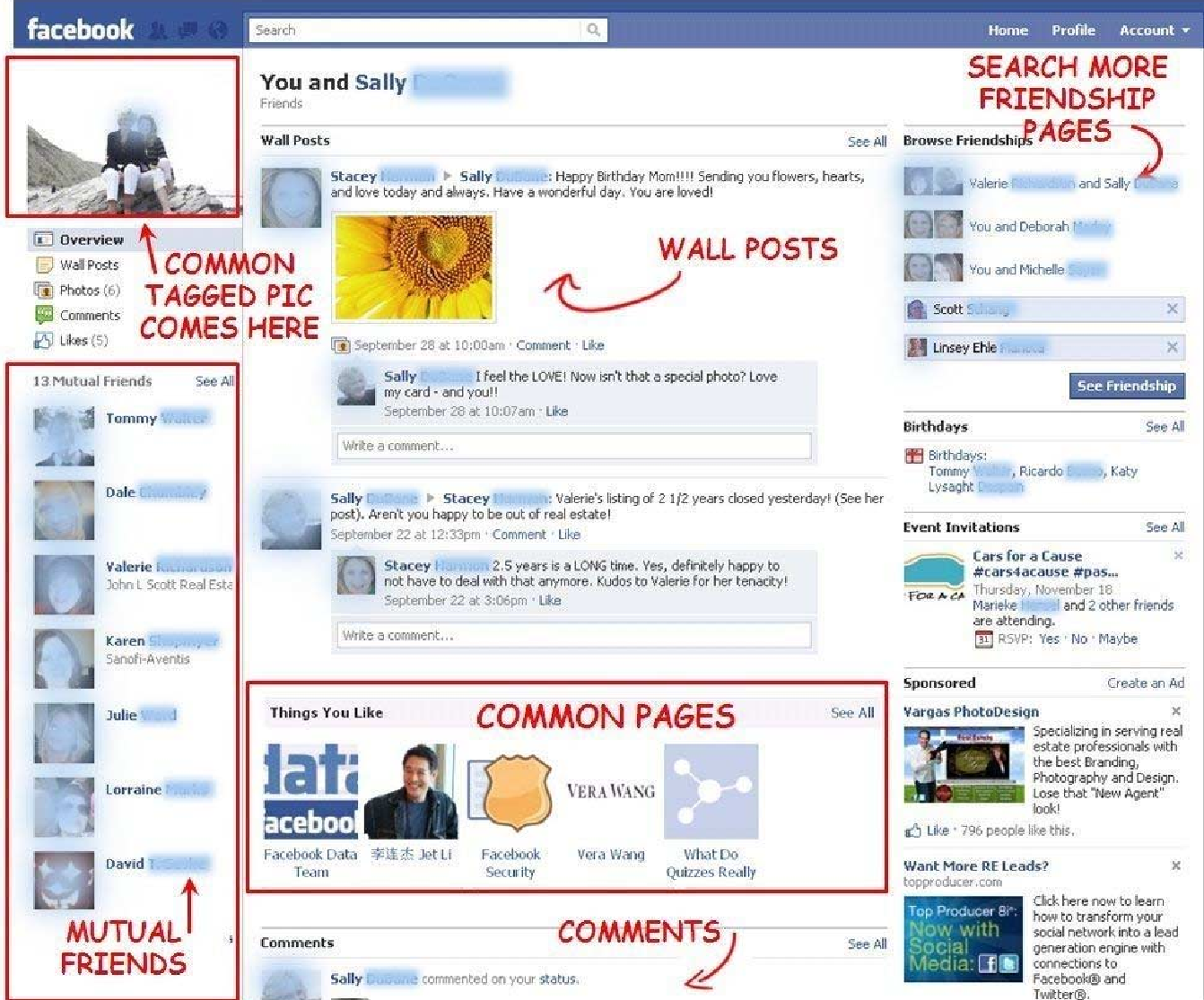
Instead of a controlled lab study, the authors analyzed 1,463 raw comments from Facebook’s official blog following the launch of "Friendship Pages"—a feature that creates a dedicated timeline for interactions between two specific users.
Core Insights: When Quantity Becomes (Bad) Quality
1. The Decontextualization Trap
Users expressed fear that Friendship Pages "cast comments and posts in a different light." By pulling fragments of conversation out of their original temporal context and placing them in a condensed "Relationship" bucket, the platform forces onlookers to invent their own interpretations—often leading to "willful distortion" of social ties.
2. The Aggregation Paradox
A recurring defense from platforms is: "This information was already visible on the wall." The researchers debunk this by citing Solove’s insight: a difference in quantity becomes a difference in quality.
- The Violation: While a user might accept a stray comment on a wall, having every interaction with an ex-partner chronicled on a single page violates the Transmission Principle. The "uninvited guests" can now scrutinize a whole history with one click.
3. The Persistence of the Past (Temporal Boundaries)
The "Attributes" of information are often tied to time. Users complained about being "haunted" by two-year-old posts on an ex's wall. Friendship Pages effectively destroyed the "temporal boundary," making past data permanently accessible and freshly relevant.
Critical Analysis & Future Directions
The study concludes that the emotional responses—words like "creepy," "scary," and "invasive"—are logical reactions to the breach of informational norms.
The Takeaway for Developers: Privacy settings shouldn't just be about "Who can see this?" but "In what context should this be seen?" The authors advocate for Privacy by ReDesign, suggesting that features should be iteratively adjusted based on how they disrupt the social fabric of users' daily lives.
Limitations: The study relies on public blog comments, which may lean toward the most vocal or frustrated users, potentially missing those who felt indifferent or positive about the feature. However, as a "crucible" for studying privacy triggers, the qualitative depth provided here is invaluable.
Conclusion
This work shifts the privacy conversation from individual control to contextual appropriateness. It reminds us that in a networked world, our "Information Boundary" is not a wall we build around ourselves, but a set of unwritten social contracts that technology must learn to respect.