
Hybrid Intelligence: Bridging the Context Gap in Keyword Extraction via Crowdsourcing
Contextual keyword extraction by building sentences with crowdsourcing
The paper introduces a hybrid model for contextual keyword extraction that augments automated frequency-based methods with crowdsourcing. By tasking online workers to build and vote on sentences using machine-selected terms, the approach bridges the gap between syntactic processing and human-level contextual understanding.
TL;DR
Extracting keywords that truly represent the meaning of a document is notoriously difficult for machines. This paper proposes a clever solution: a four-stage hybrid pipeline that combines automated term frequency analysis with "sentence building" tasks performed by the crowd. The result? A system that captures contextual nuances significantly better than traditional algorithms, matching and sometimes exceeding the quality of human experts.
Background: Why Frequency Isn't Enough
In the landscape of Information Retrieval (IR), the "frequency-based" approach has long been king. The logic is simple: if a word appears often, it’s probably important. However, this logic is flawed. A machine might see "Machine" and "Learning" and count them, but it struggles to understand the relationship between them unless it sees the context.
The authors argue that while purely automatic methods are efficient, they lack Contextual Understanding. On the other end of the spectrum, professional human indexers are too expensive. The challenge was to create a "Middle Way"—leveraging the crowd to provide logic and context without the burden of reading the entire document.
Methodology: The Four-Step "Middle Way"
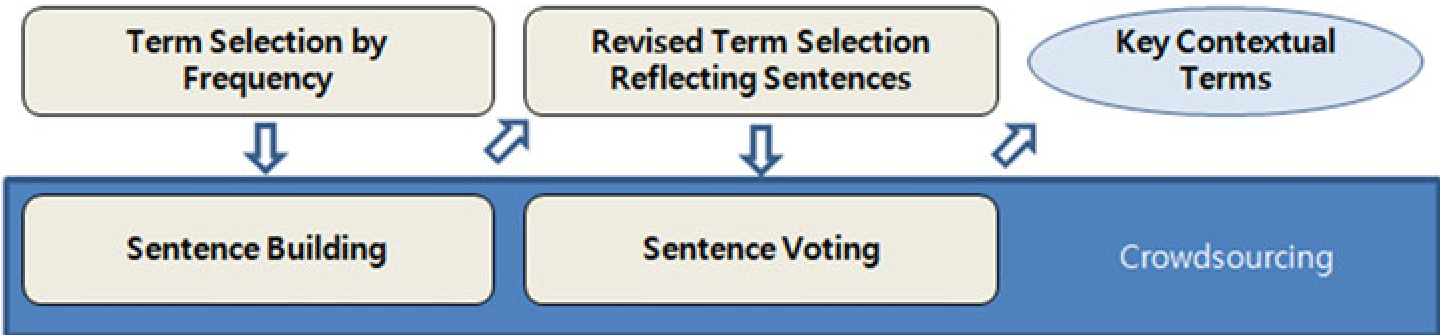
The authors break down their workflow into a sophisticated sequence designed for both efficiency and quality control:
- Automated Term Selection: Using the Stanford CoreNLP suite, the system extracts high-frequency noun phrases (NPs) and verbs. Crucially, they include verbs to capture the actions that define context.
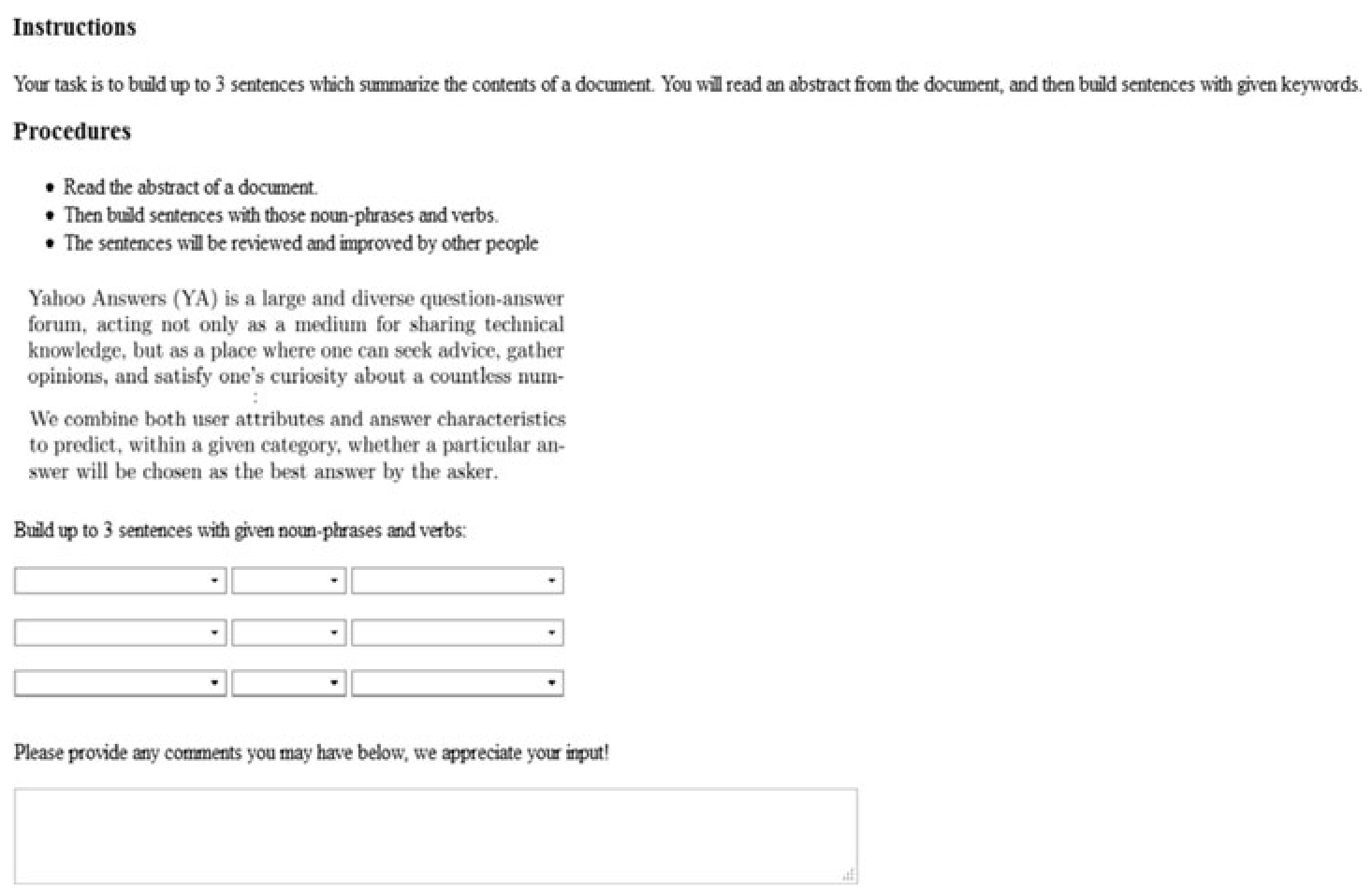
- Sentence Building (Crowdsourcing): Instead of asking workers to "pick keywords," they ask them to build simple Subject-Predicate-Object sentences from dropdown lists of the extracted terms. This forces cognitive engagement.
- Revised Term Selection: The system looks at which terms the crowd actually used to build sentences. These "human-verified" terms are given higher weights.
- Voting (Consensus): A different set of workers votes on which sentences best describe the document abstract. This serves as a final quality filter.
Insights: Why This Works
The "magic" lies in the UI design. By providing dropdown lists (as seen in the screenshot below), the authors transformed a difficult, subjective task into a structured "mind game." This lowered the barrier for entry while preventing "noise" or random tagging—a common plague in crowdsourcing.
Experiments & Results
The evaluation focused on two main comparisons:
- Machine vs. Crowd: The crowdsourced group achieved 62% Precision/Recall compared to only 46% for the automated frequency approach.
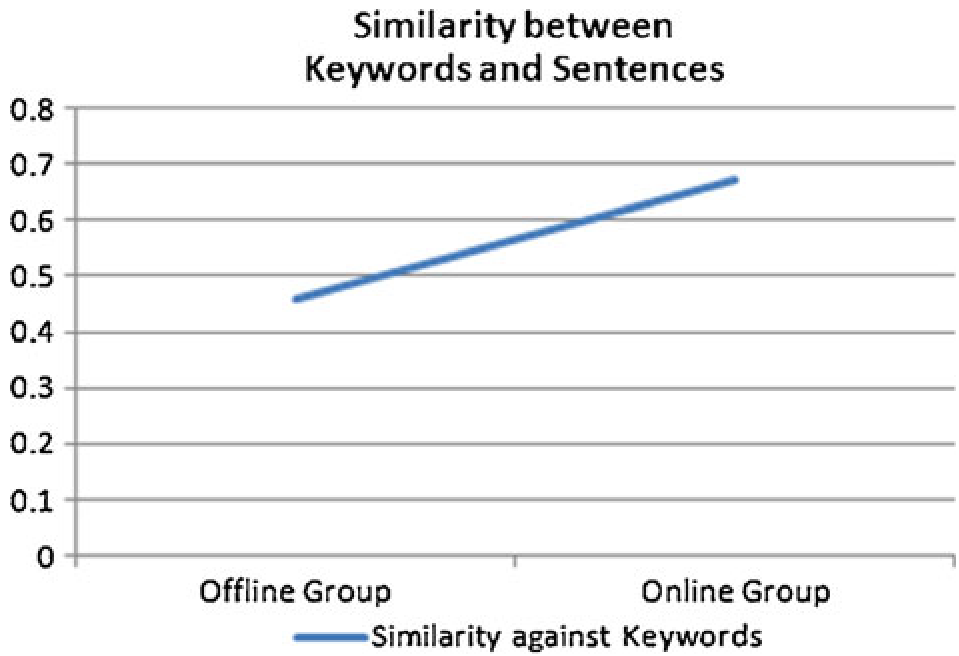
- Online Crowd vs. Offline Experts: Interestingly, the online workers (who only read the abstract) were more aligned with the author's original keywords (0.67 cosine similarity) than graduate students who read the full paper (0.46).
The authors suggest this is because the crowd, provided with limited information, focuses intensely on the "core" message (the abstract), whereas full readers get lost in the "nuance and noise" of the body text.
Critical Analysis & Conclusion
Takeaway
The paper proves that structured micro-tasks (like building a sentence) are superior to free-form tasks (like tagging) for extracting high-quality metadata. By guiding the human intelligence with machine-assisted constraints, we get the best of both worlds.
Limitations & Future Work
The primary bottleneck is the document abstract. If a document lacks a high-quality summary, the crowd's performance may degrade. Furthermore, in the modern era, one might wonder: Could a Large Language Model (LLM) replace the crowd in this loop?
While LLMs are cheaper than the crowd today, the methodology of using "Sentence Building" as a validation step for automated extraction remains a powerful framework for ensuring factuality and contextual alignment in any knowledge extraction pipeline.
Final Thought
This work serves as a foundational bridge between the era of "dumb" tagging and "smart" semantic understanding, highlighting that sometimes, to get the most out of human intelligence, you just need to give them a better set of building blocks.