
Predictive Waves: Decoding Communication Flow via Multi-Dimensional Context
Contextual Prediction of Communication Flow in Social Networks
This paper introduces a computational framework utilizing Support Vector Regression (SVR) to predict communication intent and delay in social networks. By integrating neighborhood, topic, and recipient contexts, the model achieves a prediction accuracy significantly outperforming baseline frequency-based methods on a large-scale MySpace dataset.
TL;DR
Predicting when and if a user will message another is a holy grail for social platform optimization. This paper moves beyond simple frequency counts by introducing a contextual framework inspired by physics. By modeling "Neighborhood," "Topic," and "Recipient" contexts using Support Vector Regression (SVR), the researchers achieved a massive leap in prediction accuracy on real-world MySpace data, reducing error rates from over 45% to just 13%.
The "Static Probability" Problem
Traditional information diffusion models often treat social networks like a petri dish, using epidemic models where information moves with a fixed probability.
The authors argue this is fundamentally flawed because:
- Context is Dynamic: Your likelihood to share a "movie" topic depends on who just messaged you (Backscatter) and how much your friends are talking about it (Susceptibility).
- Semantics Matter: People don't just "transmit" data; they react to the coherence of topics relative to their past interests.
- Relationships are Orthogonal: The "Medium" (the message) and "Action" (the send) are distinct but linked; prior work focused only on actions.
Methodology: The Wave Front Metaphor
The most striking aspect of this research is the use of a Physics-based metaphor. Much like the interference of light waves, a user's intent to communicate is seen as the superposition of multiple "wave fronts" from their contacts.
1. The Three Pillars of Context
- Neighborhood Context: Analyzes "Backscatter" (messages received by the user) and "Susceptibility" (the overall interest of the user's surrounding network).
- Topic Context: Uses ConceptNet and WordNet to determine semantic coherence. If a user has been consistently talking about a topic, their intent to continue is higher.
- Recipient Context: Looks at "Reciprocity" (the give-and-take balance) and "Topical Alignment" (how much Bob's interests overlap with Alice's).
2. The Prediction Engine
The model utilizes an Incremental Support Vector Regression (SVR). This allows the system to update its "understanding" of a user's behavior as new messages arrive, without needing a full retraining from scratch.
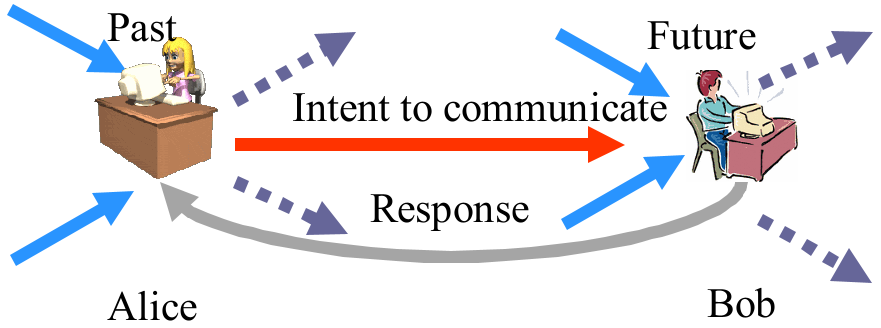 Figure: The fundamental question—predicting the likelihood and delay of communication between two nodes.
Experiments and Insights
The study utilized a massive crawl of MySpace.com (20,000 users, 1.4M messages). The findings reveal a fascinating divergence between why we talk and when we talk.
Intent vs. Delay
The SVR model crushed the baseline in predicting Intent (13.46% error vs. 49% baseline). However, for Delay, while the SVR still won, the baseline (simple mean delay) was surprisingly competitive.
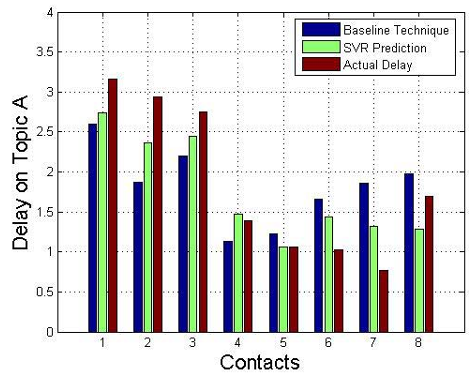 Figure: Performance comparison showing SVR (lower error) significantly outperforming the baseline across different topics.
The Scaling Effect
Interestingly, as the user's social network size (out-degree) increases, the average intent to communicate with any specific individual decays. This aligns with the "Dunbar’s Number" intuition—as our network grows, our active engagement with any single node becomes more diluted.
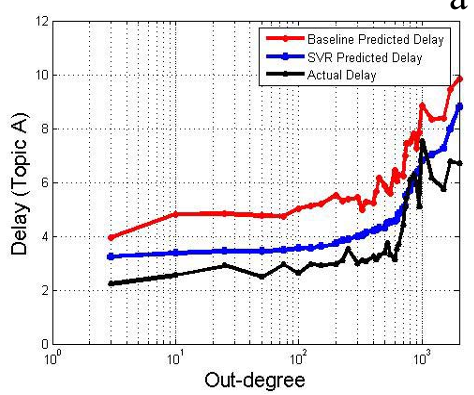 Figure: As network size increases, mean delay grows, reflecting the difficulty of maintaining active communication in large clusters.
Critical Insight & Conclusion
The major takeaway is that human intent is deeply contextual, but human timing might be habitual. The fact that social context helps predict who you will message much better than when you will message suggests that "delay" is an intrinsic property of the individual (a "latent habit"), while "intent" is an elective response to external stimuli.
Limitations: The study relies on ConceptNet distance which, while advanced for its time, lacks the deep contextual understanding of modern LLM embeddings. Future work integrating Transformer-based semantic features into this wave-front metaphor could potentially push accuracy even higher.
For developers of notification systems or social ranking algorithms, this paper provides a robust blueprint: stop looking at just frequency—start looking at the interference of the waves.