
Beyond the Infinite Scroll: Reclaiming Focus through Contextual Social Recommendations
Contextual Recommendation of Social Updates, a Tag-based Framework
The paper introduces a tag-based framework for the contextual recommendation of social updates (e.g., status messages, bookmarks) to mitigate information overload. It leverages "Contextual Tag Clouds" derived from a user's real-time web browsing activity to rank updates, achieving a recommendation accuracy of 72%.
TL;DR
In an era of relentless information streams, researchers from Alcatel-Lucent Bell Labs have proposed a framework that filters social updates—not by who you follow, but by what you are currently doing. By extracting "Contextual Tag Clouds" from your active web browser, the system ranks tweets and bookmarks with 72% accuracy, ensuring that the social "hum" of your colleagues supports rather than shatters your concentration.
The Problem: The High Cost of the "Push" Culture
Social Networking Services (SNS) like Twitter and LinkedIn thrive on real-time broadcasting. However, for a knowledge worker, these notifications are often "costly cognitive switches."
The authors identify a critical gap: Static Profile Bias. Most filters use your long-term interests (e.g., "I like AI") to show you content. But if you are currently debugging a Python script, an update about an AI ethics debate is still an interruption. The challenge is capturing Current Activity Context without violating privacy or requiring manual user input.
Method: Turning Browser History into a Semantic Shield
The core innovation is the Contextual Tag Cloud. Instead of just looking at the URL you are visiting, the framework runs five distinct "interpreters" to build a weighted vector representing your task:
- Metadata: Pulling titles and keywords from the HTML.
- Search Queries: Capturing the specific intent of your Google searches.
- Domain Names: Identifying the broad professional category (e.g.,
stackoverflow.comvs.nytimes.com). - Social Bookmarks: Leveraging the "wisdom of the crowd" by seeing how others tagged the URL on services like Delicious.
- Semantic Analysis: Mapping keywords to higher-level concepts.
System Architecture
The framework uses a privacy-first approach where data collection happens locally on the user's machine via a Firefox extension called a "Context Sniffer."
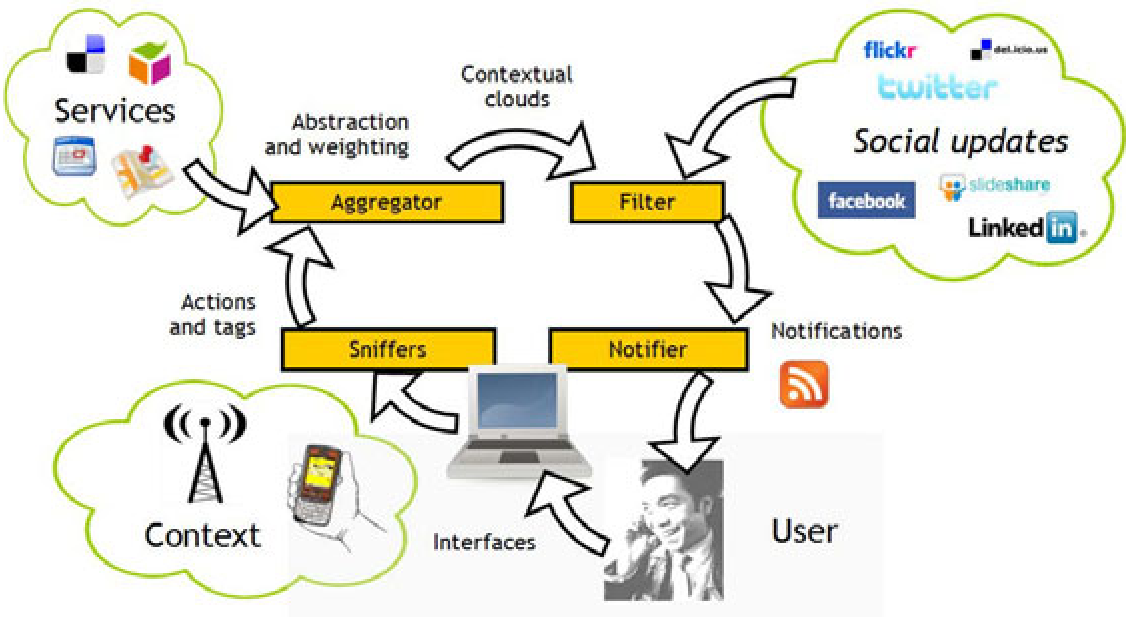 Figure 1: The data flow from local browser events to the contextual filter and back to the user notification sidebar.
The Vector Match: How It Works
The system treats a user's context () and a social update's origin context () as vectors in a high-dimensional space. The relevance is determined by the Cosine Similarity:
If the author of a tweet was browsing documentation for Graph Databases when they posted, and you are currently reading a tutorial on Neo4j, the vectors align, and the update is boosted to the top of your feed.
Results: Does it Actually Work?
The authors conducted a week-long field study with 8 volunteers. The findings were revealing:
- Accuracy: The algorithm matched human relevance judgments with a 72% accuracy rate.
- The Content Gap: Shared bookmarks were found to be far more context-relevant (71%) than general status updates (38%). This is because bookmarks are inherently tied to the document being consumed, whereas "tweets" are often random thoughts ("me now" posts).
 Figure 2: An example of a Contextual Tag Cloud visualization that a user can review before the system processes recommendations.
Critical Insights & Future Work
While the study is small-scale, it proves that web browsing is a reliable proxy for professional context.
Limitations:
- Cold Start: If a user isn't browsing (e.g., just staring at an empty desktop), the system has no signal.
- The Problem: Scaling this to thousands of users requires massive computational power for real-time vector matching.
The Road Ahead: The authors suggest moving toward "Emergent Semantics"—where the system doesn't just match keywords but understands that "Java" and "Programming" are related even if the specific words don't overlap.
Takeaway
This paper anticipates the "Ambient Intelligence" movement. By subtly shifting social updates from a chronological "Push" to a contextual "Pull," we can maintain social ties in the workplace without sacrificing our ability to achieve "Deep Work."