
TrustNet: Optimizing Social Trust Prediction via Contextual Sub-network Extraction
Contextual Sub-network Extraction in Contextual Social Networks
The paper introduces TrustNet, a social context-aware model for extracting optimal trust sub-networks from large-scale Online Social Networks (OSNs). By employing a Novel Ant Colony Algorithm (NACA) with a mutation process, it aims to facilitate efficient trust prediction between participants within specific interaction contexts, achieving superior performance on Epinions and Slashdot datasets.
TL;DR
Trust prediction in massive Online Social Networks (OSNs) often suffers from the "noise" of irrelevant interactions. This paper presents TrustNet, a framework that extracts a high-utility, dense sub-network containing only the most relevant participants for a specific context. By combining a multi-factor utility function with a refined Ant Colony Algorithm (ACA), the authors achieve significantly higher quality sub-networks compared to existing state-of-the-art (SOTA) heuristic methods.
The Scalability Bottleneck in Trust Prediction
In the modern digital economy, trust is the currency of decision-making. Whether you are hiring a coach on LinkedIn or buying a product based on an Epinions review, you rely on a chain of trust. However, OSNs are multi-contextual: a user might be a trusted "Mechanic" but a completely unreliable "Tennis Coach."
Using the entire social graph for trust prediction is:
- Ineffective: Irrelevant social links (noise) dilute the trust signal.
- Inefficient: Global graph computations are computationally prohibitive.
Existing solutions are often "path-based," looking for simple chains between source and target, which ignores the rich topology (density) required for advanced methods like Matrix Factorization.
Methodology: Beyond Simple Pathfinding
The authors frame sub-network extraction as an optimization problem where the goal is to maximize an objective function that balances Node Utility and Network Density.
1. The Multi-Factor Utility Function
The "importance" of a node isn't just about its connectivity. TrustNet considers:
- Independent Factors: Role Impact (expertise) and Reliability (historical accuracy).
- Relational Factors: Preference Similarity and Social Intimacy relative to the source and target.
2. NACA: A Mutation-Powered Ant Colony Algorithm
The core innovation lies in the Novel Ant Colony Algorithm (NACA). Standard ACA implementations for the Knapsack problem often get stuck in local optima because they only "add" components.
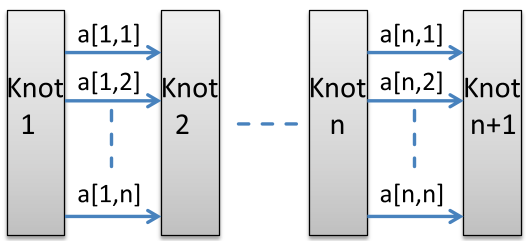
Key Innovations in NACA:
- Double-Tabu Mechanism: One table tracks the current path, while another tracks discarded nodes that failed to improve the objective function, preventing dead-end cycles.
- Mutation Process: After an ant completes a solution, the algorithm tries to delete nodes with low utility. If the removal improves the overall network density/utility, the deletion is finalized. This allows the "swarm" to prune unnecessary branches.
Experiments and Comparative Analysis
The researchers tested TrustNet against three heavyweights: BiNet (Binary ACA), SCAN (Monte Carlo), and FDRS (Greedy).
Performance on Large-Scale Datasets
On Epinions (131k nodes) and Slashdot (82k nodes), TrustNet consistently delivered the highest objective values.

- Superiority in Epinions: TrustNet achieved an average objective value of 0.709, which is 11% higher than BiNet.
- Convergence Speed: As seen in the graphs below, TrustNet finds high-quality solutions significantly faster than SCAN or FDRS, which is crucial for real-time recommendation engines.
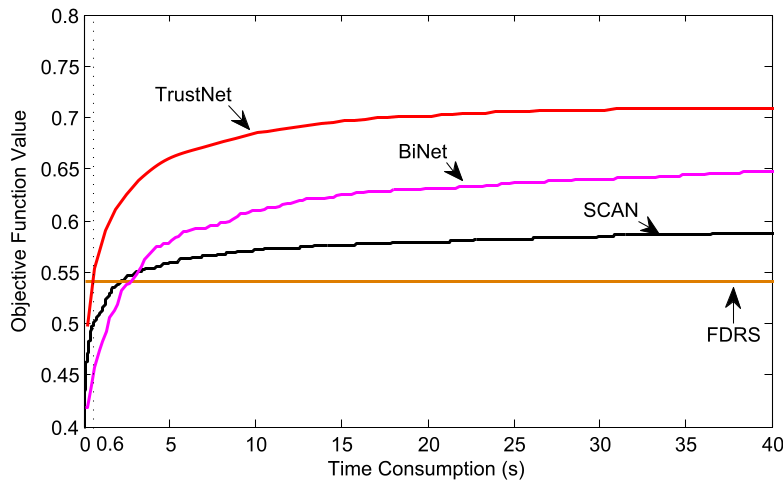 Figure: The objective function value climbs rapidly for TrustNet, outperforming competitors within the first few seconds.
Critical Insight & Conclusion
The true value of this work lies in the Mutation Process. By allowing the algorithm to "change its mind" and remove nodes, it breaks the monotonic growth constraint of typical heuristic search. This mimics natural biological refinement more closely than simple additive algorithms.
Takeaway: Effective trust prediction isn't just about "who you know," but about "who matters right now." TrustNet provides the mathematical and algorithmic scaffolding to filter global social noise into actionable, contextual insights.
Future Outlook: Integrating these sub-network extraction techniques as a pre-processing layer for Graph Neural Networks (GNNs) could potentially solve the over-smoothing problem often found in deep learning models applied to large social graphs.