
Bridging the Digital Literacy Divide: Redesigning Vocational Training for Oral Communities
Contextualizing ICT Based Vocational Education for Rural Communities: Addressing Ethnographic Issues and Assessing Design Principles
This paper presents a contextualized ICT-driven Technical Vocational Education and Training (TVET) model specifically designed for low-literate rural populations in India. By integrating ethnographic insights into a multimodal tablet-based system, the authors achieved a dramatic increase in learning efficacy, notably raising the successful question-answering rate of non-literate users from 0% to 80%.
TL;DR
To empower rural, non-literate populations, technology must do more than just "remove text." This paper exposes why standard UI paradigms fail oral cultures and proposes a revolutionary Pre-training model and Contextualized UI strategy. By translating abstract digital concepts into physical gestures and culturally relevant animations, the researchers enabled non-literate users to master toilet-building skills with an 80% success rate on tablet-based assessments.
The Problem: The Literacy Bias in Global Tech
Most Technical Vocational Education and Training (TVET) systems are built on a hidden assumption: that the user understands abstraction. Modern UIs rely on lists, hierarchies, and symbols (like 'X' for close or 'Tick' for correct) that are second nature to formally educated users but completely alien to "oral users."
In rural India, the "Orality" culture means knowledge is transmitted via concrete, practical experience rather than abstract symbols. When these users were first presented with standard tablet-based training, they struggled not because they lacked the intelligence to build a toilet, but because they couldn't decode the medium of instruction.
Methodology: From Physical Gestures to Digital Fluency
The team at AMMACHI Labs realized that they couldn't just hand a tablet to a first-time user. They developed a multi-stage Pre-training Module to build a "mental bridge":
- Physical Representation: Users perform real-world gestures (e.g., crossing arms for "No," a physical tick gesture for "Yes") to internalize the logic of feedback.
- Paper Prototypes: Static images of the UI are used to teach the concept of "touching an icon" to trigger a response, removing the technical intimidation of the device itself.
- Tablet Interface: Only after mastering the logic do users move to the digital device, focusing on fine-tuning touch and drag gestures.
Architecture of the Learning Application
The application itself was overhauled to be culturally grounded. A narrator character resembling a traditional village lady was used to provide instructions in the local dialect, replacing disembodied "computer voices."
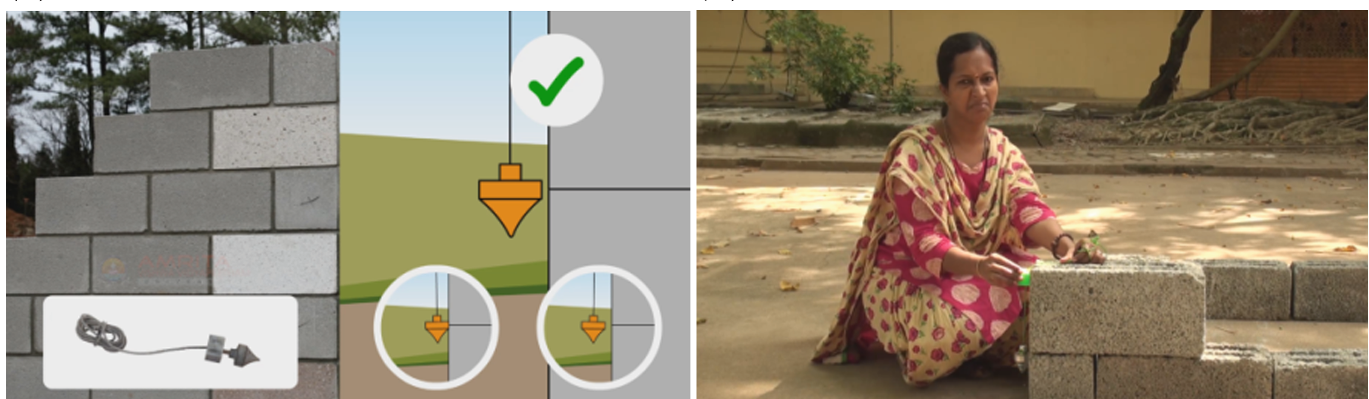 In the redesigned video (right), first-person camera angles and direct hand gestures replaced abstract symbols to show correct tool usage.
Experiments & Results: A 0% to 80% Success Story
The efficacy of this contextualized approach was tested through five usability studies involving 60 rural women across India (Karnataka, Tamil Nadu, Chhattisgarh, and Andhra Pradesh).
The quantitative leap was staggering:
- Non-literate Users: In early iterations (Study 2), success was virtually non-existent. After the introduction of pre-training and contextual UI (Study 5), 80% of questions were answered correctly.
- User Independence: For semi-literate users, the need for a moderator to help navigate the UI dropped significantly, with unassisted success rising from 25% to 63%.
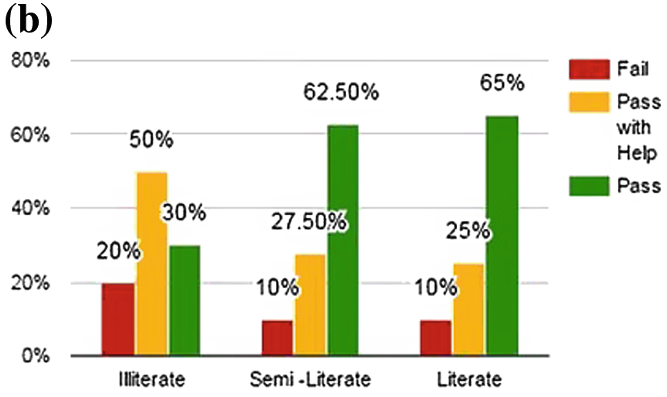 The comparison between Study 2 (Green) and Study 5 (Blue) demonstrates the massive performance gains across all literacy levels.
Critical Insight: Respecting Orality
The core takeaway is that abstraction is a learned skill, not a prerequisite for learning. By identifying the ethnographic issues—such as the fact that oral users answer based on "life experience" rather than "video content"—the researchers were able to design "Consequence-driven" feedback. Instead of just showing a red 'X' for an error, the video would show the physical consequence of an incorrect construction step.
Limitations and Future Work
While the success in toilet-building is impressive (250+ toilets built across 21 states), the study is limited to a specific manual skill. The next challenge for this research is to see if similar "Orality-grounded" designs can teach more complex, less physical concepts—like financial literacy or basic healthcare—where physical consequences are harder to visualize.
Conclusion
This work shifts the burden of adjustment from the user to the designer. It proves that with a culturally sensitive "Pre-training" phase and the removal of abstract literacy-biases in UI, the "Digital Divide" can be closed, turning technology into a true vehicle for socio-economic empowerment in the world's most remote communities.