
CAM: Maximizing Social Activity Through Continuous Marketing Strategies
Continuous Activity Maximization in Online Social Networks
This paper introduces the Continuous Activity Maximization (CAM) problem, which aims to optimize marketing investments in social networks within a lattice-constrained space. By extending traditional discrete activity maximization to a continuous strategy domain, the authors achieve a more realistic modeling of probabilistic seed activation through marketing strategies.
TL;DR
Social network optimization is moving beyond just "counting influenced nodes." This paper introduces Continuous Activity Maximization (CAM), a framework that treats marketing as a continuous investment (lattice-based) rather than a binary selection. By proving the non-submodularity of activity benefits and introducing a Sandwich Approximation Framework with specific sampling techniques (RE/RN), the authors solve a complex NP-hard problem with scalable, theoretically guaranteed algorithms.
Context: From Binary Influence to Continuous Activity
Standard Influence Maximization (IM) asks a simple question: Which nodes should we trigger to reach the most people? However, in the real world:
- Edges aren't equal: Interacting with a close friend might generate more "activity benefit" (profit) than a casual acquaintance.
- Strategies aren't binary: You don't just "pick" a user; you offer them a 20% discount, a 50% coupon, or a free trial—each with a different probability of success.
The CAM problem addresses these gaps by modeling marketing strategies as -dimensional vectors on a lattice .
The Mathematical Challenge: Why Greedy Isn't Enough
In traditional IM, the objective function is submodular (the law of diminishing returns applies). In CAM, the objective function is monotone but neither DR-submodular nor DR-supermodular.
Specifically, the "combination effect"—where two seeds together activate a high-value edge that neither could reach alone—breaks the submodularity. Without this property, a standard greedy algorithm loses its guarantee.
Methodology: The Sandwich & Sampling Strategy
The authors propose a multi-step solution to bypass the lack of DR-submodularity:
1. The Sandwich Framework
Since is hard to optimize directly, the authors define:
- Lower Bound (): Only counts edges where both endpoints are activated by the same seed.
- Upper Bound (): Relaxes the requirement, allowing any influenced node to contribute to half of its connected edge activity.
- Finding the Solution: Both bounds are DR-submodular. By maximizing these, we "sandwich" the optimal solution.
2. Scalable Sampling (RE & RN Sampling)
To handle massive networks, the authors adapt Reverse Influence Sampling (RIS):
- RE-sampling (Random Edge): Estimates the main objective and lower bound by sampling high-value edges and generating reverse-reachable sets.
- RN-sampling (Random Node): Specifically designed for the upper bound's node-centric structure.
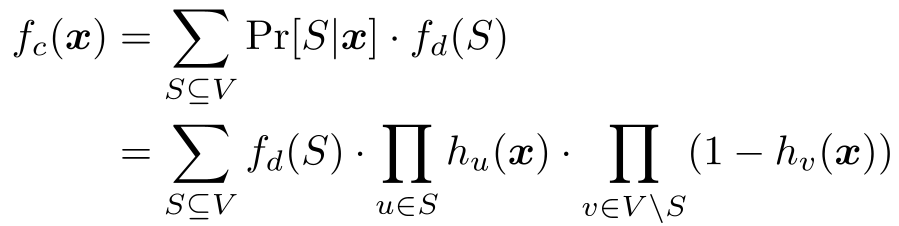 Formula 5: The continuous activity function reflecting the total expected benefit across all possible seed sets generated by strategy .
Experimental Insights
The authors tested their framework using Dataset-3 (Arxiv collaboration), Dataset-2 (Wiki), and Dataset-1 (Co-authorship).
Key Results:
- Superiority over Baselines: The Sandwich approach consistently yielded higher activity benefits than
MaxDegreeorRandomstrategies. - Performance Stability: While
MaxDegreeandIMfluctuated depending on the dataset type, the CAM algorithm remained robust due to its data-dependent approximation ratio.
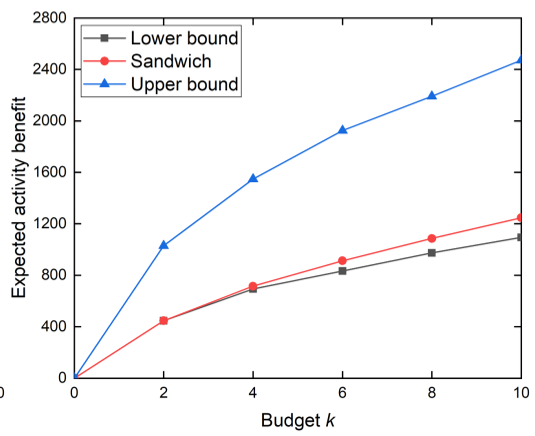 Figure: Performance on Dataset-3 under the IC-model, showing the Sandwich algorithm outperforming traditional heuristics as the budget increases.
Critical Analysis & Future Outlook
While the paper provides a breakthrough for lattice-based optimization in social networks, there are a few considerations:
- Complexity: Creating a constructed graph for Monte Carlo simulations (as suggested in Remark 2) adds overhead, though the RIS-based IMM adaptation mitigates this significantly.
- Granularity Trade-off: The accuracy depends on the granularity . A very small (near-continuous) increases the number of greedy iterations (), which might challenge real-time applications.
Conclusion: This work is a significant milestone for "Viral Marketing 2.0." It proves that we can optimize complex, non-submodular rewards in social networks using disciplined mathematical bounds and modern sampling techniques.