
Cola DLM is a hierarchical continuous latent diffusion language model that factorizes text generation into global semantic organization and local textual realization. By modeling a latent prior in continuous space using a block-causal Diffusion Transformer (DiT), it achieves competitive performance and strong scaling behavior compared to 2B-parameter autoregressive (AR) and discrete diffusion (LLaDA) baselines.
TL;DR
Cola DLM is a new generative paradigm that moves text modeling from the surface token level into a hierarchical continuous latent space. By separating "what to say" (global semantics) from "how to say it" (local realization), it utilizes a block-causal Diffusion Transformer (DiT) to achieve strong scaling and non-autoregressive efficiency, outperforming standard 2B-parameter baselines in complex semantic tasks.
The "Order Problem" in Modern LLMs
The dominant Autoregressive (AR) paradigm treats language as a one-dimensional chain. While effective, this imposes a strict Left-to-Right Inductive Bias. If you want to change a word in the middle or plan a global structure, AR struggles because it is "blind" to the future.
Discrete diffusion models (like LLaDA) attempted to fix this by denoising masks, but they operate in "jagged" discrete spaces where global semantic structure is hard to organize. Cola DLM's core insight is that language possesses a natural hierarchy: a low-dimensional semantic core and a high-dimensional surface form.
Methodology: The Hierarchical Decomposition
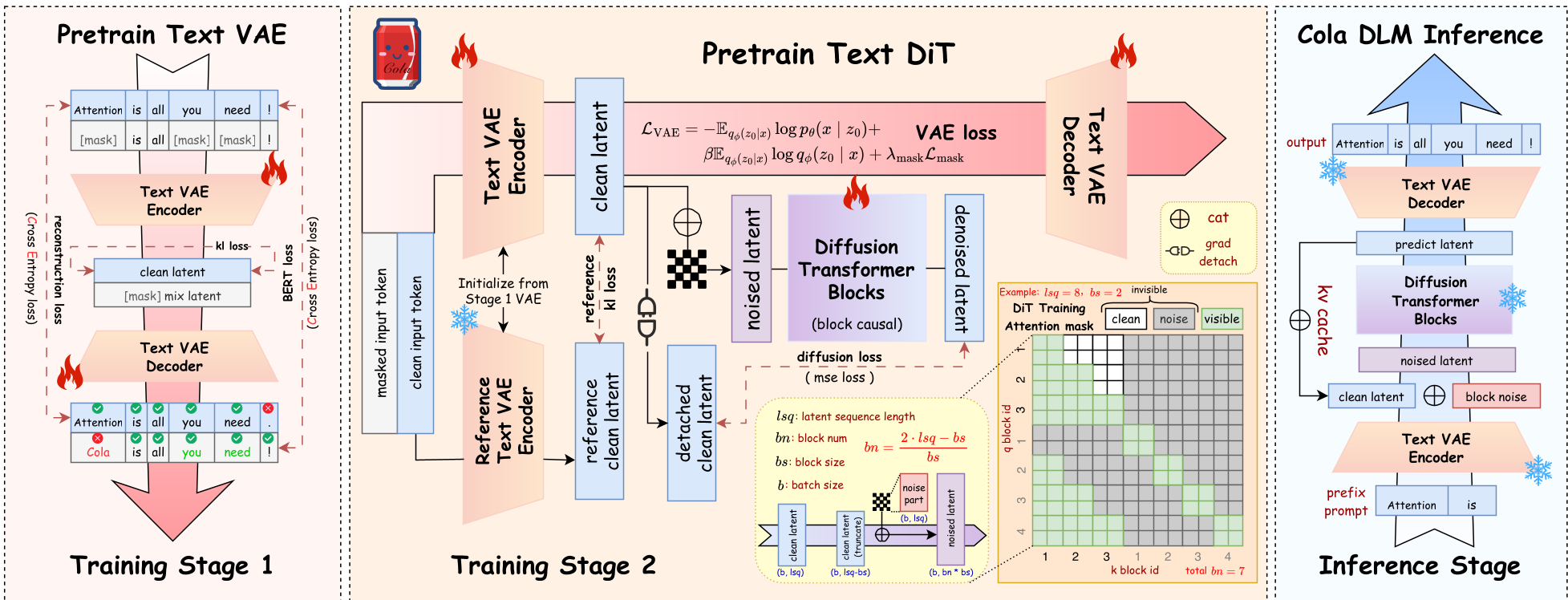
Cola DLM doesn't just denoise tokens; it performs Latent Prior Transport. The process is divided into three distinct modules:
- Text VAE: Map discrete tokens into a "smooth" continuous latent space.
- Block-Causal DiT: This is the brain. It learns to transport noise into a semantic latent variable while maintaining causality across blocks of text to allow parallel processing.
- Conditional Decoder: Takes the "semantic blueprint" from the DiT and fills in the specific tokens.
Why the "Latent" Matters
By using a latent variable , the model effectively compresses information. The "Rate-Distortion" theory suggests that if we can capture the essence of a sentence in a low-dimensional vector, the prior (the diffusion part) has a much easier job than trying to predict every single comma and period simultaneously.
Experiments & Scaling Laws
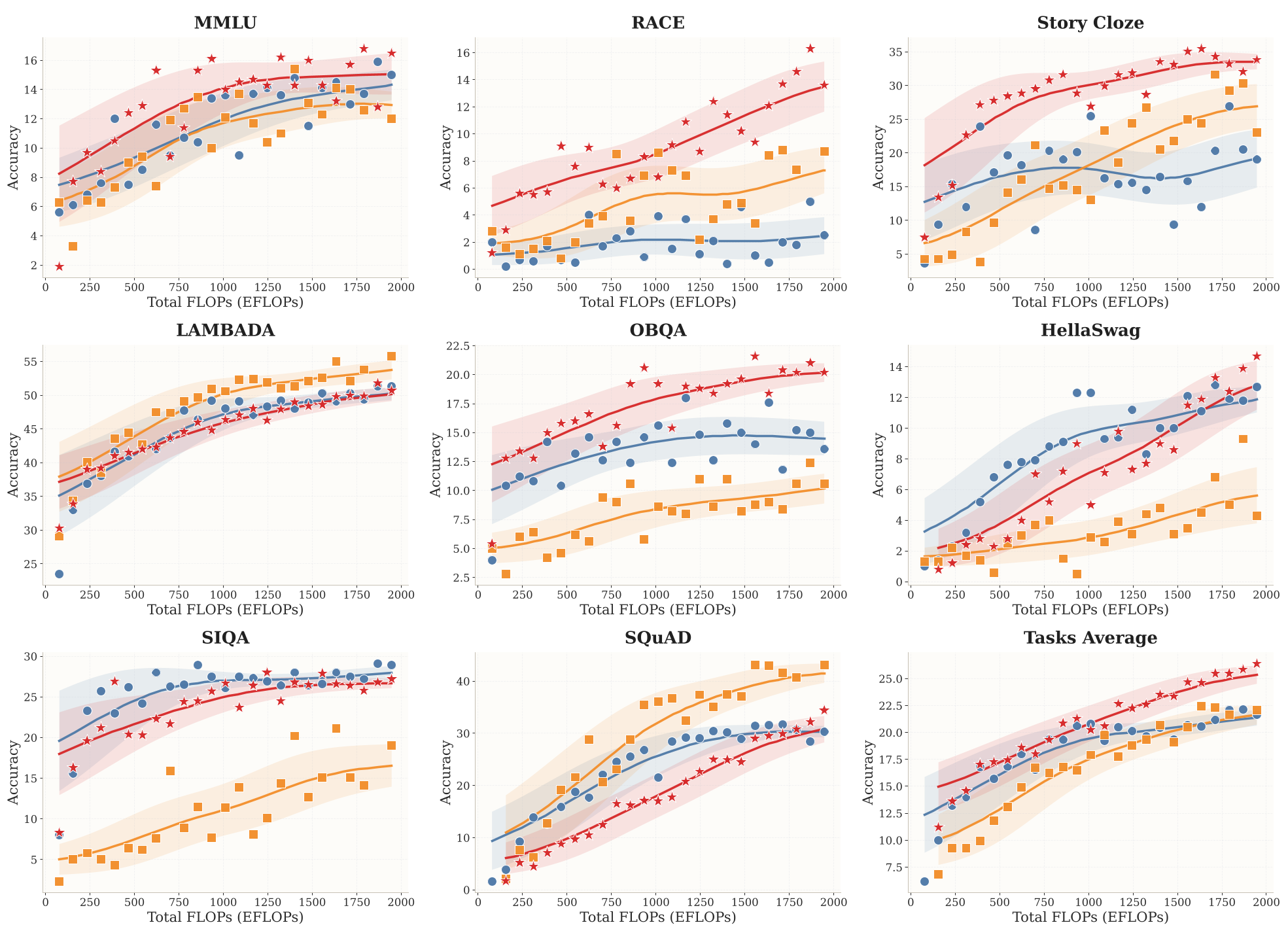
The authors put Cola DLM through a rigorous "2B-parameter battle" against Llama-style AR models and LLaDA.
- Scaling Performance: As compute (EFLOPs) increases, Cola DLM’s performance on Task Average rises more persistently than AR, especially on reasoning-heavy benchmarks like MMLU and OBQA.
- Generation Efficiency: Unlike AR, which must generate tokens in steps, Cola DLM uses block-causal generation. With a block size of 16, it can generate 16 tokens in significantly fewer sequential steps (idealized 1.6-2.0x speedup).
Critical Insight: The PPL vs. Quality Gap
A fascinating finding in the paper is the mismatch between Perplexity (PPL) and Generation Quality. In continuous models, a "bad" PPL doesn't always mean "bad" text.
- Generation cares about hitting the "good region" of the decoder.
- Likelihood cares about the exact point-wise calibration. Cola DLM proves that we can achieve SOTA generation even if our PPL isn't the lowest, marking a shift in how we should evaluate future non-AR models.
Towards a Unified Multimodal Future
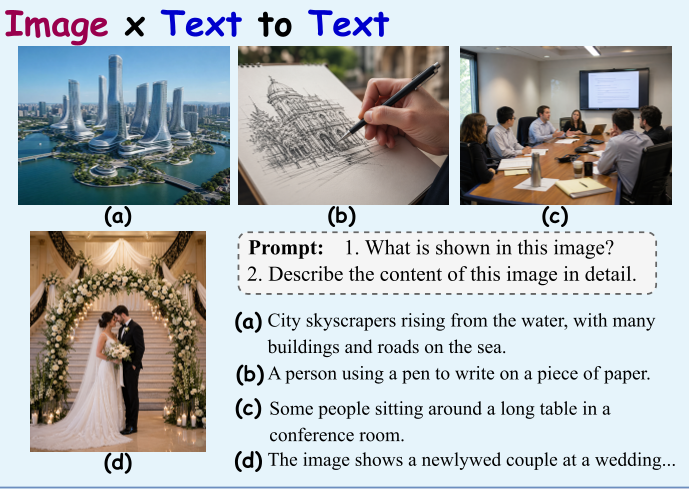
The most exciting prospect of Cola DLM is its modality-agnostic structure. Because it operates in continuous space, the "Text VAE" can be swapped or augmented with an "Image VAE". The same block-causal DiT prior can then bridge the gap between reading a prompt and imagining an image, all within a unified probabilistic framework.
Conclusion
Cola DLM is more than just a "diffusion LLM." It is a theoretical and empirical validation that language modeling is moving towards hierarchical information decomposition. By decoupling semantic planning from token realization, we open the door to models that are faster, more flexible, and naturally multimodal.