
Cola DLM: Transcending the Autoregressive Paradigm via Continuous Latent Diffusion
Continuous Latent Diffusion Language Model
Cola DLM is a hierarchical continuous latent diffusion language model that factorizes text generation into global semantic prior modeling and local textual realization. By utilizing a Text VAE for latent mapping and a block-causal Diffusion Transformer (DiT), it achieves state-of-the-art scaling performance comparable to autoregressive (AR) models while offering non-sequential inference flexibility.
TL;DR
Cola DLM is a breakthrough architecture that treats language modeling as a hierarchical process. By shifting the diffusion process from the "surface" token level to a "deep" continuous latent space, it breaks the sequential chains of traditional Transformers. It matches the scaling potential of GPT-style models while offering faster, block-wise parallel inference and a direct bridge to multi-modal (image/video) synthesis.
The Problem: The "Left-to-Right" Straitjacket
The AI industry has been obsessed with Next-Token Prediction. While successful, this Autoregressive (AR) paradigm forces models to think in a strictly linear fashion—calculating the next word based solely on previous ones. This creates two massive bottlenecks:
- Inference Inefficiency: You can't generate the 100th word without finishing the 99th.
- Inductive Bias: The model lacks a "global view" before starting to "speak."
Previous diffusion models for text tried to fix this but often worked in discrete token space (masking words and filling them in), which is mathematically "bumpy" and makes it hard for the model to learn smooth semantic transitions.
The Insight: "Prior Transport" vs. "Observation Recovery"
The core genius of Cola DLM lies in its Hierarchical Information Decomposition. Instead of trying to denoise the text directly, it treats text like an image latent.
- The VAE (The Interface): Maps discrete text into a continuous "manifold" (a smooth mathematical space).
- The DiT (The Brain): A Diffusion Transformer that organizes global semantics.
- The Prior Transport: Unlike other models that try to "recover" a lost word, Cola DLM uses diffusion to "transport" a random Gaussian noise into a refined semantic latent.
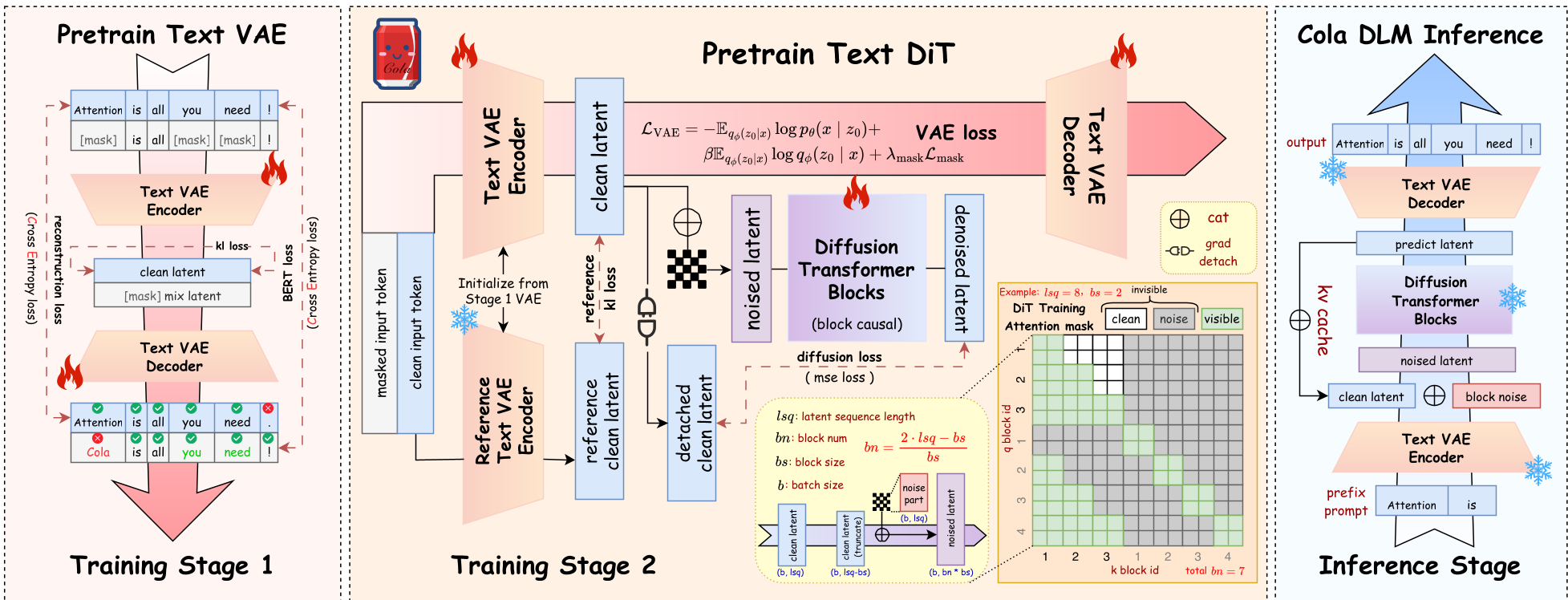 Figure 1: The training pipeline involves a two-stage process: VAE stabilization followed by joint latent-prior learning using a block-causal mechanism.
Methodology: Block-Causal DiT
To keep the efficiency of parallel processing without losing the logical flow of language, the authors use a Block-Causal approach.
- Within a block: All tokens (latents) can see each other, allowing for non-autoregressive, parallel generation.
- Across blocks: The model maintains a causal order, ensuring the story doesn't contradict its own past.
This design uses Flow Matching (FM). Instead of complex SDEs (Stochastic Differential Equations), FM simply learns a vector field—a straight-line path from noise to meaning—making training more stable and sampling much faster.
Experimental Battleground: Does it Scale?
One of the most critical questions for any new architecture is the "Scaling Law." Can it get smarter with more data and compute?
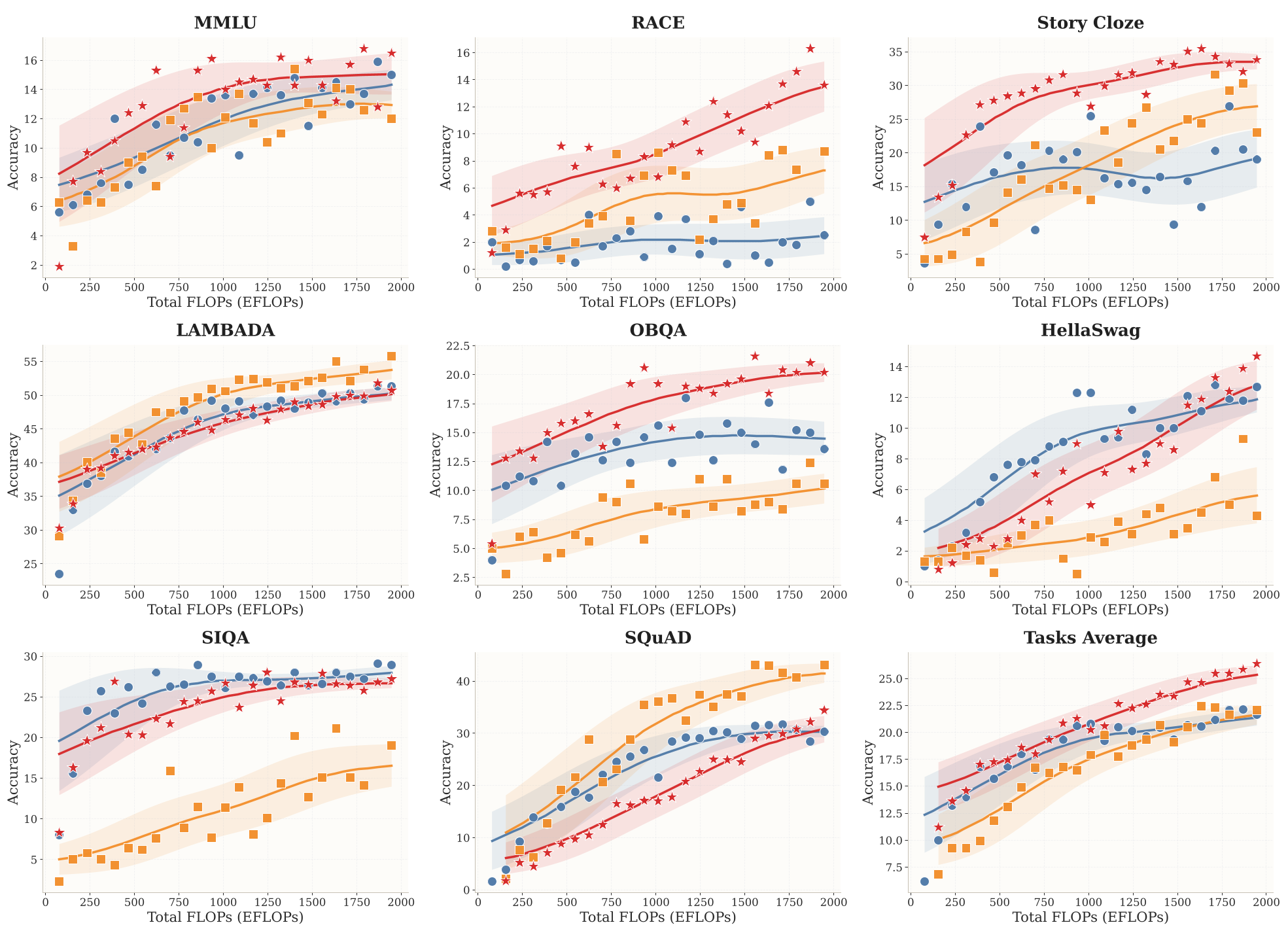 Figure 2: Scaling curves show Cola DLM (Orange) matching or exceeding AR (Blue) and LLaDA (Green) performance as compute (EFLOPs) increases.
Key results from the researchers:
- Task Versatility: On reasoning-heavy tasks like MMLU and RACE, Cola DLM showed superior scaling compared to discrete diffusion.
- Speed: Generating 16 tokens in a single block required only ~10 steps, a significant improvement over the 16 sequential steps required by AR models.
- Semantic Drift: The authors proved that a "Global Semantic Structure" exists—as they increased latent dimensions (from 16 to 128), the model's ability to handle complex noise improved predictably.
The "Likelihood" Trap
A fascinating insight in the paper is the Likelihood-Quality Gap. The authors found that Cola DLM might have a "poor" Perplexity (PPL) score (the standard metric for LLMs) but still produces "excellent" text. Why? Because traditional PPL measures how accurately a model predicts a specific gold token. Cola DLM cares about reaching a semantically valid region. It’s like judging a painter not by the final image, but by how accurately they hit a specific microscopic coordinate on the canvas.
Conclusion: A Unified Future
Cola DLM isn't just about text. Because it maps language into a continuous latent space, it speaks the same "native language" as modern image and video generators (like Sora or Stable Diffusion).
The authors showcased preliminary Unified Text-Image modeling, where the same block-causal prior handles both modalities. This marks a shift toward a future where we don't have separate "vision" and "language" models, but a single "Continuous Latent" brain.
Limitations
- The Variational Gap: The VAE bottleneck can still cause some information loss.
- Optimization Complexity: Training an encoder, prior, and decoder simultaneously is harder than just "next-token" fitting.
Final Takeaway
If we want truly efficient, multi-modal, and globally-aware AI, we might have to leave the discrete token-by-token chain behind. Cola DLM provides the roadmap for that transition.