
Digital Twins: The Future of Personalized Healthcare and Continuous Monitoring
Towards continuous monitoring in personalized healthcare through digital twins
The paper proposes a novel reference model for personalized healthcare using Digital Twins (DT) and autonomic computing. It establishes a framework for "Human Digital Twins" (HDT) to enable continuous monitoring and virtual simulation of medical treatments for chronic diseases like diabetes.
TL;DR
This research explores the integration of Digital Twins (DT) with Autonomic Computing to revolutionize personalized medicine. By creating virtual "clones" of patients that adapt in real-time, the authors provide a roadmap for continuous monitoring and risk-free simulation of medical treatments, particularly for chronic conditions like diabetes.
The Complexity Gap in Modern Healthcare
Despite the explosion of wearable IoT devices, healthcare remains largely reactive. Traditional systems face three major hurdles:
- Data Heterogeneity: Integrating massive, diverse data streams from smartwatches to glucose monitors.
- Health Dynamism: A patient’s condition is never static; monitoring must adapt as health deteriorates or improves.
- Simulation Deficiency: Doctors often cannot "test" a treatment’s long-term effect without physical risk to the patient.
The authors argue that the "Digital Twin" concept—borrowed from Industry 4.0—is the missing link. However, a DT in healthcare isn't just a 3D model; it's a complex software system that must be self-adaptive.
Methodology: The Autonomic Digital Twin Reference Model
The core contribution is a reference model that leverages Models@run.time (MARTs). Unlike traditional models that are discarded after the design phase, MARTs live alongside the system during execution.
The Human Digital Twin (HDT) Architecture
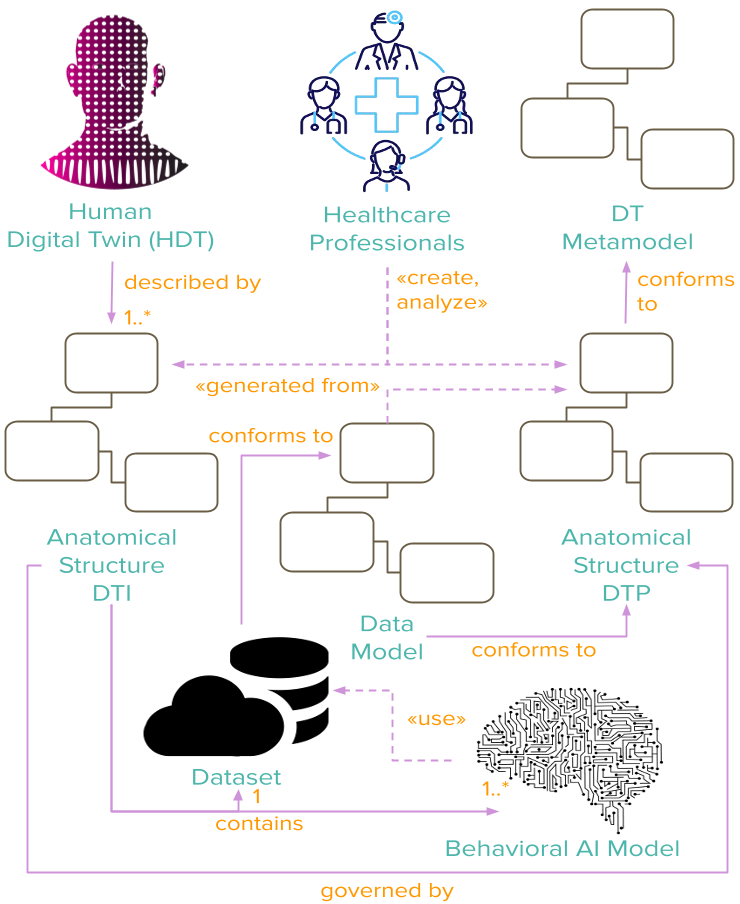
The authors propose a hierarchical structure where a Human Digital Twin is composed of multiple Anatomical Structures (AS) (e.g., the heart or endocrine system).
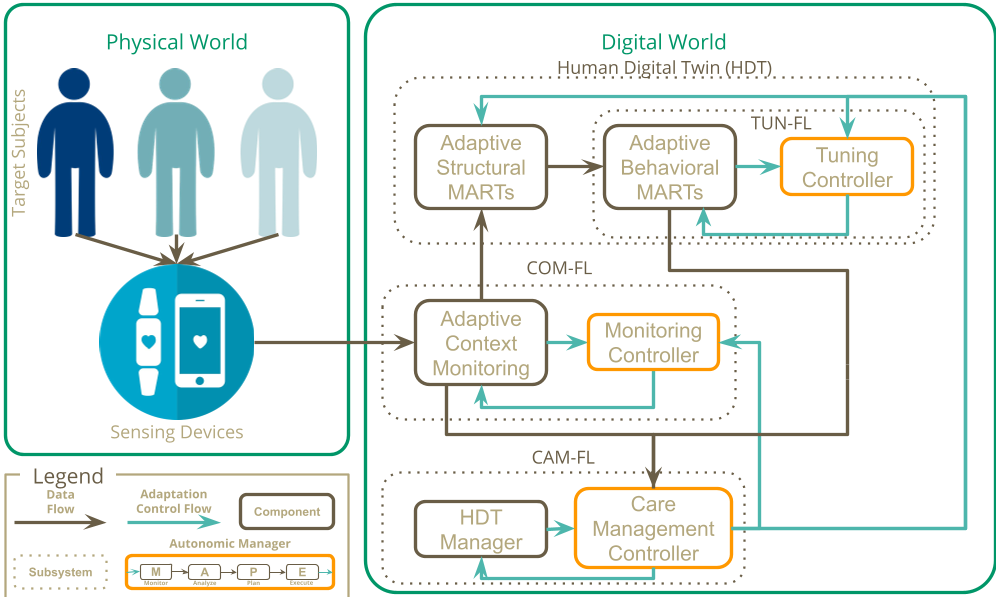
The system operates through three critical feedback loops:
- Contextual Monitoring Loop: Adjusts sensing frequency based on patient risk (e.g., monitoring more frequently during a hypoglycemic crisis).
- Tuning Feedback Loop (TUN-FL): Continuously calibrates behavioral models (Machine Learning) to ensure the virtual twin's predictions match the physical patient's reality.
- Care Management Feedback Loop (CAM-FL): This is the high-level "brain" where clinicians perform trade-off analyses between different treatment paths.
Precision Medicine in Action: The Diabetes Scenario
The paper illustrates the model through Diabetes Chronic Management.
- DTP (Prototype): A general template for an endocrine system is defined.
- DTI (Instance): Specific data from a patient (insulin resistance, activity levels) populates the template.
- Evolution: If a patient progresses from prediabetes to Type 2, the Digital Twin evolves its internal structure to begin tracking blood glucose—a process the authors call "Model Evolution."
- Virtual Testing: Instead of immediately prescribing a higher insulin dose, the doctor can run a simulation on the Digital Twin Instance to predict outcomes, avoiding potential side effects in the real world.
Critical Insight: Beyond Industry 4.0
While industrial DTs focus on "predictive maintenance" for machines, Human DTs must handle Biological Uncertainty. This work is pioneering because it doesn't just treat the twin as a data dashboard, but as a Self-Adaptive System (SAS) capable of autonomic decision support.
Limitations and Future Outlook
While the vision is compelling, several challenges remain:
- Fidelity: Creating a digital replica of human tissues at the molecular level is computationally staggering.
- Interoperability: Different "organ twins" (e.g., a heart twin from Siemens and a lung twin from Philips) must be able to communicate.
- Ethics: The paper hints at the ethical implications of virtual experimentation and data privacy.
Conclusion
This paper marks a shift from "eHealth" (digital records) to "Digital Twin Healthcare" (dynamic simulation). By applying principles of autonomic computing, the authors show that healthcare systems can become as smart and adaptive as the biological systems they are designed to protect.