
Beyond Consensus: How Discrete Actions Fuel Social Polarization
Continuous opinions and discrete actions in social networks: A multi-agent system approach
This paper introduces a novel Multi-Agent System (MAS) model for opinion dynamics that integrates Continuous Opinions with Discrete Actions (CODA). It demonstrates how social phenomena like dissensus, clustering, and oscillations emerge when agents only observe the quantized "actions" (binary choices) of their neighbors rather than their internal continuous opinions.
TL;DR
Why do we disagree even when we talk to each other? This paper proposes a CODA (Continuous Opinions and Discrete Actions) model where agents have internal continuous beliefs but can only see the binary "actions" (e.g., Yes/No, Vote A/Vote B) of their neighbors. The study proves that this simple quantization of feedback is enough to prevent consensus, create stable polarized clusters, and even trigger periodic oscillations in opinion, providing a mathematical blueprint for social dissensus.
The "Liar's" Consensus: Why Information Loss Matters
In classical control theory and social modeling, such as the Deffuant or Hegselmann-Krause models, agents usually reach a middle ground if they are connected. However, these models ignore a fundamental human constraint: expression is often binary. You might be 51% in favor of a policy or 99% in favor, but your vote (your action) looks exactly the same to your neighbor.
The authors argue that this "quantization" creates a significant loss of nuance. When we only observe the 0s and 1s of our peers, the system stops acting like a smooth heat-diffusion process and starts acting like a complex, non-linear dynamical system where extremist opinions become "weights" that are hard to move.
Methodology: The Weight of Extremism
The core of the CODA model is its update rule. Unlike standard consensus, the change in agent 's opinion is governed by:
- The Factor: This is the "Inductive Bias" of the model. If an agent is an extremist (opinion close to 0 or 1), this term becomes near-zero, meaning they are barely influenced by others.
- Quantized Feedback (): Agents only react to the action of their neighbors. If a neighbor's internal opinion is 0.49, they represent a "0" to everyone else.
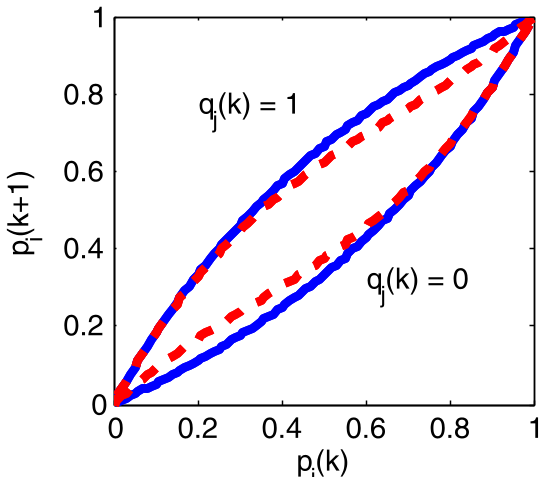 The CODA model (red) closely approximates Bayesian updates (blue) but allows for a more tractable consensus-style analysis.
Key Insights: Polarized Clusters and Diffusion
One of the most powerful contributions of this paper is the definition of a Robust Polarized Cluster.
A group is "Robust" if every member has more neighbors inside the group than outside.
The authors mathematically prove that such a cluster will never change its action, regardless of what the rest of the network does. This explains the "Echo Chamber" effect: as long as you are surrounded by enough like-minded individuals, the outside world's influence is mathematically nullified.
The Power of an Influential Minority
The paper doesn't just look at stability; it looks at propagation. It identifies conditions under which a small group can convert a large network (Action Diffusion). By strategically placing a robust cluster in the "inner circle" of a network, the actions can cascade outward even to "peripheral" agents who initially had zero contact with the opposing view.
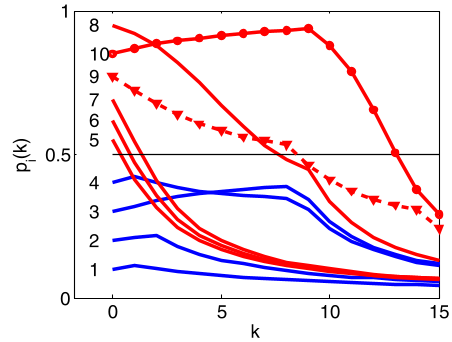 Fig 2: Watch how a minority (Agents 1-4) eventually forces Agent 10—who started as a staunch '1'—to flip to '0' through a cascade of neighborhood changes.
Experiments: Lattices and Oscillations
The authors tested their model on two distinct topologies:
- 6x6 Square Lattice: They observed the formation of "patches" of same-action agents. Rather than a global average, the network settles into local neighborhoods of agreement.
- Complete/Ring Graphs: In symmetric conditions, the model produces oscillatory behavior. Agents never settle; they constantly "over-correct" their internal opinions, swinging back and forth across the 0.5 threshold forever.
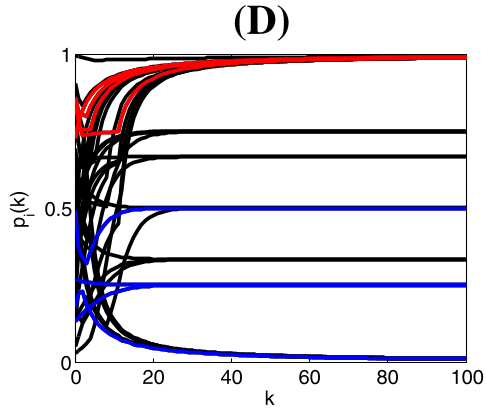 Final opinions on a square lattice show the emergence of stable, localized dissensus (clustering).
Critical Perspective
Takeaway: This paper elegantly bridges the gap between physics-based discrete models and control-theoretic continuous models. It provides a formal verification for why connected societies remain fragmented.
Limitations: The model assumes a fixed graph . In real social networks, ties are dynamic (homophily)—we choose to follow people who already agree with us. Adding "edge-weight evolution" to this CODA model would likely make the polarization even more extreme.
Future Outlook: This framework is a goldmine for analyzing online social media. By substituting the "quantizer" with an "algorithm filter," one could model how platform design directly influences the stability of robust polarized clusters.