
CP-SMA: Solving the Cold-Start Problem in Real-Time Social Event Recommendations
Recommending Venues Using Continuous Predictive Social Media Analytics
The paper introduces Continuous Predictive Social Media Analytics (CP-SMA), a hybrid system designed to recommend venues during city-scale events by combining deductive and inductive stream reasoning. It leverages real-time social media streams and semantic user profiling to provide high-quality link predictions even when visitor preference data is initially sparse.
TL;DR
Predicting visitor behavior at transient, city-scale events like Milan Design Week is a nightmare for standard AI because historical data is usually useless. This paper presents CP-SMA, a system that combines real-time "Social Listening" with semantic "Visitor Modeling" to suggest venues. By using inductive stream reasoning (SUNS), it provides accurate recommendations even when visitor data is incredibly sparse.
Background: The "Temporal Flux" Problem
Most recommendation engines rely on long-term historical logs. However, city-scale events (exhibitions, festivals) present a unique challenge:
- Function Change: A bar might become an art gallery for just five days.
- Ephemeral Connections: Visitors and venues interact in ways that have no prior history.
- Data Scarcity: In the first 48 hours of an event, there isn't enough signal to train deep models.
The authors' insight is to bridge this gap using Semantic Enrichment. If we don't know what Alice likes at this event, we can infer it by linking her past tweets to global knowledge bases like DBpedia.
Methodology: Deductive + Inductive Reasoning
The CP-SMA architecture is a pipeline designed for continuous updates. It consists of three main pillars:
- Social Listener (SL): Uses deductive reasoning to filter the firehose of tweets. It links microposts to venues using spatial-temporal bounding boxes and optimized regular expressions.
- Visitor Modeler (VM): This is the "brain." It extracts entities from a user's social history and maps them to DBpedia. This transforms a raw user ID into a rich "Historical Profile."
- Visitor-Venue Recommender (VVR): The inductive engine. It uses the SUNS (Statistical Unit Node Set) framework, a multi-variate prediction model for relational graphs.
 Figure 1: The architecture demonstrates the flow from raw social streams to enriched semantic knowledge and finally to the inductive prediction unit.
The Secret Sauce: Matrix Factorization with Regularization
Unlike standard Singular Value Decomposition (SVD), which is highly sensitive to the number of latent variables (often leading to overfitting), the SUNS model used here employs regularization that allows the system to scale its "latent variable" count without crashing in performance.
Evaluation & Results
The system was tested on the Milan Design Week 2013 (MDW13) dataset, involving 500,000 visitors and 681 venues.
The performance was measured using nDCG (normalized Discounted Cumulative Gain) across two scenarios: Day 3 (Sparse data) and Day 6 (End of event).
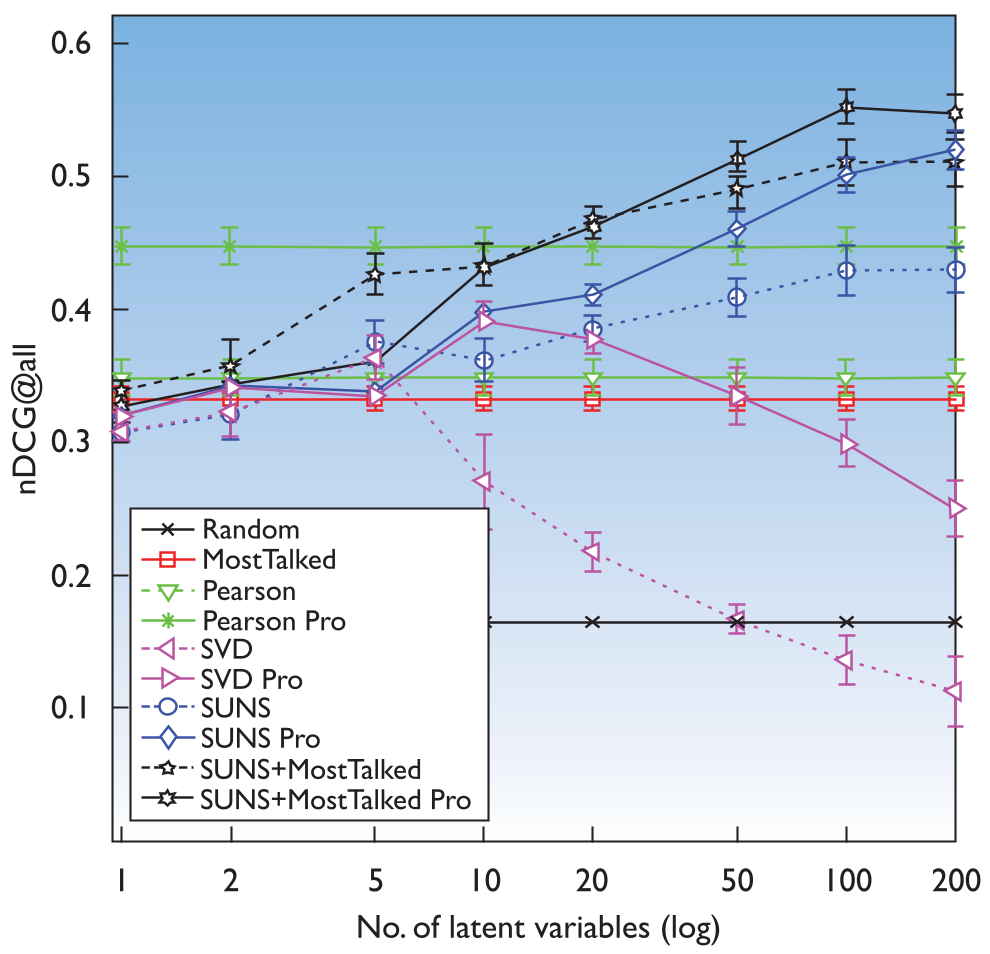 Figure 2: Performance comparison (nDCG@all) against latent variables. Note how SUNS Pro maintains stability while SVD peaks early and then degrades.
- Cold-Start Mastery: On Day 3, combining "Most Talked About" venues with SUNS Pro yielded the best results, proving that popularity is a critical signal when individual data is scarce.
- Semantic Power: Including visitor profiles (SUNS Pro) consistently outperformed basic models, validating the use of DBpedia-enriched profiles.
Critical Insight: Why it Works
The brilliance of this work lies in its Hybrid Nature. Pure machine learning fails when data is sparse; pure logic (the semantic web) fails when data is noisy. CP-SMA uses logic to "clean and enrich" the social media stream and then uses statistical learning (Matrix Factorization) to "predict" the gaps.
Limitations & Future Work
While robust, the system relies heavily on the quality of entity extraction (DBpedia Spotlight). If a user tweets in a niche dialect or uses heavy slang, the semantic enrichment fails. Future iterations could explore using Graph Neural Networks (GNNs) to better capture the evolving topology of the social graph beyond simple matrix factorization.
Conclusion
CP-SMA demonstrates that social media is more than just a stream of text—it is a live sensor of human intent. By combining real-time processing with structured semantic knowledge, we can build recommendation systems that aren't just reactive, but truly predictive.