
Beyond the Dominant Label: Predicting Multi-Faceted Image Emotions via MTSSR
Continuous Probability Distribution Prediction of Image Emotions via Multitask Shared Sparse Regression
The paper introduces a novel framework for predicting the continuous probability distribution of image emotions in the Valence-Arousal (VA) space using a Multitask Shared Sparse Regression (MTSSR) model. By constructing the large-scale "Image-Emotion-Social-Net" dataset, the authors demonstrate that subjective emotional responses are better modeled as Gaussian Mixture Models (GMM) rather than single-label categories, achieving state-of-the-art performance in affective distribution prediction.
TL;DR
Most AI models try to tell you if an image is "happy" or "sad." This paper argues that's not enough because emotions are subjective. The authors propose a system to predict the continuous probability distribution of emotions using a Multitask Shared Sparse Regression (MTSSR) framework. By treating emotion as a Gaussian Mixture Model (GMM) in the Valence-Arousal space, they capture the full spectrum of how different people might react to the same image.
Problem & Motivation: The Subjectivity Gap
In affective image analysis, two major hurdles exist:
- The Affective Gap: The disconnect between pixels (features) and the feelings they evoke.
- Subjective Evaluation: A photo of a storm might excite a photographer but terrify a child. Traditional "dominant label" approaches ignore this variance.
The authors observed that emotional responses to an image aren't random; they follow a structure. On the Image-Emotion-Social-Net dataset, they found these responses typically form two clusters in the Valence-Arousal (VA) space, corresponding to positive and negative sentiments. This led to the insight: Emotion is a distribution, not a point.
Methodology: Mapping Pixels to Distributions
The paper's core contribution is the transition from simple regression to Multitask Shared Sparse Regression (MTSSR).
1. Modeling the Distribution
They model the VA labels using a GMM: where are mixing coefficients and represents bidimensional Gaussian components.
2. The MTSSR Framework
Instead of predicting the distribution of one image at a time, MTSSR looks at multiple images (tasks) simultaneously. It assumes that if images are visually similar, their emotion distributions should share a similar sparse representation on the training set.
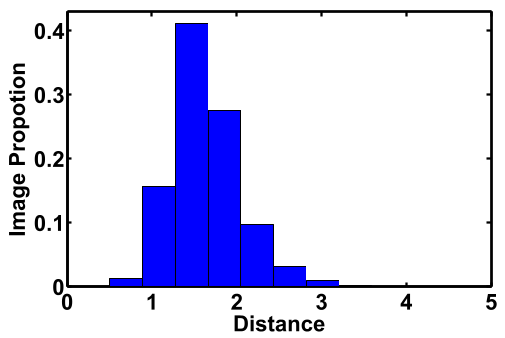 Figure: The Subjective nature of emotions represented in VA space (left) and the resulting GMM modeling (right).
The optimization uses an Iteratively Reweighted Least Squares (IRLS) approach, incorporating constraints to ensure the predicted covariance matrices remain positive definite—a critical mathematical requirement for a valid Gaussian distribution.
Experiments & Results
The authors tested features at three levels:
- Low-level: GIST, Color, Texture.
- Mid-level: Scene Attributes, Principles-of-Art.
- High-level: Adjective Noun Pairs (ANP) and Facial Expressions.
Key Findings:
- High-level Wins: ANPs (like "beautiful landscape" or "sad eyes") performed best, proving that semantic understanding is key to "feeling" an image.
- Task Relatedness: MTSSR outperformed standard SSR by an average of 4-6% in KL divergence, proving that learning across multiple images helps the model generalize better.
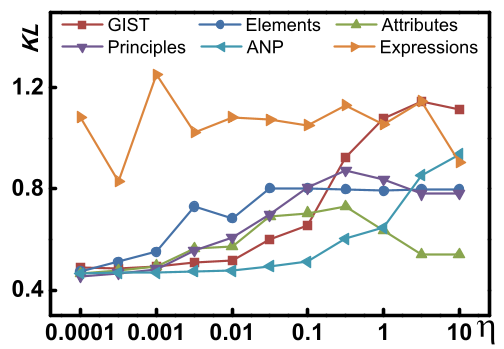 Figure: Comparison across different features and models. Lower KL divergence indicates better performance.
Critical Analysis & Conclusion
Takeaway
The shift to continuous distribution prediction is a significant step toward "Human-Centric" AI. By acknowledging that an image can be both "awe-inspiring" and "scary" simultaneously, this research paves the way for more nuanced recommendation systems and more empathetic AI.
Limitations & Future Work
While MTSSR is robust, it relies on linear representations of training samples. The authors predict that Deep Learning—specifically using CNNs to directly regress distribution parameters—will be the next frontier. Additionally, integrating social context (who is the viewer?) could further personalize these predictions beyond general population distributions.
Title of Original Paper: Continuous Probability Distribution Prediction of Image Emotions via Multitask Shared Sparse Regression Authors: Sicheng Zhao, Hongxun Yao, Yue Gao, Rongrong Ji, Guiguang Ding