
The Joy of Feeling: A Novel Joystick-Based Framework for Real-Time Emotion Annotation
Continuous, Real-Time Emotion Annotation: A Novel Joystick-Based Analysis Framework
This paper introduces a novel joystick-based framework for continuous, real-time emotion annotation in the Valence-Arousal (V-A) space. The authors validate the system through multi-modal analyses—including System Usability Scale (SUS), trajectory similarity, and Change-Point Analysis (CPA)—achieving an "excellent" usability score of 80.17 and demonstrating that joystick movements can effectively map to emotionally salient video events.
TL;DR
Researchers have developed a joystick-based system that allows users to record their emotional shifts in real-time while watching videos. Unlike traditional mice, the joystick's physical feedback reduces "brain drain" (cognitive load), allowing for more accurate data. The study proves that these physical movements can be mathematically analyzed to pinpoint exactly when a "scary" or "amusing" moment occurs in a video.
Background Positioning
In the landscape of Affective Computing, obtaining reliable "ground truth" labels is a notorious bottleneck. This work moves away from discrete labels (e.g., "Happy" vs "Sad") toward a continuous, dimensional model (Valence-Arousal). It positions itself as an ergonomic upgrade to the industry-standard "FEELtrace" or mouse-based tools, bridging the gap between human psychology and machine learning data requirements.
The Problem: The Cognitive Penalty of Pointing
Continuous annotation is hard. When a participant uses a mouse to track their feelings on a 2D screen, they must:
- Observe the stimulus (the video).
- Intro-spect their internal state.
- Manually move the cursor while visually confirming its position on a UI.
- Often hold down a button continuously.
This creates a "dual-task" interference where the act of measuring the emotion actually interferes with the feeling itself.
Methodology: Leveraging Proprioception
The core insight is the use of a spring-loaded joystick. Because the stick provides physical resistance and returns to center ( in V-A space) when released, users gain a sense of "positional awareness" through touch (proprioception). This allows them to keep their eyes on the video rather than the interface.
The Analysis Pipeline
The authors didn't just build a tool; they built an evaluation framework:
- RLPR (Robust Local Polynomial Regression): A method to filter out "noisy" or "outlier" human raters to find the core emotional trajectory.
- CPA (Change-Point Analysis): Using the E-Divisive with Medians (EDM) algorithm to find statistical shifts in the annotation data.
 Figure 1: The annotation UI superimposed on the video, showing the V-A space and visual manikins.
Experiments and Results: Mapping Action to Affect
The study involved 30 participants watching 8 emotion-inducing videos (Amusement, Boredom, Relaxation, Scaredness).
1. Consistency
Using MANOVA and pairwise comparisons, the authors proved that participants weren't just moving the joystick randomly; they exhibited high agreement. For instance, "Scary" videos consistently moved trajectories into the High Arousal/Low Valence quadrant.
2. Saliency Detection
The most impressive result came from Change-Point Analysis. The system could automatically identify the exact second a ghost appeared in a horror clip solely by looking at the "jerk" or shift in the joystick data.
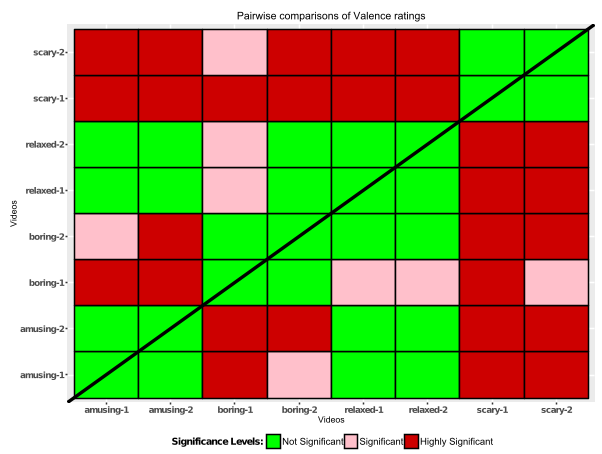 Figure 2: V-A Space trajectories (left) and the temporal mapping of change points (right) showing how annotations track video events.
3. Classification Accuracy
Using a Support Vector Machine (SVM), the authors classified 5-second chunks of data. While boring/relaxed states were harder to distinguish (a known issue in affect research), "scary" and "amusing" chunks were identified with high coherence (up to 91.67% accuracy for scary video change-points).
Critical Analysis & Conclusion
Takeaway
This framework proves that the medium of annotation matters. By moving from a "visual-manual" task (mouse) to a "proprioceptive-manual" task (joystick), we can extract higher-quality temporal data from human subjects.
Limitations
- Hardware Dependency: Joysticks are less ubiquitous than mice/touchscreens.
- Cognitive Load: While reduced, the load is not zero. Younger "gamer" populations might have an unfair advantage in using the tool compared to older demographics.
- Refining the Stimuli: The authors noted that "Amusing" stimuli are highly subjective (e.g., sexual irony), suggesting that even the best tool cannot overcome poor stimulus selection.
Future Outlook
The next step for this technology is integration with wearable sensors (ECG, GSR). By aligning joystick "change points" with physiological spikes, we can finally build a "Rosetta Stone" for human emotions that works in real-time.