
Continuous Top-k Processing in Social Streams: Beyond Simple Text Filtering
Continuous Top-k Processing of Social Network Information Streams: A Vision
The paper proposes a conceptual framework and architecture for the continuous top-k processing of information streams within social networks. It introduces a comprehensive scoring model that integrates textual content relevance (IR-based) with multi-faceted social factors, such as user influence, follower relationships, and real-time interactions (likes, shares).
TL;DR
In the era of information explosion, simply following users isn't enough—we need to see the best content first. This paper outlines a vision for a system capable of maintaining a continuous "Top-k" list for every user, using a sophisticated scoring model that blends IR-based text relevance with social influence and real-time engagement data. It addresses the scalability bottleneck by redefining how time-decay and social interactions trigger ranking updates.
Context & Motivation: The Information Overload Problem
Modern social networks (Twitter, Facebook, RSS) have shifted from passive consumption to active, high-velocity streams. However, users are often overwhelmed by the volume. Traditional solutions use Boolean filtering (show everything containing a keyword) or Static Snapshots (recalculate rankings only when a user refreshes).
The authors argue that these are insufficient. The "Gold Standard" is Continuous Top-k Processing, where the system provides a real-time, perpetually updated list of the most relevant items. The challenge? Incorporating "Social Criteria" (who posted it, who liked it) into this process makes the scoring function non-monotonic and computationally "expensive."
The Proposed Social Scoring Model
The core contribution is a rich, multi-dimensional scoring function. Unlike previous models that only look at text, this paper's model (Equation 5) factors in:
- Content Similarity (CS): Does the message match the user's profile interests?
- User-Based Factors: The global authority of the publisher (UI) and the specific relationship strength between the publisher and the follower (UR).
- Interaction-Based Factors: Global popularity of the message (AI) and the relevance of those interactions to the specific user (AR).
- Time Decay: The natural decrease in a message's value as it ages.
Breaking the Logic: The Time Decay Challenge
Calculating time decay is a nightmare for continuous systems because every message's score changes every second. The authors propose using Order-Preserving Decay Functions.
- Insight: Instead of decreasing the score of old messages, give new messages a "Time Bonus." This keeps the relative order identical and allows for "static" indexing of scores relative to a system start time ().
System Architecture
The paper proposes an event-driven architecture designed for extreme scale.
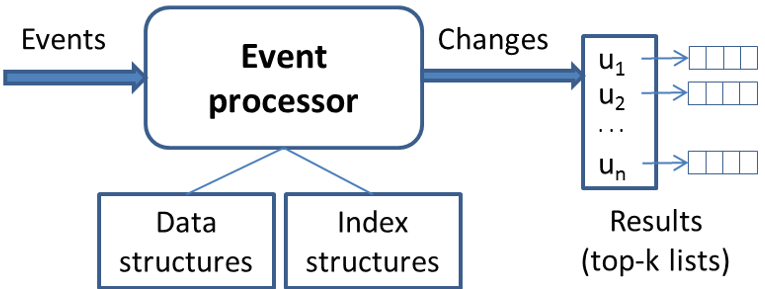
The system splits events into two tiers:
- Primary Events (Message/Action): Handled instantly. New likes or retweets trigger a lookup in the Social Index and Content Index to see if the message should jump into a user's Top-k list.
- Secondary Events (Network Changes): Changes in follow relationships or profile updates are processed in batches periodically to minimize overhead.
Methodology: Pruning the Search Space
To handle millions of queries, the system uses a Threshold Algorithm (TA) derivative.

The goal is to only calculate the score for users who actually have a chance of seeing the message in their Top-k. By maintaining a threshold (the score of the current -th best message for user ), the system can "prune" or ignore any update that doesn't exceed this bar.
Critical Insight & Future Outlook
This work highlights a critical transition in Stream Processing: the move from Single-Factor (text only) to Multi-Factor (Social + Content + Interaction) scoring.
Limitations:
- The model assumes a centralized event processor; at the scale of 2026 social networks, this likely requires high-performance distributed coordination.
- Specific index structures for the "Social Index" are mentioned as a vision but require more empirical validation for specific graph topologies (e.g., power-law distributions).
Future Work: The authors suggest that the interaction between the "Social Index" and "Content Index" is the next frontier. How do we build a single index that efficiently queries both a graph (who I follow) and a term-space (what I like) simultaneously?