
SANTA: Scaling Social-Aware Top-k Queries in Real-Time Information Streams
Continuous Top-k Queries in Social Networks
The paper introduces SANTA (Social and Action Network Threshold Algorithm), a novel framework for continuous top-k query processing in social media streams. It integrates content similarity, social graph relationships, and real-time interaction events (likes, shares) into a unified scoring model, achieving state-of-the-art efficiency in dynamic environments.
TL;DR
The SANTA algorithm provides a high-performance solution for the "Continuous Top-k" problem in social networks. Unlike traditional methods that only look at keywords, SANTA factors in who is talking to whom and how people are reacting (likes/shares) in real-time. By decoupling the k-th score from the main index and using a smart "message window" in the SANTA+ variant, the authors achieved a 100x speedup in handling interaction events compared to prior state-of-the-art approaches.
Problem & Motivation: The "Social" Gap in Stream Processing
Managing information overload in social networks requires more than just keyword matching. A post's relevance is often a cocktail of:
- Content: Does this match my interests?
- Social Graph: Is the author a close contact or an influencer?
- Interactions: Is this post "going viral"?
- Recency: Is this fresh?
Prior algorithms like COL-Filter struggled because they baked the "k-th best score" (which changes constantly) into their index structures. In a multi-dimensional social context, every time a new "Like" arrives, the system would have to perform massive, expensive index updates, making real-time performance impossible at scale.
Methodology: Decoupling and Persistence
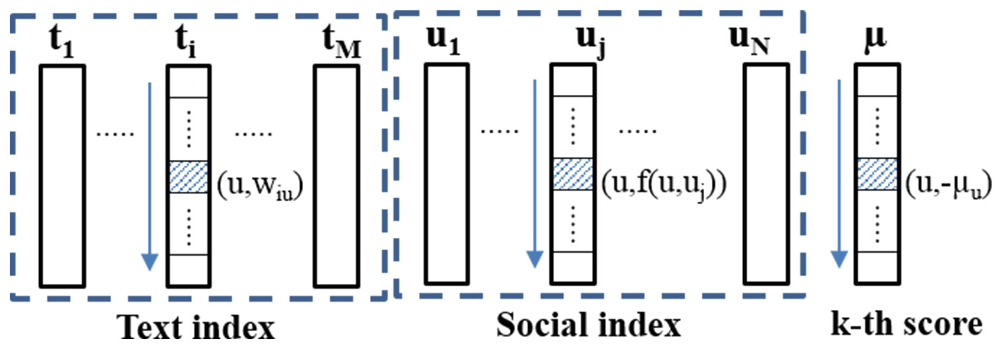
The core insight behind SANTA is decoupling. Instead of merging the user's current top-k threshold into the term or social lists, SANTA keeps a dedicated list () for the k-th scores.
1. The Index Structure
The system uses three primary sorted lists:
- Text Index: Maps terms to users interested in them.
- Social Index: Maps influencers to their followers.
- -th Score Index (): Tracks the minimum score a message needs to break into a user's top-k.
2. SANTA+: The Performance Multiplier
The authors realized that action events (a second user liking a first user's post) are the most frequent yet expensive updates. SANTA+ introduces a "Message Window" that stores recently processed messages and their candidate lists. When a new action occurs, the system doesn't start from scratch; it resumes the search from where it left off, using the stored candidate list to skip redundant calculations.
Experiments & Results: Crushing the Baseline
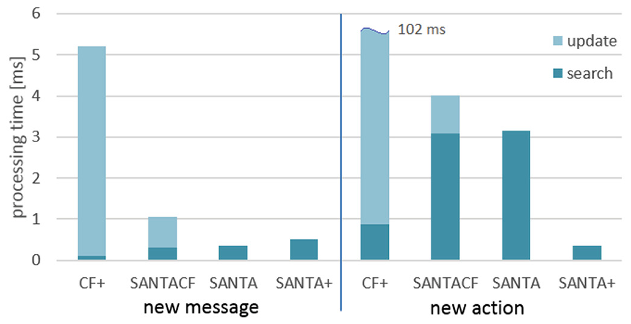
The researchers tested SANTA against CF+ (an optimized version of COL-Filter) using a real-world Twitter dataset containing 104,000 users and 18 million relationships.
- Efficiency: SANTA was 5x faster at processing new messages.
- The Action Breakthrough: For user actions (likes/retweets), CF+ took over 100ms, while SANTA handled them in roughly 3ms. SANTA+ squeezed this even further to sub-millisecond levels.
- Scalability with k: As (the number of results) increased from 10 to 100, SANTA showed a manageable, linear growth in processing time, proving its robustness for production environments.
Critical Analysis & Conclusion
Takeaway
SANTA proves that "complex" scoring models don't have to be "slow." By carefully choosing which parts of the index are static and which are dynamic, we can build recommendation engines that react to social signals in milliseconds.
Limitations
- Memory Footprint: Keeping a large message window for SANTA+ requires significant RAM, though the authors showed that even a small window captures 95% of events.
- Complexity of Tearing: While the "Time Bonus" approach avoids re-sorting, very old but highly viral messages might eventually require cleanup strategies not fully detailed here.
Future Outlook
The next step for this technology is integrating result diversity. It's not enough to show the top-k most relevant posts; they should also cover a broad range of topics to avoid "echo chambers." SANTA’s modular architecture provides a solid foundation for adding such diversity-aware constraints in the future.