
Contouring the Digital Pulse: Why India Demands Data Privacy Laws
Contouring the Behavioral Patterns of the Users of Social Network(ing) Sites and the Need for Data Privacy Law in India: An Application of SEM-PLS Technique
This study utilizes Structural Equation Modelling with Partial Least Squares (SEM-PLS) to analyze the behavioral patterns of Indian Social Networking Site (SNS) users. It successfully validates a conceptual model linking privacy attitudes, control, and knowledge to the perceived necessity of a dedicated data privacy law in India.
TL;DR
In a landmark study utilizing SEM-PLS, researchers have mapped the behavioral landscape of Indian social media users to determine the driving forces behind the demand for data privacy legislation. The study reveals that while privacy concern is a primary catalyst for demanding legal frameworks, factors like "Privacy Knowledge" and "User Control" play complex, and sometimes counter-intuitive, roles in shaping these concerns.
Contextualizing India's Privacy Struggle
For decades, privacy in India was a social norm rather than a legal mandate. Following the Supreme Court's declaration of privacy as a fundamental right, a critical question emerged: What specific behaviors drive users to want a formal law?
Unlike the offline world, where we use physical cues to manage disclosure, the virtual space is "visually anonymous." The authors argue that on Social Networking Sites (SNSs), users must shift from unconscious physical protection to deliberate cognitive self-protection, a transition that is fraught with friction.
Methodology: The SEM-PLS Approach
To decode this, the researchers adopted the Theory of Planned Behavior (TPB). They moved beyond simple surveys to a powerful statistical method called Structural Equation Modelling (SEM).
The Model Architecture
The study split its investigation into two distinct parts:
- Measurement Model: Ensuring that the survey questions truly represented the concepts (e.g., does "Attitude" effectively measure "Behavioral Beliefs"?).
- Structural Model: Testing the actual causal paths between different concepts.
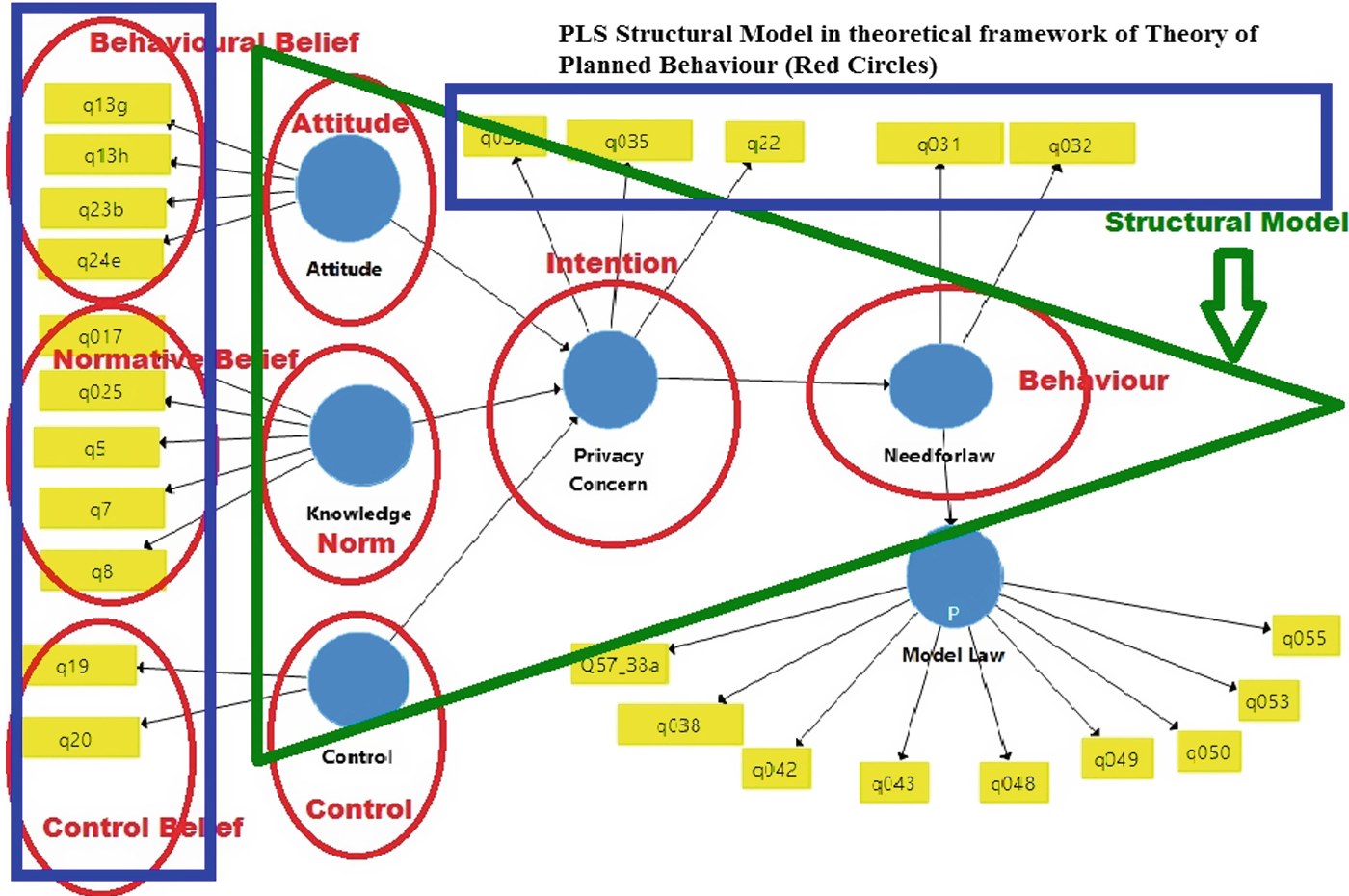 Figure 1: The priori PLS-path model showing the interplay between Latent Variables (circles) and Manifest Variables (rectangles).
Deep Dive into the Results
The findings offer a nuanced look at the Indian digital psyche.
- The Power of Concern: Privacy Concern is the strongest predictor for the "Need for Law" with a high path coefficient (0.533).
- The Knowledge Paradox: One of the most striking results is the negative relationship (-0.229) between Privacy Knowledge and Privacy Concern. In the Indian context, as users became more knowledgeable about the intricacies of SNSs, their active concern appeared to diminish—potentially due to overconfidence in their ability to manage settings or a "desensitization" effect.
- Reliability: The study achieved high "Composite Reliability" scores (averaging >0.65 for most constructs), lending academic weight to its conclusions.
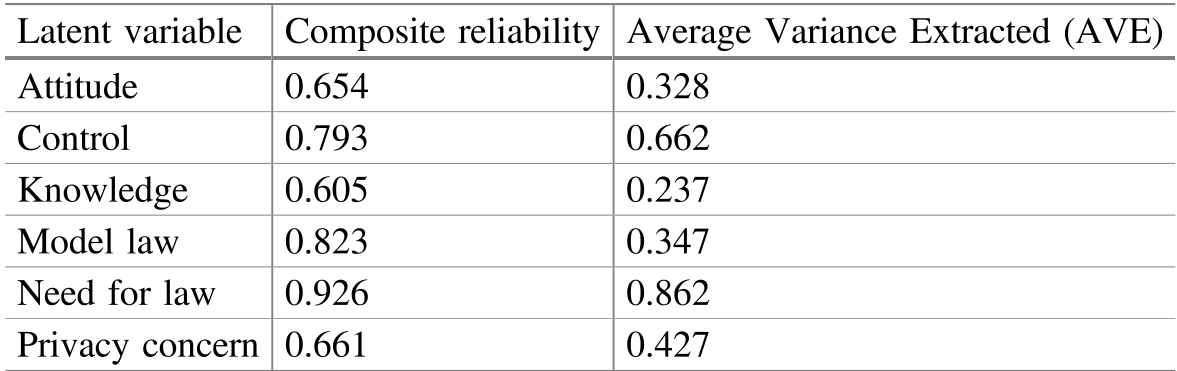 Table 1: Statistical validation showing robust internal consistency across latent variables.
Critical Insight: Who Wants the Law Most?
The study’s predictive relevance (Q² > 0) confirms that users who feel they have better control over their data are actually more concerned about the broader landscape, leading them to advocate for a "Model Law." This suggests that the demand for legislation in India is not coming from the "digitally illiterate," but rather from the empowered users who understand the systemic risks.
Conclusion & Future Outlook
This paper provides the empirical "teeth" for the argument that India needs a tailored Data Privacy Law. It proves that user attitude is not just about personal preference—it is a structured response to the inherent risks of SNS algorithms.
Limitations: The study primarily focused on adults and used convenience sampling. Future research must address the "invisible users"—children using fake accounts—to truly understand the nationwide risk profile.
Final Takeaway: Legislation shouldn't just focus on "educating" users (as knowledge might lower concern); it must focus on giving users Structural Control, as this is what ultimately drives the healthy demand for a safer digital ecosystem.