
Contradictory Comments: Bridging the Gap Between Pedagogical Values and Feedback Practice
Contradictory Comments: Feedback in Professional Communication Service Courses
This research article presents a pilot study on instructor feedback in professional communication service courses, utilizing qualitative interviews and content analysis of 599 feedback comments. The paper identifies a critical "contradiction" where pedagogical values (rhetorical awareness) often fail to manifest in actual feedback practices (micro-level corrections).
TL;DR
Professional communication instructors often talk the talk of "rhetorical situation" but walk the walk of "grammar correction." This pilot study by Sara Doan reveals that feedback in service courses is often misaligned with professional goals, largely because instructors borrow outdated techniques from first-year composition. To fix this, we need to move toward directive, workplace-aligned feedback strategies.
Background: The Problem with Borrowed Lore
For decades, professional communication (PC) has been the "service" wing of English departments. Because of this administrative positioning, many instructors are trained in First-Year Composition (FYC) and undergraduate writing center theory.
The problem? FYC values the "writer’s journey" and "reader response" (e.g., "I felt confused here"). PC demands Genre as Social Action—using a document as a tool to achieve a specific business outcome. This study investigates whether instructors actually enact PC values or if they fall back on the "lore" of their FYC roots.
Methodology: Triangulating Intent vs. Action
The study focuses on four instructors teaching different service courses (Technical, Business, and Health Science Writing). The author used:
- Qualitative Interviews: To capture "Stated Values."
- Content Analysis: Coding 599 real comments to capture "Enacted Values."
- Think-Aloud Protocols: Asking instructors to explain their comments on specific student papers.
Instructor Profiles and Tools
 Table 1: The pilot study included a mix of PhD students and lecturers, testing different delivery formats (Online vs. Face-to-Face) and grading tools.
Core Findings: The Great Misalignment
The study exposed a "Micro-Macro" gap. While instructors claimed to value Audience Analysis and Persuasion, their feedback was often trapped in the weeds of formatting and syntax.
1. The Rhetorical Terminology Trap
Instructors frequently use terms like "Purpose," "Audience," and "Context." However, the data suggests that simply dropping these terms in a margin comment doesn't help students. If an instructor asks "What is your purpose here?", a student often lacks the theoretical framework to answer in a way that improves the document's professional utility.
2. Intent vs. Reality in Feedback
The comparison between what instructors said they did and what they actually wrote is revealing:
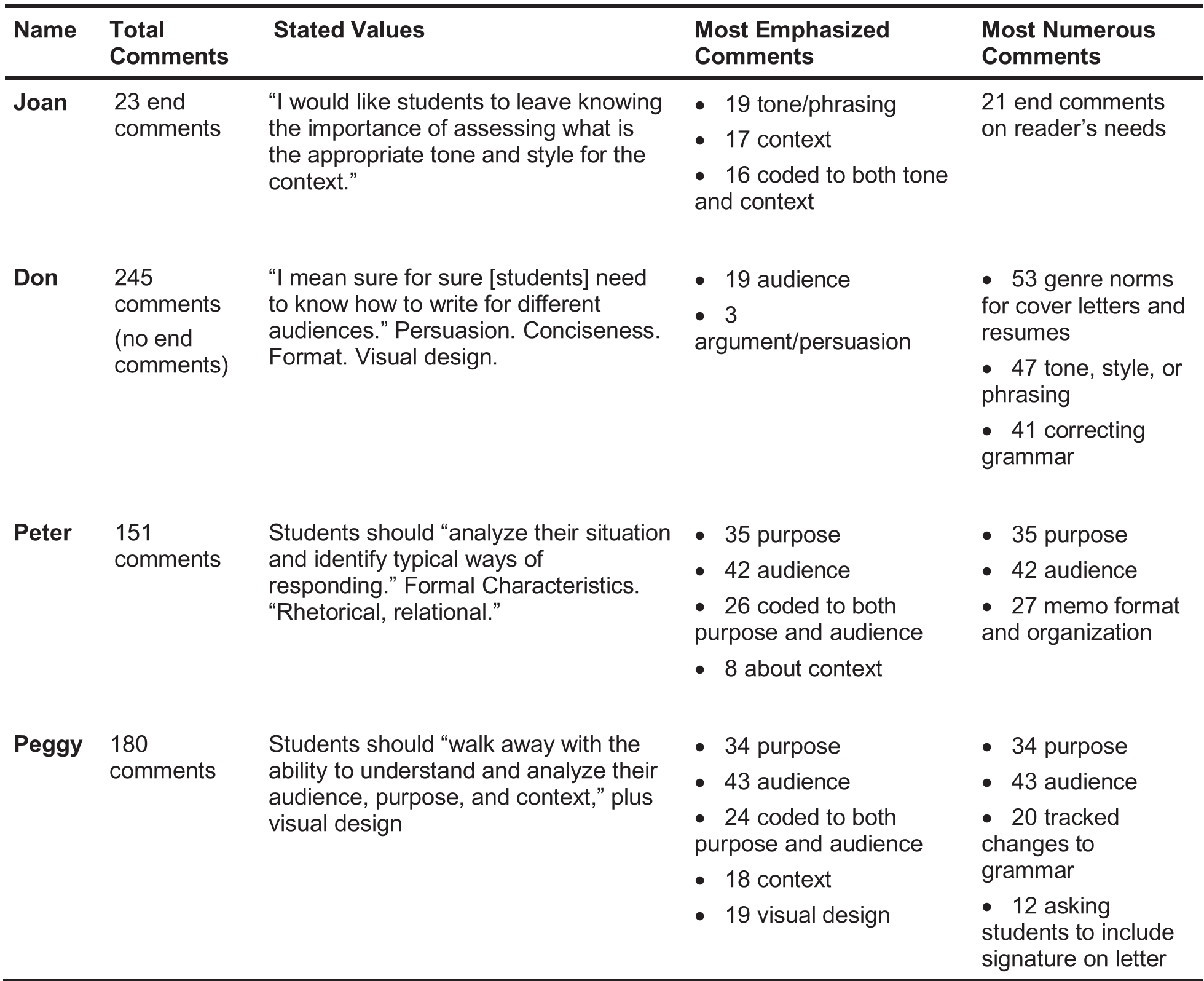 Table 2: Note the high frequency of "Genre Norms" and "Grammar" comments compared to the "Stated Values" of high-level rhetorical analysis.
3. The "Conversational" Flaw
Following FYC traditions, some instructors tried to be "soft" or "conversational." For example, Peggy (an instructor in the study) gave conflicting advice—telling a student to be more "concise" while simultaneously asking for more "detail" to make a letter longer. Without directive guidance, the student is left in a state of rhetorical paralysis.
Deep Insight: Toward a New PC Pedagogy
The author concludes with three major implications for the field:
- Beyond Terminology: We must teach what genres are (tools for work), not just what they look like (templates).
- Directivity is a Virtue: In professional contexts, "Reader Response" is less valuable than "Directive Feedback." Students need to know how and why to change a text to achieve a business goal.
- Disciplinary Independence: PC needs its own instructor training pipelines that emphasize workplace realities over academic prose conventions.
Conclusion & Future Work
This pilot study serves as a "thick description" of the current tensions in writing instruction. It proves that our feedback is a microcosm of our pedagogical identity. If we want to graduate "workplace-ready" writers, our margin comments must move away from red-pen corrections and toward strategic coaching.
The author is currently expanding this into a larger study involving 25 veteran instructors to see if experience helps close the "Contradiction Gap."