
Contrail: Reclaiming Privacy in Social Networking via Edge-Side Content Filtering
Contrail: Decentralized and Privacy-Preserving Social Networks on Smartphones
The paper introduces Contrail, a decentralized communication platform for mobile social networks that ensures user privacy by keeping data on trusted edge devices. It utilizes a cloud-based relay for connectivity and a novel sender-side content filtering mechanism to minimize energy and bandwidth consumption.
TL;DR
Contrail is a decentralized communication platform designed to build social networks where users own their data. By moving the filtering logic to the "Sender" (the producer's device) and using a stateless cloud relay, it bypasses the need for centralized data silos while overcoming the battery and bandwidth constraints of 3G/4G smartphone networks.
Background: The Privacy-Efficiency Paradox
We currently live in an era of "Centralized Trust." To share a photo or location, we upload it to a corporate server which then distributes it. This is efficient but creates a single point of failure for privacy. While decentralized networks like Diaspora exist, they were designed for wired hosts. On a smartphone, "always-on" peer-to-peer (P2P) connections are battery killers, and 3G data caps make broadcasting data to every friend prohibitively expensive.
Methodology: High-Level Architecture
The core philosophy of Contrail is: Trust the Edge, Use the Cloud.
1. The Cloud as a Stateless Relay
Unlike Facebook, which acts as a "Brain," the Contrail cloud is a "Mailbox." It provides:
- Decoupling in Time: If Alice sends a message to Bob while he is offline, the cloud stores the encrypted item until he reconnects.
- Elastic Scaling: It uses stateless worker roles that can be scaled up (as shown in the Azure implementation) to handle thousands of concurrent users.
2. Sender-Side Content Filters
This is the "Secret Sauce." Instead of the sender pushing everything to the cloud, the Consumer (Alice) installs a filter on the Producer's (Bob's) device. Example: Alice only wants to know if Bob enters "Mountain View." Her device sends a filter code to Bob's phone. Bob's phone only uploads location data if and only if he enters that specific geographic box.
 The interaction between client-side modules and the cloud-based messaging layer.
Key Performance Insights
Latency and Scalability
A major concern for decentralized systems is "Lag." Contrail’s evaluation shows that the processing overhead is negligible. The end-to-end latency is almost entirely dictated by the underlying network (3G or Wi-Fi), with Contrail adding less than 10ms of "tax."
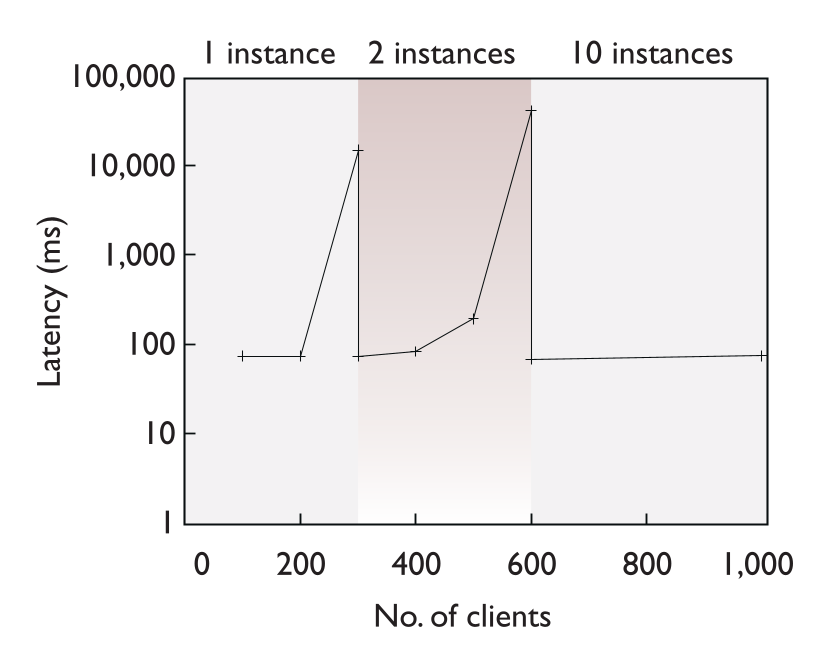 Scalability test: Using 10 Azure instances, the system maintains sub-100ms latency even as the client count exceeds 1,000.
Battery Efficiency
The paper highlights a critical trade-off: frequent data transfers drastically reduce battery life. By using filters, the device avoids unnecessary radio wake-ups.
| Data Rate (msgs/min) | Battery Lifetime |
|---|---|
| 0 (Idle) | 6.49 Hours |
| 1 | 5.12 Hours |
| 60 | 3.95 Hours |
By ensuring data is only sent when it matches a filter, Contrail moves the device closer to the 6.49-hour "Idle" ideal rather than the 3.95-hour "Heavy Use" drain.
Critical Analysis: Why This Matters
The brilliance of Contrail lies in its Semantic Efficiency. Features like "ItemIDs" allow newer data to obsolete older data. In a location-sharing app, if a phone is offline and generates 10 location updates, Contrail is smart enough to delete the first 9 from the cloud buffer once the 10th arrives. This "Obsolescence" logic is vital for mobile systems where every byte costs energy.
Limitations:
- Filter Complexity: While a "Balanced Tree" approach makes matching fast (milliseconds for 1,000 filters), very complex filters (like image recognition) might still strain mobile CPUs.
- Initial Discovery: The system assumes a "White List" for filter installation, which requires an out-of-band way to initially trust a friend.
Conclusion
Contrail demonstrates that we don't need to sacrifice privacy for social connectivity. By treating the cloud as a simple relay and empowering the edge with intelligent filtering, we can build social applications that are both efficient and truly "Personal."