
Decoding Cross-Border Sentiments: A Spatiotemporal Slant on the Russian-Ukrainian Crisis
Contrasting Public Opinion Dynamics and Emotional Response During Crisis
The paper introduces a spatiotemporal analysis framework to contrast public opinion (stance) and emotional dynamics in Russia and Ukraine during the 2014-2015 crisis using VKontakte data. It utilizes the POLYARNIK system for stance detection and develops a new fine-grained emotion prediction model for low-resource languages, achieving SOTA-level insights into geopolitical sentiment drift.
TL;DR
This study presents a large-scale analysis of public opinion and emotional responses on the VKontakte (VK) social network during the peak of the Russian-Ukrainian crisis (2014-2015). By combining stance detection with fine-grained emotion prediction, the researchers tracked how populations in Russia and Ukraine perceived targets like Putin, the EU, and NATO. The results provide a data-driven confirmation of traditional polls while revealing hidden sub-currents of opinion that mainstream media often overlooks.
Background: Beyond Traditional Polling
In the middle of a geopolitical crisis, understanding what people actually think is a race against time. Traditional polls take weeks to execute and are subject to social desirability bias. This paper positions itself as a "passive polling" alternative, leveraging the massive, organic data stream of VK (the "Facebook of Eastern Europe") to measure the pulse of two nations in real-time.
The Methodology: Stance and Emotion in Low-Resource Contexts
The researchers faced a significant hurdle: most NLP tools are optimized for English. To overcome this, they:
- Refined User Data: They moved beyond raw "big data" by filtering for 49,208 "real" users, excluding bots and hyper-active news accounts to ensure demographic representative-ness.
- Stance Prediction: Using the POLYARNIK system, they classified posts based on whether the author was "in favor" or "against" specific entities (e.g., #Euromaidan, #Donbas).
- Emotion Logic: They built an emotion classifier for Russian and Ukrainian by bootstrapping Twitter hashtags used to signal affect (e.g., #joy, #fear) and validating them with native speakers.
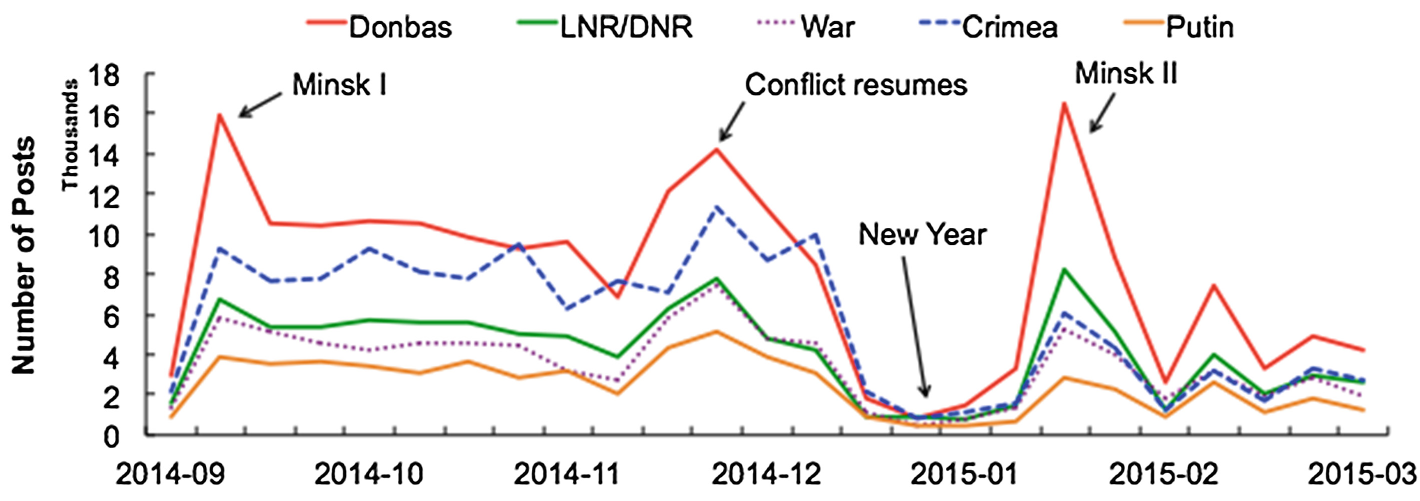 Figure 1: Topic popularity evolution, showing spikes during major political events like the Minsk I & II agreements.
Key Insights: Divergence and Convergence
The core of the study lies in the Correlograms and Positive Score Ratios.
- The "War" Consensus: Interestingly, sentiments regarding the "war" itself showed a correlation as high as ρ = 0.94 between the two countries, implying that as the situation worsened, negative sentiment toward the conflict rose in tandem on both sides.
- The Geopolitical Split: Sentiments regarding the EU were sharply negatively correlated (ρ = -0.4), highlighting the polarized views of Western integration.
- Counter-Stereotypes: The data revealed nuanced perspectives, such as Russian users criticizing Putin’s violation of international treaties and Ukrainian users expressing frustration with the EU’s perceived "betrayal."
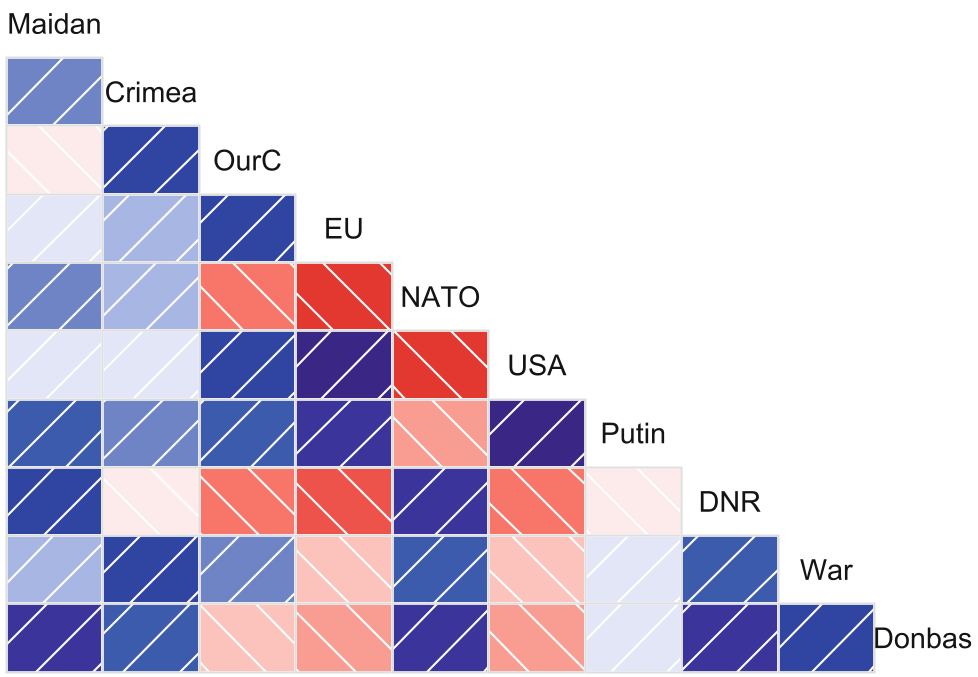 Figure 2: Correlogram showing how opinions towards specific targets move in relation to one another across borders.
Visualizing the Narrative: Storylines
One of the paper's novel contributions is the use of Storyline Visualization. Traditionally used for plot analysis in literature, here it tracks how different topics (entities) "interact" in the public consciousness.
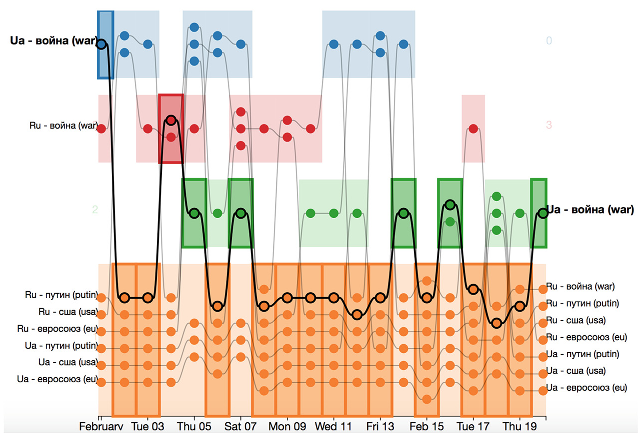 Figure 3: Storyline visualization of opinion dynamics around the G20 meeting and Minsk II agreement.
In Figure 3, we see the "drift" of opinions. For example, during the Minsk II agreement, opinions toward the war in Ukraine moved into a "positive" (hopeful) cluster following the ceasefire, while Russian sentiment became more negative regarding the same target.
Critical Analysis & Future Outlook
While the study provides a robust framework, it acknowledges the sparsity of emotional data—only 4% of posts were classified as emotional, suggesting that crisis discourse on social media is often more factual or purely opinion-based than purely affective.
Takeaway: This research proves that automated social media monitoring is not just "noise." It can accurately reflect—and sometimes predict—the shifts in national identity and political stance that occur during a crisis. For future researchers, the challenge lies in improving emotion detection accuracy in these low-resource, high-slang environments.
Conclusion
By mapping the digital geography of a crisis, the authors have provided a blueprint for understanding conflict in the age of social media. The ability to see beyond media-imposed stereotypes to the raw, fluctuating opinions of citizens remains a critical tool for modern political science and crisis management.