
Beyond Discrete Labels: Mastering Emotion Intensity in Speech Synthesis with Perception Vectors
Control Emotion Intensity for LSTM-Based Expressive Speech Synthesis
This paper introduces an expressive speech synthesis framework based on LSTM-RNNs that enables fine-grained control over emotion intensity. By utilizing a data-driven "perception vector" extracted via Multidimensional Scaling (MDS), the model achieves superior emotional flexibility and naturalness compared to traditional discrete modeling approaches.
TL;DR
Researchers have developed a way to move beyond "happy" or "sad" checkboxes in AI voices. By introducing Perception Vectors—low-dimensional continuous variables derived from real acoustic data—this LSTM-based TTS system allows users to dial emotion intensity up or down with high precision, significantly outperforming traditional "one-hot" discrete methods in both naturalness and flexibility.
Background: The Problem of "Robotic" Emotions
While modern Text-to-Speech (TTS) has mastered intelligibility, expressiveness remains a final frontier. Most current systems treat emotion as a discrete category. If you want a "happy" voice, you get one version of "happy." But human emotion is a spectrum; there is a world of difference between a subtle smile and exuberant joy. Prior works using one-hot vectors or simple adaptation techniques fail to capture these delicate gradations, often resulting in speech that feels binary and unnatural.
Methodology: From Acoustic Statistics to Emotional Space
The authors solve this by treating emotion as a measurable physical phenomenon. Their workflow involves two elegant stages:
1. The Emotion Analysis Module
Instead of manually labeling intensity, the system extracts statistics from seven acoustic dimensions: Pitch (mean/range/variance), Energy (mean/range/variance), and Speech Rate.
- Clustering: They found that a 3-cluster approach (Weak, Moderate, Strong) provides the best balance of distinguishability without overlap.
- Dimensionality Reduction: Using Multidimensional Scaling (MDS), they map these 7-dimensional acoustic features into a 2D "Perception Vector." This creates a continuous map where any point represents a specific emotional weight.
 Figure 1: The dual-module architecture combining Emotion Analysis with LSTM Synthesis.
2. The Synthesis Module
The system uses a Bi-directional LSTM (Long Short-Term Memory) network. Unlike standard RNNs, the Bi-LSTM can access future and past context, which is crucial for the fluid "rise and fall" of emotional prosody. The Perception Vector is concatenated with text features at every frame, guiding the model on how intensely to express the words.
Experimental Evidence: Precision Control
The researchers tested their model against a baseline using one-hot vectors.
- Subjective Superiority: In AB preference tests, listeners overwhelmingly preferred the Perception Vector (62%) over the One-hot baseline (18%).
- Controllability: As seen in the MOS (Mean Opinion Score), by adjusting the perception vector from (-30, -30) to (30, 30), the synthesized intensity followed a near-linear progression in human perception.
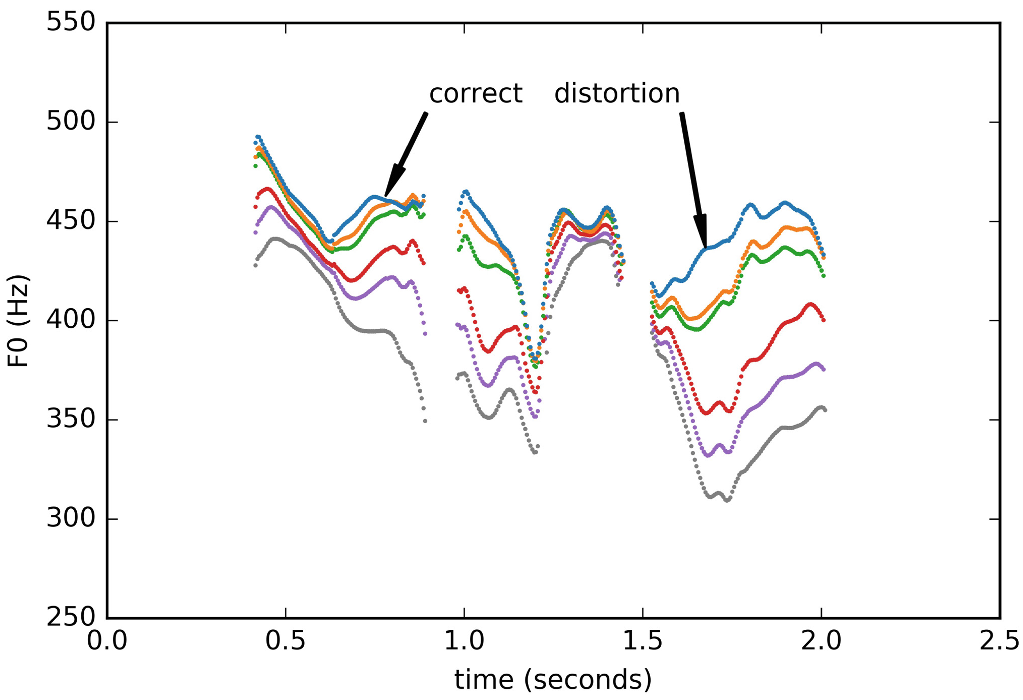 Figure 2: F0 (Pitch) trajectories for the same sentence. Notice how manipulating the perception vector doesn't just "shift" the pitch, but complexly alters the contours to reflect true emotional dynamics.
Critical Insight: The "Over-Correction" Limit
One fascinating finding in the study is the limit of flexibility. When the researchers pushed the perception vector to extremes (e.g., [50, 50]), the F0 contours began to show unwanted distortion. This suggests that while continuous vectors provide more range, there is a "goldilocks zone" (around [30, 30]) where the emotion is strong yet the voice remains natural.
Conclusion & Future Outlook
This work demonstrates that data-driven perception vectors are far more effective for emotive TTS than manual labels. By grounding the "feel" of a voice in low-level acoustic statistics (Pitch and Energy), the model learns the high-level "concept" of intensity.
As we move toward more immersive AI assistants and digital humans, the ability to fine-tune the "volume" of an emotion will be the difference between a tool that sounds like a machine and a companion that sounds like a person. Future research might expand this into end-to-end architectures like Tacotron or VITS to eliminate the need for traditional vocoders entirely.