
Controlling Inter-Session Network Coding: Leveraging Social Structures in DTNs
On control of inter-session network coding in delay-tolerant mobile social networks
The paper introduces a parameterized pairwise Inter-Session Network Coding (IS-NC) control policy specifically designed for heterogeneous Delay-Tolerant Mobile Social Networks (DTNs). By utilizing a mean-field approximation to derive a fluid model, the authors provide a framework to optimize routing and coding decisions jointly, demonstrating superior performance over traditional intra-session coding in social community-based topologies.
TL;DR
This paper tackles the complex problem of Inter-Session Network Coding (IS-NC) in mobile networks where stable end-to-end paths don't exist. By moving away from node-specific decisions and focusing on social community structures, the authors develop a fluid model that accurately predicts data dissemination and allows for optimizing how sessions are "mixed" to maximize delivery probability under energy constraints.
Background & Motivation: The DTN Challenge
Delay-Tolerant Networks (DTNs) operate on the "store-carry-and-forward" paradigm. When two people pass each other, their devices (nodes) exchange packets. The challenge has always been efficiency. While "intra-session" coding (coding packets within the same file) is well-understood, inter-session coding (combining packets from different users) is notoriously difficult (NP-hard).
The authors observed a crucial gap: human mobility isn't random. We move in communities. Most DTN protocols either ignore this or use it only for routing. This paper argues that if we understand the community structure, we can control how different data streams are coded together to boost performance.
Methodology: The Fluid Model and Community Control
The core of the paper is a parameterized pairwise IS-NC control policy. Instead of deciding "should I code these two packets?" for every single encounter, the system uses probabilities () based on whether the nodes belong to Community A or Community B.
1. Mathematical Modeling
To avoid the complexity of analyzing every node, the authors use a mean-field approximation. This transforms the random, jumping behavior of a network into a set of smooth Ordinary Differential Equations (ODEs). These equations track:
- Buffer occupancy: How many nodes in a community have specific packets.
- Index dissemination: How "Degree of Freedom" (unique pieces of data) spread through the social graph.
2. Architecture of the Protocol
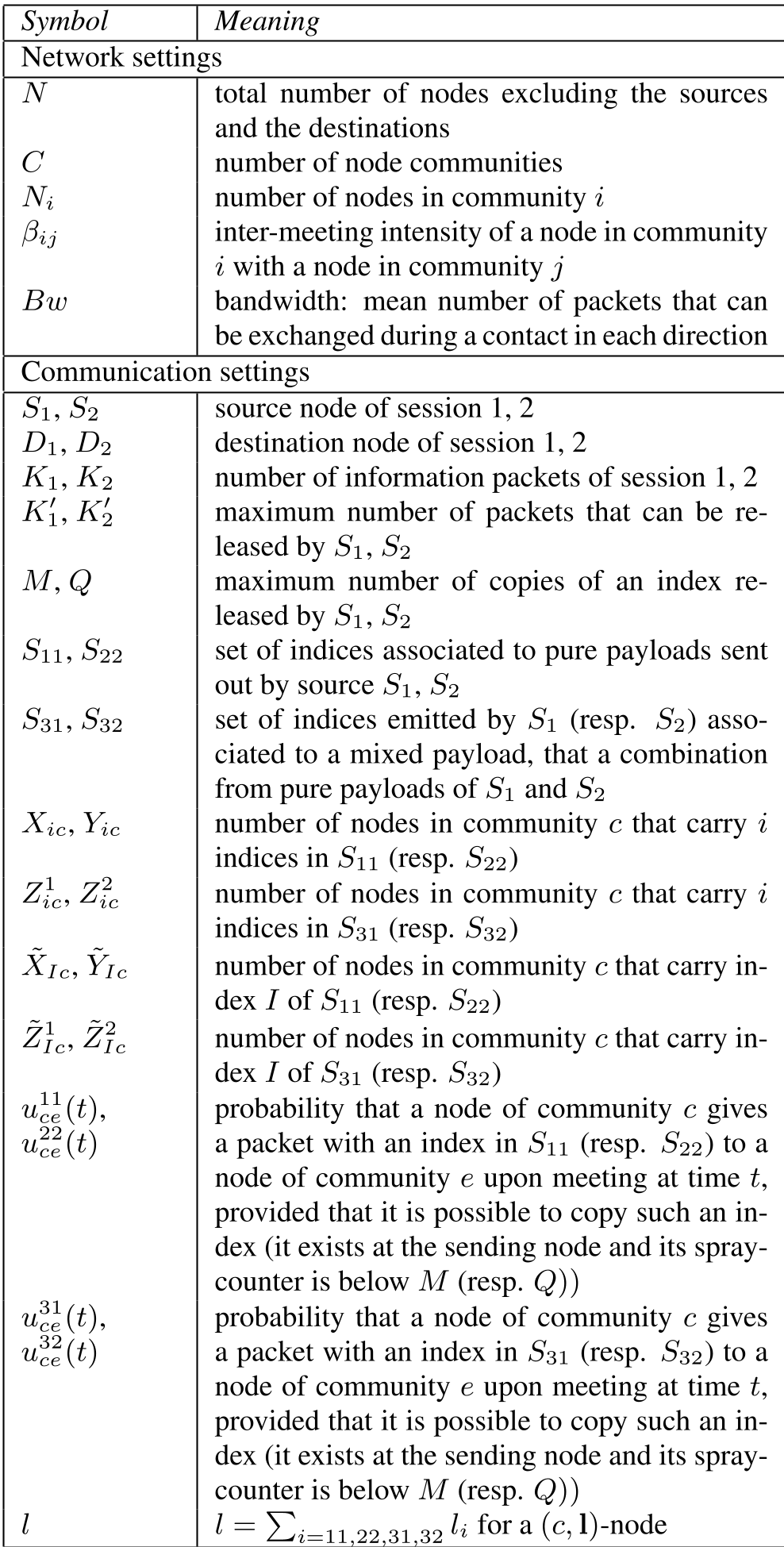
The protocol (Algorithms 1 & 2) manages how "pure" packets (S11, S22) and "mixed" packets (S31, S32) are distributed. The strategy allows for "remedy" packets—sending extra information to help a destination decode a combined packet.
Experiments & Validation
The authors validated their theoretical fluid model against a synthetic contact trace of 1000 nodes.
- Accuracy: The ODEs accurately predicted the "infection" rate of the network for various packet types (Pure vs. Coded).
- Performance Gain: By testing on a "toy-example" topology (Source 1/Dest 2 at one end, Source 2/Dest 1 at the other, with a relay community in the middle), they showed that community-based IS-NC outperforms even the best-tuned intra-session routing policies.
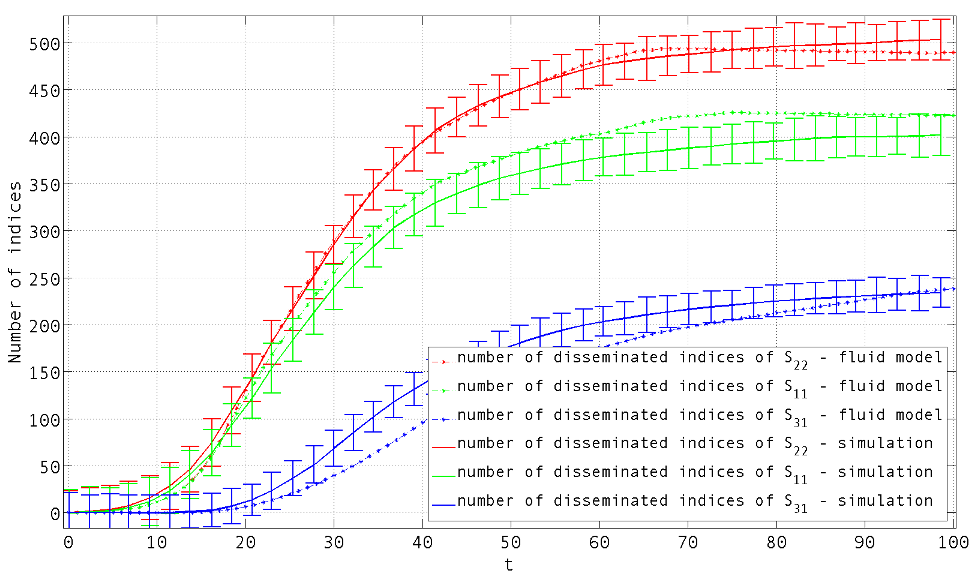 Fig: The close alignment between the Fluid Model (solid lines) and Simulations (markers) proves the model's reliability for optimization.
Deep Insights: Why it Works
The "aha!" moment of the paper is in Section 5.2. In traditional connected networks (like a Wi-Fi AP), you mix packets at the central relay. However, in Social DTNs, the authors found that mixing is often more beneficial at the "side" communities before the data even reaches the central relay. This is a non-intuitive result that only a social-aware model could reveal.
Conclusion and Future Outlook
This research provides a powerful mathematical lens for viewing network coding in social settings. While the current optimization is centralized, the Fluid Model serves as a foundation for future decentralized heuristics. By proving that community-level control is sufficient to gain the benefits of IS-NC, the authors open the door for more scalable, social-aware protocols in vehicular and pocket-switched networks.
Takeaways
- Scalability: Community-based policies scale with the number of groups, not the number of nodes.
- Social Reality: Real-world traces (like MIT Reality Mining) confirm that these community topologies are not just theoretical—they are everywhere in our social interactions.