
Controlled Social Network Adaptation: When Subjectivity Governs the Objective World
Controlled Social Network Adaptation: Subjective Elements in an Objective Social World
This paper introduces a second-order adaptive social network model that integrates subjective representation states and human control into the coevolution of social contagion and homophily-based bonding. By employing a multi-level self-modeling framework, the author demonstrates how individuals can actively manage their social connections through communication and observation control, achieving clustering and segregation in a simulated tetradic relationship.
TL;DR
This research challenges the "objective-only" view of social networks. By introducing a second-order adaptive model, the paper demonstrates how our internal representations of others and our control over communication dictate how social networks evolve. It shows that social clustering isn't just about who we are, but about who we know (or think) others are.
Background: Beyond "Birds of a Feather"
In social network science, two forces usually dominate: Social Contagion (we become like our neighbors) and Homophily (we connect with those who are already like us). Traditionally, these are modeled as objective laws. However, this paper asks a critical psychological question: Do people even know how similar they are to others?
The author argues that bonding depends on subjective representations. If you don't realize someone shares your interests, the homophily "law" won't trigger. Conversely, if you fake an interest, you can manipulate the network adaptation process.
Methodology: The Three-Level Architecture
The core of this work is a higher-order adaptive network. Instead of a simple flat graph, the model uses "reification" to represent network characteristics as states themselves across three planes:
- Base Level (Social Contagion): The actual objective states of people (e.g., how much they like a specific activity).
- First Reification Level (Subjective Representation): What Person A thinks about Person B's states and the strength of their connection ().
- Second Reification Level (Control): The "on/off" switches for communication and observation ( and ).
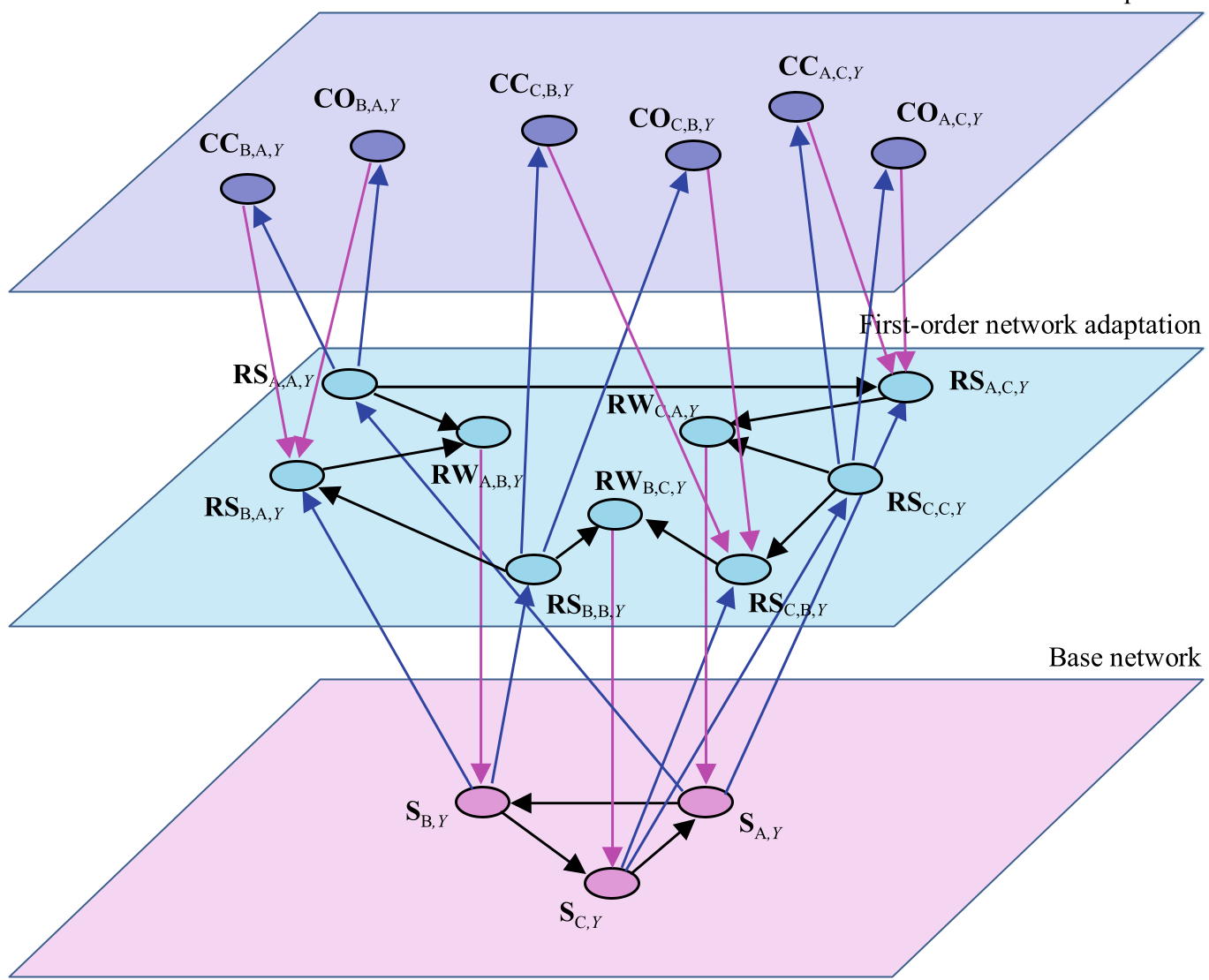
The logic is elegant: Bonding is driven by the First Reification Level, which in turn is populated by information allowed through the Second Reification Level.
Mathematical Intuition: The Tipping Point
The model uses a Simple Linear Homophily Function:
The variable acts as a tipping point. If the difference between represented states is less than , the bond strengthens; if it's larger, the bond weakens. This explains why social groups often drift toward extreme polarization (segregation) or tight-knit unity (clustering).
Experimental Insight: The Tetradic Case Study
The paper simulates a group of four friends (Mark, Dion, Ann, Jenny). Initially, they are paired in one way, but through controlled communication, they discover new similarities.
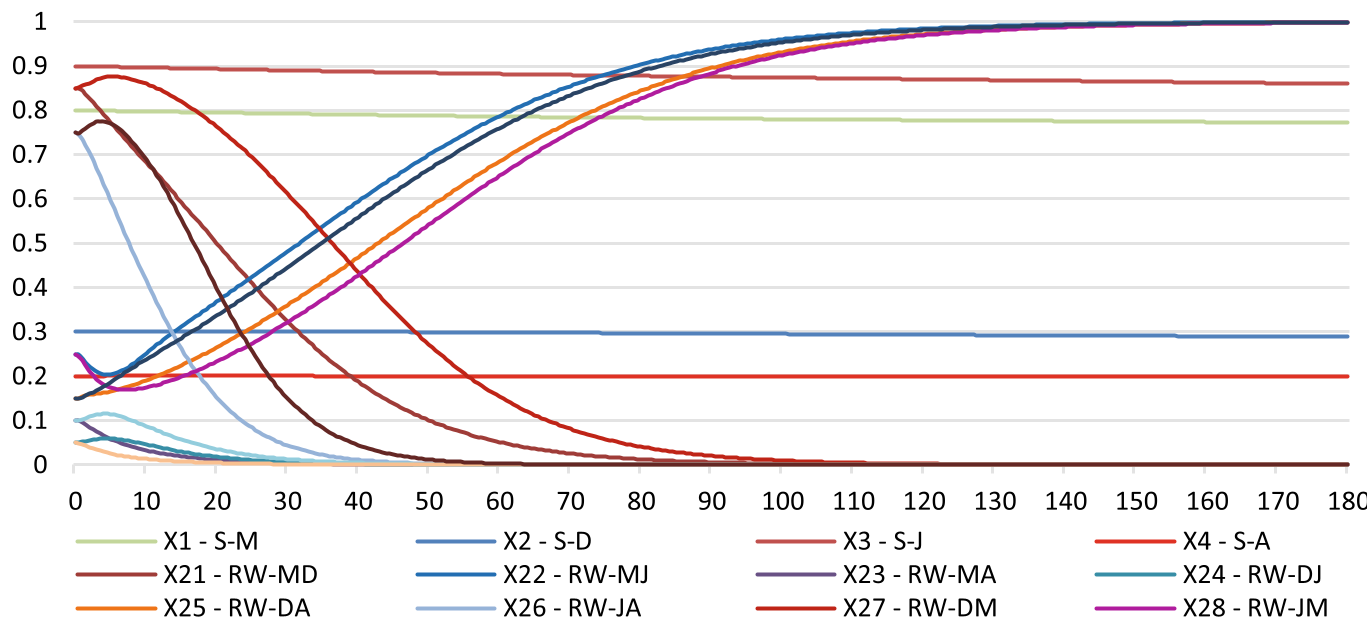
As seen in the simulation:
- Control States (purple and grey lines) jump to 1, opening the gates for information.
- Subjective Representations (green lines) then form, allowing the agents to "see" each other's true preferences.
- Only after these internal states are updated does the Connection Weight (, pink and blue lines) shift to a new equilibrium.
Critical Analysis & Conclusion
This paper provides a robust mathematical foundation for what we intuitively feel in the age of social media: perception is reality.
Key Takeaways:
- Adaptation is controllable: We aren't just passive nodes; we control the flow of information that triggers network changes.
- Equilibrium is Binary: The model predicts that under homophily, connections usually end up at either 0 (total segregation) or 1 (perfect bond).
Limitations & Future Work: While the model is powerful, it assumes agents are relatively rational in how they form representations. A fascinating extension would be to model malicious misrepresentation (faking properties) specifically to disrupt a network, or exploring how "filter bubbles" are essentially a failure of the Observation Control () state to acknowledge diverse nodes.
Ultimately, this research moves us closer to a "Digital Twin" of social dynamics that respects the complexity of the human mind.