
Controlling the Dual Contagion: A Network Approach to Disease and Scare
Controlling the Spreads of Infectious Disease and Scare via Utilizing Location and Social Networking Information
This paper proposes a novel framework to jointly control the spread of infectious diseases and public scare by leveraging localization and social networking data. It introduces a multi-layered network model consisting of "Ordinary Nodes" (people/places) and "Regional Nodes" to provide quantitative risk assessments and optimize administrative resource allocation.
TL;DR
The 2014 Ebola crisis highlighted a massive gap in crisis management: while agencies were fighting the virus, they were losing the battle against public panic. This paper proposes a systemic framework that uses location tracking and social network analysis to model the simultaneous spread of biological infection and psychological scare, providing a roadmap for proactive administrative response.
Background: The Invisible Epidemic of Fear
When a pandemic strikes, the public's first questions are often personal: "Was I at that restaurant at the same time as the patient?" or "What is my actual risk?" Traditional models (like SEIR) focus on population-level statistics but fail to address individual anxiety. This lack of transparency creates a vacuum filled by "scare," which can lead to social disorder and the exhaustion of medical resources by the "worried well."
The Core Insight: Unified Modeling of People, Places, and Devices
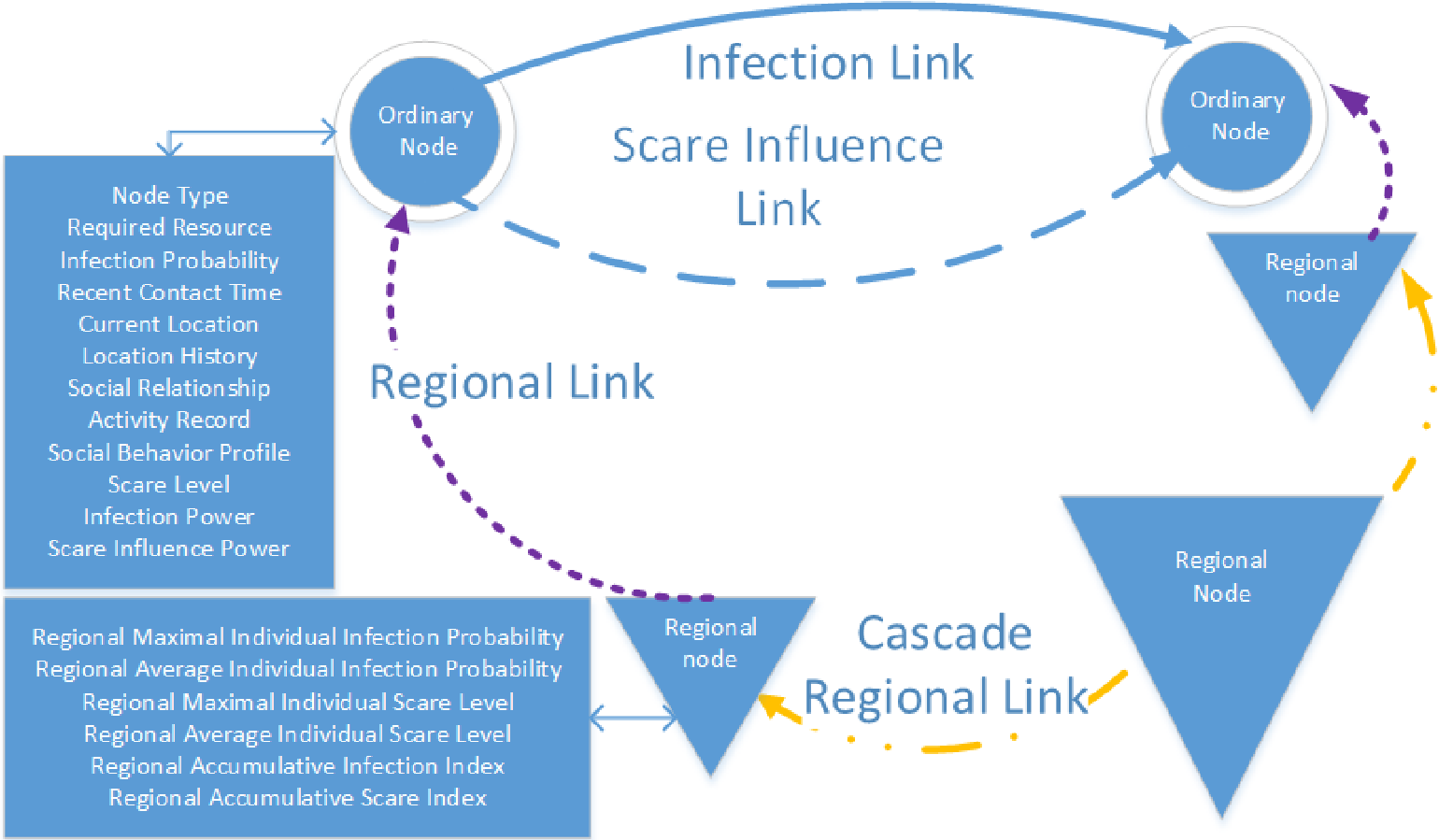
The authors argue that we cannot treat disease and fear as separate entities. They propose a network model consisting of Ordinary Nodes (representing people, specific locations like gas stations, or even shared devices like credit card readers) and Regional Nodes (geographical aggregates).
Methodology: Defining "Power" in a Network
To quantify the risk, the paper introduces two critical metrics:
- Infection Power: Derived from a node’s infection probability, location history, and social behavior (e.g., a person frequenting crowded bars has higher power than a homebody).
- Scare Influence Power: Measured by a person’s social media reach and reputation. High-influence nodes can trigger regional panic if they are quarantined without proper communication.

The relationships are governed by:
- Infection Links: Directed weights based on contact duration and type.
- Scare Influence Links: Directed weights based on trust and communication frequency.
Strategic Directions for Crisis Management
The paper outlines four research pillars to transform data into action:
1. Data Collection & Modeling
Utilizing WiFi Access Point (AP) logs, cellular data, and social media to build a "live" graph of human interaction. This allows for the calculation of an Infection Probability that is customized to an individual's specific pathing.
2. Spread Analysis and Prediction
By simulating the network, agencies can predict how a single infection might cascade through a social circle or a specific transit hub.
3. Resource Planning
This is where the math meets the floor. Using optimization methods (Max-Flow/Min-Cut), the model calculates the minimum resources (vaccines, hospital beds, cleaning crews) required to keep the "Regional Accumulative Infection Index" below a safe threshold.
Deep Insight: Why This Matters
The fundamental value of this research lies in its proactive nature. By identifying "high-risk places" (Regional Nodes) before symptoms appear in the population, administrative agencies can perform targeted "cleaning/blockades" rather than reactive, city-wide shutdowns.
Furthermore, the paper addresses the Public Trust Paradox: the more transparent an agency is about why certain actions are taken (based on individual risk scores), the lower the overall "Scare Level." Scientists become the source of truth, neutralizing the spread of rumors.
Conclusion and Limitations
While the framework is robust, its primary challenge is privacy. Collecting granular location and social data requires significant ethical safeguards and public buy-in. However, as a "work-in-progress," this paper successfully shifts the paradigm of epidemic control from "managing patients" to "managing a complex, dual-layered network of biology and information."
Future Outlook
Expect to see these models integrated with edge computing (processing contact tracing on-device to preserve privacy) and AI-driven sentiment analysis to monitor the "Scare Index" in real-time across social platforms.